Hydroxyurea and blood transfusions were associated with lower stroke rates in children with sickle cell anemia
Primary and secondary stroke prophylaxis in children with sickle cell anemia: a meta-analysis
Meta-analysisBenefit found
How effective are various interventions for primary and secondary stroke prevention in children with sickle cell anemia?
Who
Children with sickle cell anemia
Compared
No therapy: 10.7 per 100 person-year for primary stroke
Hydroxyurea: 1.0 per 100 person-year for primary stroke
Chronic blood transfusion: 1.0 per 100 person-year for primary stroke
Main outcome
Stroke rates per 100 person-years
Bottom line: Hydroxyurea and chronic blood transfusion effectively reduce primary and secondary stroke rates in children with sickle cell anemia.
Blood Adv · 2025-10-10Download image
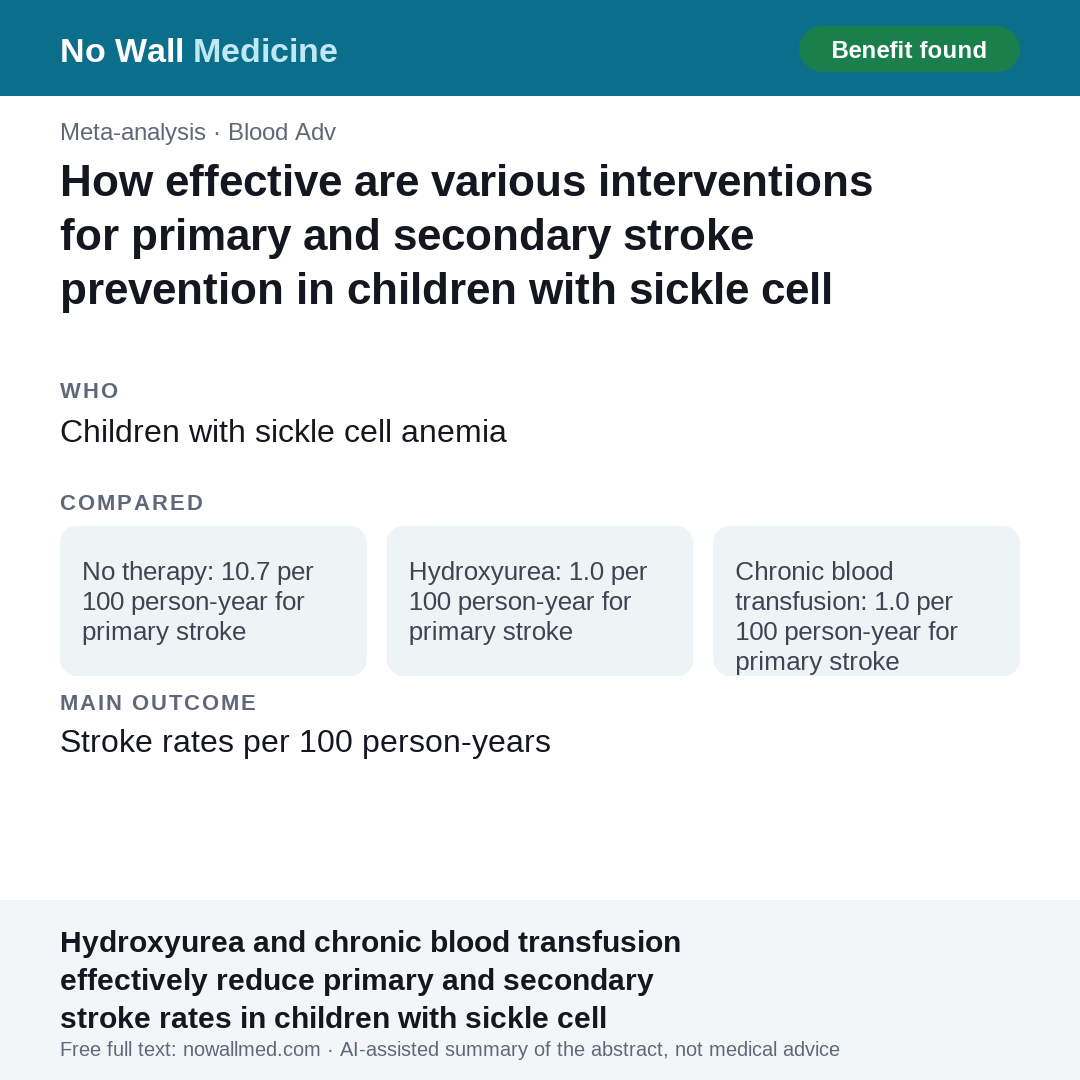
Clinical question: How effective are various interventions for primary and secondary stroke prevention in children with sickle cell anemia?
Why it matters: Clinicians need to evaluate the effectiveness of different preventative treatments for primary and secondary stroke in children with sickle cell anemia.
Key points
- Researchers performed a pooled analysis of studies with at least 6 patients to compare hydroxyurea, chronic blood transfusion, stem cell transplant, and revascularization surgery against no therapy.
- For primary stroke prevention in children with high transcranial Doppler speeds, stroke rates were 10.7 per 100 person-years with no therapy compared to 1.0 for both hydroxyurea and blood transfusion.
- Secondary stroke recurrence rates per 100 person-years were 19.6 with no therapy, 3.5 with hydroxyurea, 2.7 with blood transfusion, 1.0 with stem cell transplant, and 3.3 with revascularization surgery.
Headline and key points written with AI from the paper’s abstract, with every number checked against it. Read the paper before relying on them.
Was this summary helpful?
Abstract
We conducted a pooled analysis to evaluate the effectiveness of hydroxyurea (HU), chronic blood transfusion (CBT), myeloablative allogeneic hematopoietic stem cell transplant (HCT) with a matched related donor, and revascularization surgery (RVS) in children with sickle cell anemia (SCA). We compared the interventions with no therapy for primary and secondary stroke prevention. The Medline and EMBASE databases were searched for articles that included ≥6 patients published before January 2025. Four reviewers reviewed all studies to arrive at a consensus assessment. The stroke rates (per 100 person-year) for primary stroke prevention in children with transcranial Doppler measurement ≥200 cm/s were as follows: no therapy, 10.7; after initial HU, 1.0; and after initial CBT, 1.0. The stroke recurrence rates for secondary stroke prevention per 100 person-years were 19.6 after no therapy, 3.5 after initial HU, 2.7 after initial CBT, 1.0 after HCT, and 3.3 after RVS. Neither the HCT nor the RVS study adjusted for the time-dependent stroke recurrence rate, resulting in an overestimation of their therapeutic benefit compared to the stroke recurrence rates before the intervention. In low- and middle-income countries (LMICs), where ∼99% of all children with SCA are born, the stroke recurrence rate in untreated children in the first year was 36.4 to 51.4 strokes per 100 person-years, in 2 studies; in the only randomized controlled trial for secondary stroke prevention with initial HU (SPRING trial n = 101), 38% (5 of 13) of the deaths occurred within the first year. For children in LMICs where local HU costs <$0.20 per day, HU is a practical, inexpensive option for primary and secondary stroke prevention.
Abstract reproduced under the article’s CC BY NC ND licence.
Subject terms
Cite this article
Rangarajan HG, Mejias-Figueroa JA, Gehred A, Rodeghier M, DeBaun MR. Primary and secondary stroke prophylaxis in children with sickle cell anemia: a meta-analysis. Blood Adv. 2025. doi:10.1182/bloodadvances.2023012544
Spotted a mistake? Suggest a correction
Top studies every Monday
The week’s key trials and guidelines in your specialties, plus any topics you follow. By email, free.
Get the weekly digest