Primary care interventions show small improvements in mental health and quality of life for patients with multiple conditions
Primary care and community interventions for multimorbidity involving depression or anxiety: systematic review with meta-analysis
Systematic review with meta-analysisBenefit found
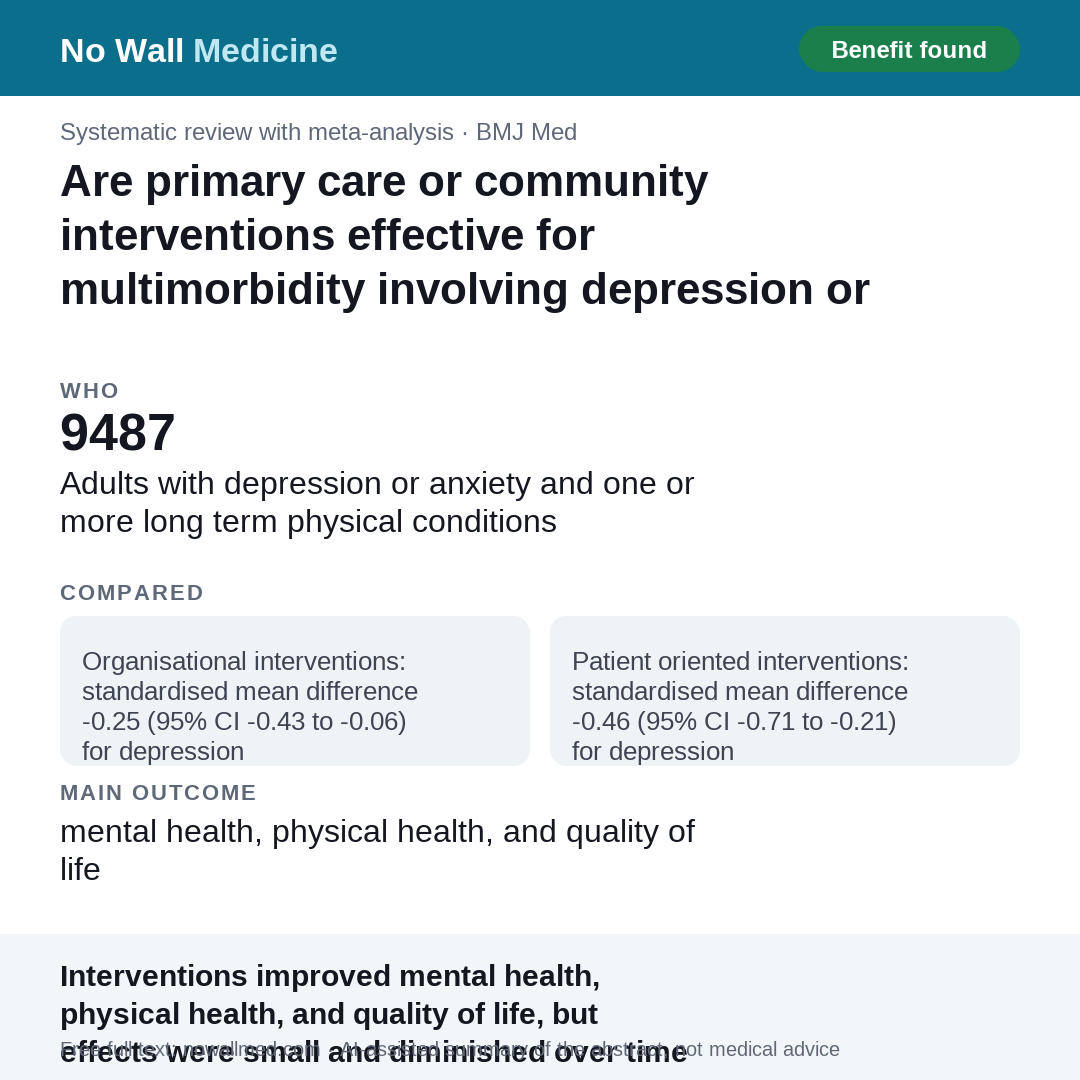
Are primary care or community interventions effective for multimorbidity involving depression or anxiety?
Who
9487
Adults with depression or anxiety and one or more long term physical conditions
Compared
Organisational interventions: standardised mean difference -0.25 (95% CI -0.43 to -0.06) for depression
Patient oriented interventions: standardised mean difference -0.46 (95% CI -0.71 to -0.21) for depression
Main outcome
mental health, physical health, and quality of life
Bottom line: Interventions improved mental health, physical health, and quality of life, but effects were small and diminished over time for patient oriented interventions.
Limitation: Effects for patient oriented interventions were diminished at the late follow-up period.
BMJ Med · 2026-04-10Download image
Clinical question: Are primary care or community interventions effective for multimorbidity involving depression or anxiety?
Why it matters: It was unclear how effective primary care or community-based interventions are for improving mental health, physical health, and quality of life in patients with multiple chronic conditions.
Key points
- Researchers analyzed 29 randomized controlled trials involving 9487 participants with depression or anxiety and one or more long-term physical conditions.
- Organizational interventions led to small improvements in depression symptoms and quality of life, but had no effect on anxiety symptoms at the end of the intervention.
- Patient-oriented interventions like exercise or psychotherapy showed small improvements in depression and quality of life, but these effects diminished at the 12-month follow-up or later.
Headline and key points written with AI from the paper’s abstract, with every number checked against it. Read the paper before relying on them.
Abstract
Objective
To identify and characterise primary care or community based interventions for patients with multimorbidity involving depression or anxiety, and to determine their effectiveness for improving patients' mental health, physical health, and quality of life. Design
Systematic review with meta-analysis. Data sources
Medline, Embase, Cochrane Library, CINAHL, PsycInfo, and Web of Science databases, from inception to 11 November 2024. Eligibility criteria for selecting studies
Included studies were randomised controlled trials of primary care or community based interventions targeting adults with depression or anxiety disorders and one or more long term physical conditions. Risk of bias assessment used the Cochrane risk of bias tool. Interventions were categorised as organisational or patient oriented, and were subgrouped by intervention type. Intervention components were systematically categorised, and effects on mental health and quality of life outcomes were meta-analysed in groups defined by intervention type and assessment time point. Physical health outcomes were too heterogenous to meta-analyse and were synthesised without meta-analysis with Fisher's method for combining P values. Results
29 randomised controlled trials comprising 9487 participants were included. High quality evidence was found for organisational interventions (n=10, including collaborative care, stepped care, and post-discharge interventions) which resulted in small improvements in symptoms of depression (standardised mean difference -0.25, 95% confidence interval (CI) -0.43 to -0.06) and quality of life (0.21, 0.01 to 0.41), but had no effect on symptoms of anxiety at the end of the intervention. No effect on depression or anxiety symptoms was observed, and no data for quality of life were found from organisational interventions at the late follow-up period (18-24 months). In the subgroup analysis, collaborative care resulted in sustained improvements in symptoms of depression at 18-24 months. Synthesis without meta-analysis showed evidence of benefit from organisational interventions (specifically collaborative care) on physiological (eg, haemoglobin A1c levels), but not on functional (eg, disability) or global physical health outcomes. Low to moderate quality evidence was found for patient oriented interventions (n=19; interventions including exercise, psychotherapy, and psychoeducation) which led to small improvements in symptoms of depression (standardised mean difference -0.46, 95% CI -0.71 to -0.21) and quality of life (0.22, 0.14 to 0.29) at the end of the intervention. These effects were diminished at the late follow-up period (≥12 months). In the subgroup analysis, no reported data for the long term effects of exercise, psychotherapy, or psychoeducation (18-24 months after randomisation) were found. Synthesis without meta-analysis showed evidence of benefit from patient oriented interventions (primarily psychotherapy) on physiological, functional, and global physical health outcomes. Conclusions
The study showed that interventions improved mental health, physical health, and quality of life outcomes in people with multimorbidity involving depression or anxiety, but the effects were small and, for patient oriented interventions in particular, diminished over time. Systematic review registration
PROSPERO CRD420251004355.
Abstract reproduced under the article’s CC BY licence.
Spotted a mistake? Suggest a correction