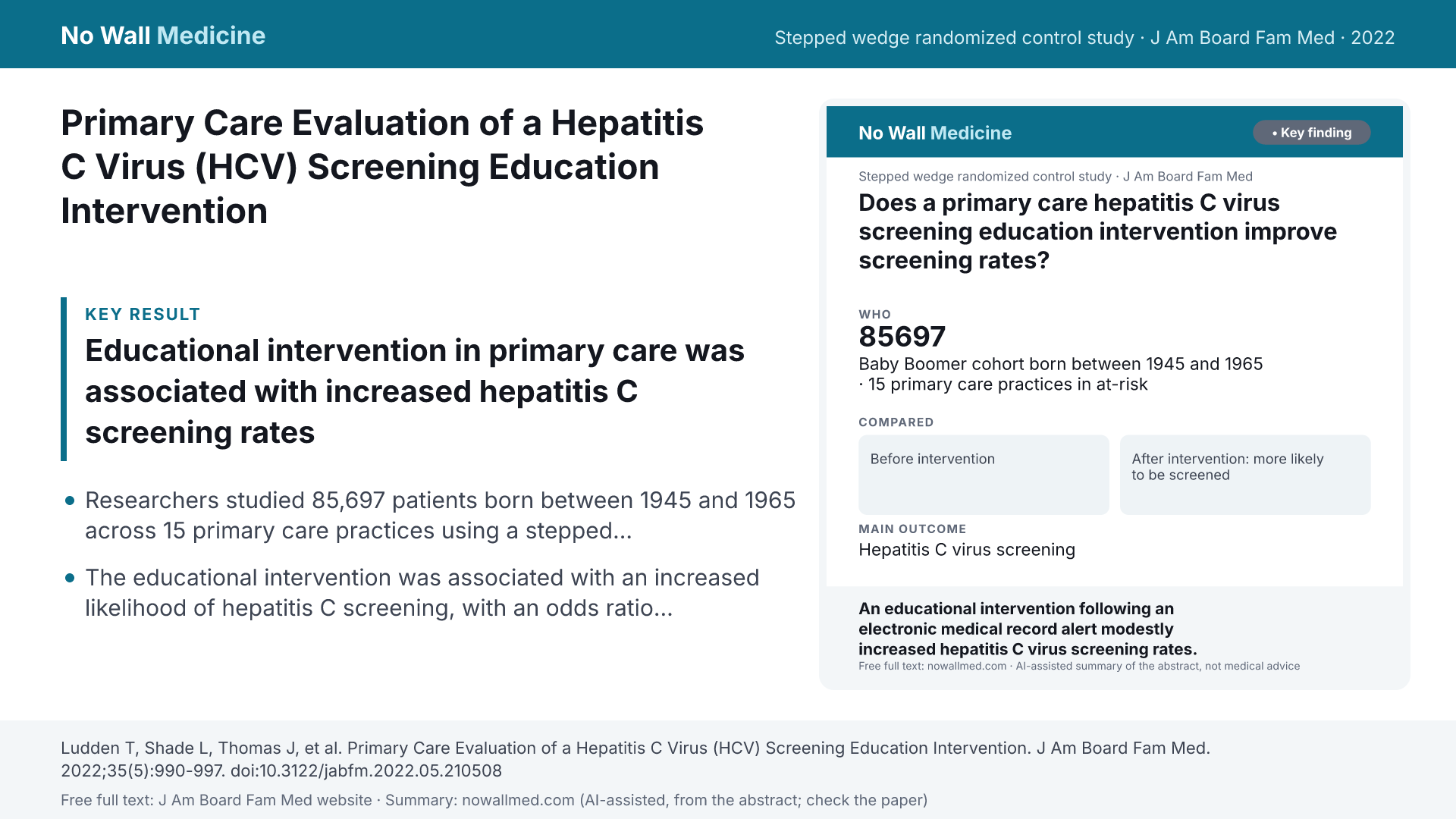
Educational intervention in primary care was associated with increased hepatitis C screening rates
Primary Care Evaluation of a Hepatitis C Virus (HCV) Screening Education Intervention
Stepped wedge randomized control studyKey finding
Does a primary care hepatitis C virus screening education intervention improve screening rates?
Who
85697
Baby Boomer cohort born between 1945 and 1965 · 15 primary care practices in at-risk neighborhoods
Compared
Before intervention
After intervention: more likely to be screened
Main outcome
Hepatitis C virus screening
Result: odds ratio 1.296 (95% CI 1.098 to 1.529)
Bottom line: An educational intervention following an electronic medical record alert modestly increased hepatitis C virus screening rates.
J Am Board Fam Med · 2022-10-18Download image
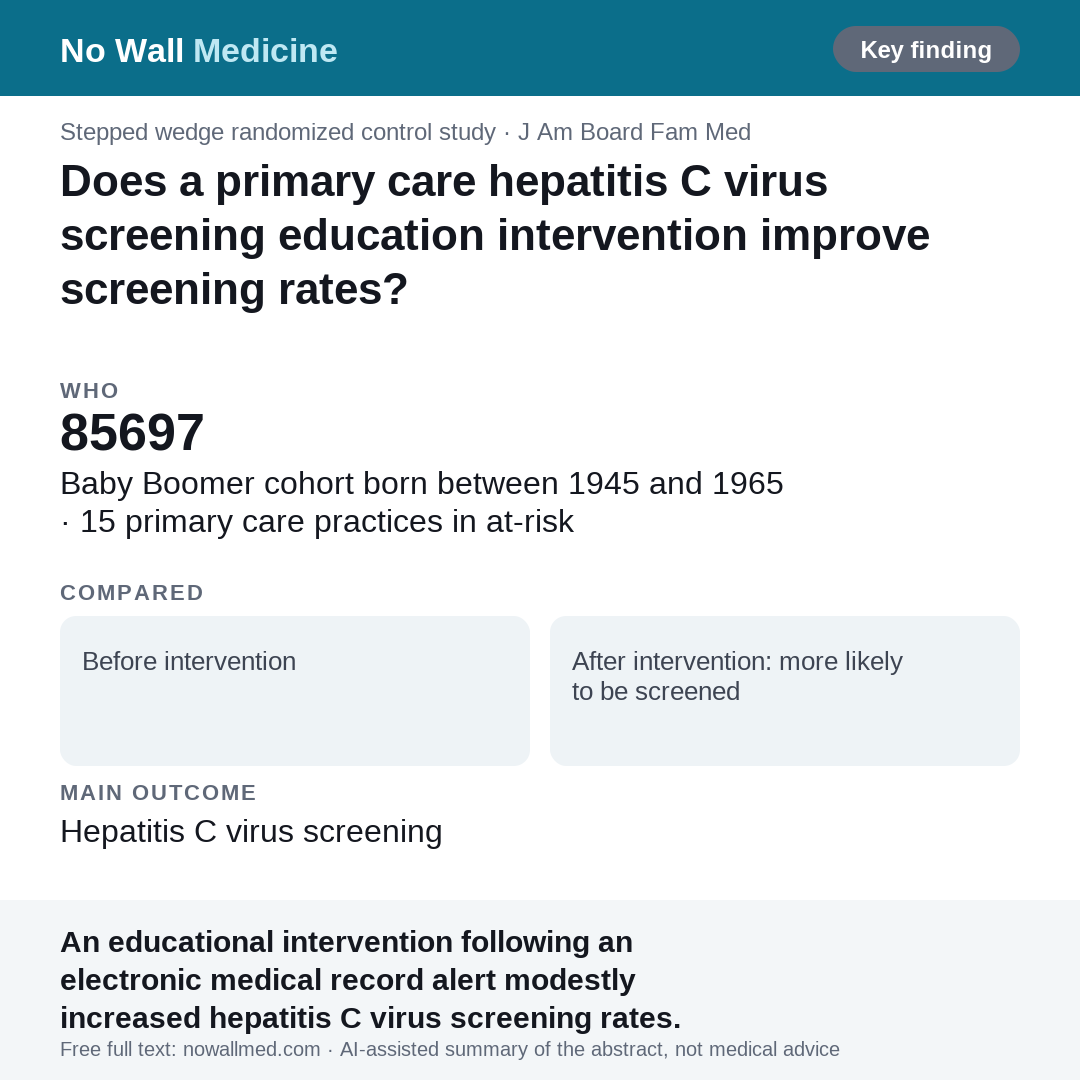
Clinical question: Does a primary care hepatitis C virus screening education intervention improve screening rates?
Key points
- Researchers studied 85,697 patients born between 1945 and 1965 across 15 primary care practices using a stepped wedge randomized control study design.
- The educational intervention was associated with an increased likelihood of hepatitis C screening, with an odds ratio of 1.296 (95% CI 1.098-1.529).
- Females were less likely to be screened than males, and patients under age 65 were more likely to be screened than those aged 65 and older.
Headline and key points written with AI from the paper’s abstract, with every number checked against it. Read the paper before relying on them.
Was this summary helpful?
Subject terms
Headline, design, result, key points, caveat and citation as plain text.
Cite this article
Ludden T, Shade L, Thomas J, et al. Primary Care Evaluation of a Hepatitis C Virus (HCV) Screening Education Intervention. J Am Board Fam Med. 2022. doi:10.3122/jabfm.2022.05.210508
Spotted a mistake? Suggest a correction