Researchers plan a trial to test integrated primary care management for patients with chronic obstructive pulmonary disease
Primary Care Integrated Management of chronic obstructive pulmonary disease (PRIM-COPD): study protocol for a cluster-randomised controlled trial
Cluster-randomised controlled studyUnclear result
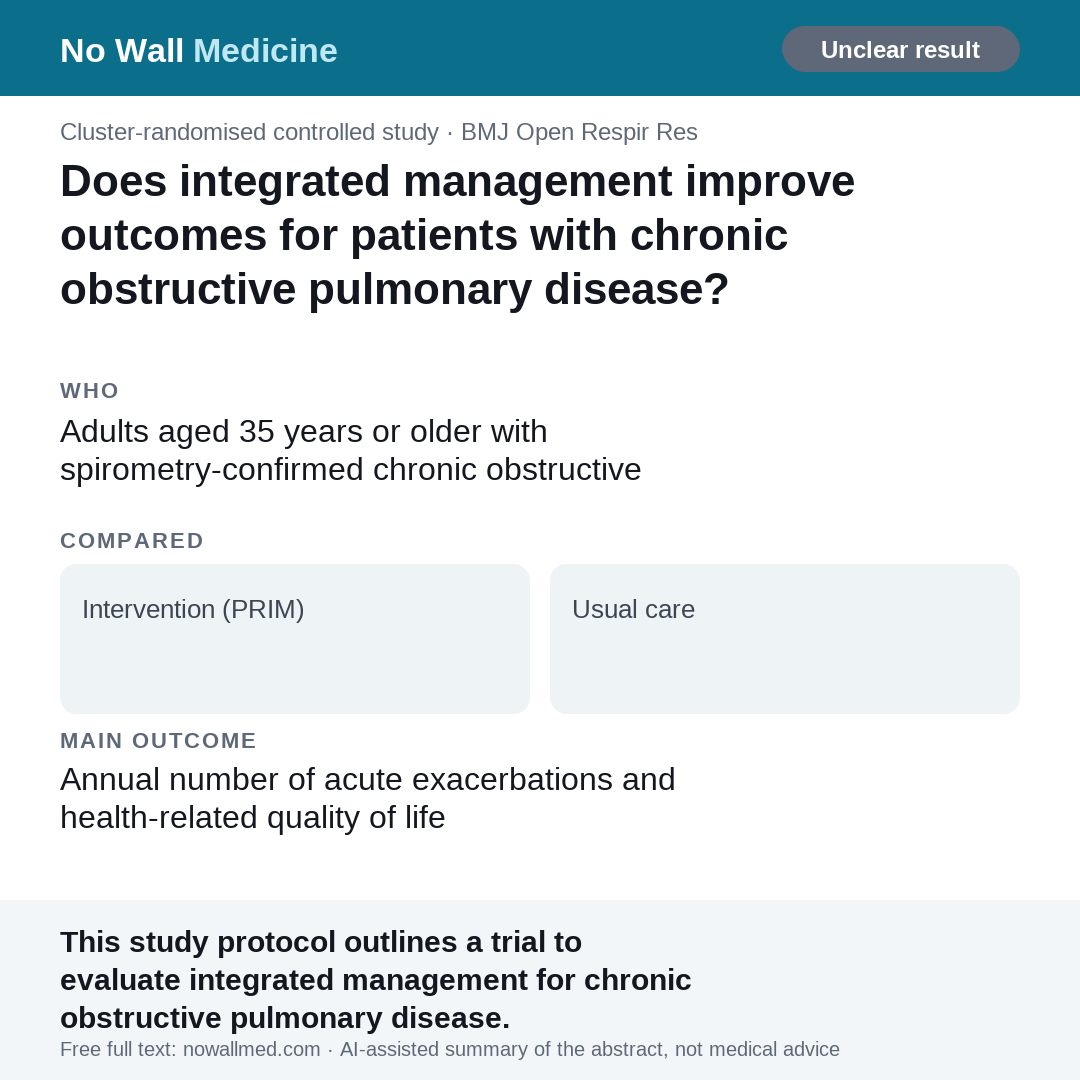
Does integrated management improve outcomes for patients with chronic obstructive pulmonary disease?
Who
Adults aged 35 years or older with spirometry-confirmed chronic obstructive pulmonary disease · Seven pilot regions in China
Compared
Intervention (PRIM)
Usual care
Main outcome
Annual number of acute exacerbations and health-related quality of life
Bottom line: This study protocol outlines a trial to evaluate integrated management for chronic obstructive pulmonary disease.
BMJ Open Respir Res · 2026-07-08Download image
Clinical question: Does integrated management improve outcomes for patients with chronic obstructive pulmonary disease?
Why it matters: Gaps exist in early diagnosis, guideline-based treatment, and long-term management of chronic obstructive pulmonary disease in primary care settings.
Key points
- The study will involve adults aged 35 years or older with spirometry-confirmed chronic obstructive pulmonary disease across seven pilot regions in China.
- Researchers will compare a management approach involving quarterly general practitioner follow-ups and health education against usual care.
- The trial will measure the annual number of acute exacerbations and health-related quality of life as primary outcomes.
Headline and key points written with AI from the paper’s abstract, with every number checked against it. Read the paper before relying on them.
Abstract
Introduction
Chronic obstructive pulmonary disease (COPD) is a leading cause of morbidity and mortality worldwide, with China bearing a particularly high burden. Major gaps persist in early diagnosis, guideline-based treatment and long-term disease management, especially in primary care. This study aims to evaluate the efficacy and feasibility of the National Essential Public Health Services (NEPHS) COPD management approach and to generate evidence to inform the optimisation of national COPD care standards. Methods and analysis
The Primary Care Integrated Management (PRIM) trial is a prospective, multicentre, cluster-randomised controlled study conducted in seven pilot regions in China, with primary healthcare institutions as the unit of randomisation. Participants are adults aged ≥35 years with spirometry-confirmed COPD, recruited either through screening or from existing patient databases. Institutions will be randomised in a 1:1 ratio to the intervention (PRIM) or usual care arms using a computer-generated allocation sequence, stratified by urban-rural location. The intervention comprises quarterly general practitioner (GP)-led follow-ups, health education and disease management according to pilot NEPHS COPD guidelines, supported by a three-tier oversight structure involving the National Center for Respiratory Medicine, leading tertiary hospitals and primary healthcare institutions. Co-primary outcomes are the annual number of acute exacerbations and health-related quality of life (European Quality of Life-5 Dimensions and 5 Levels). Secondary outcomes include smoking status, health status assessed by the COPD Assessment Test (CAT), dyspnoea score and GP knowledge. Analyses will follow the intention-to-treat principle, using multivariable regression models adjusted for clustering and prespecified baseline covariates. Cost-effectiveness analyses of the PRIM intervention in the Chinese population are also planned. Ethics and dissemination
Ethics approval has been granted by China-Japan Friendship Hospital (approval number 2024-KY-163). Trial registration number
NCT06573580.
Abstract reproduced under the article’s CC BY NC licence.
Topics
Cite this article
Yu Y, Ren X, Chu X, Yan J, Guo F, Wan Q. Primary Care Integrated Management of chronic obstructive pulmonary disease (PRIM-COPD): study protocol for a cluster-randomised controlled trial. BMJ Open Respir Res. 2026. doi:10.1136/bmjresp-2025-003771
Spotted a mistake? Suggest a correction