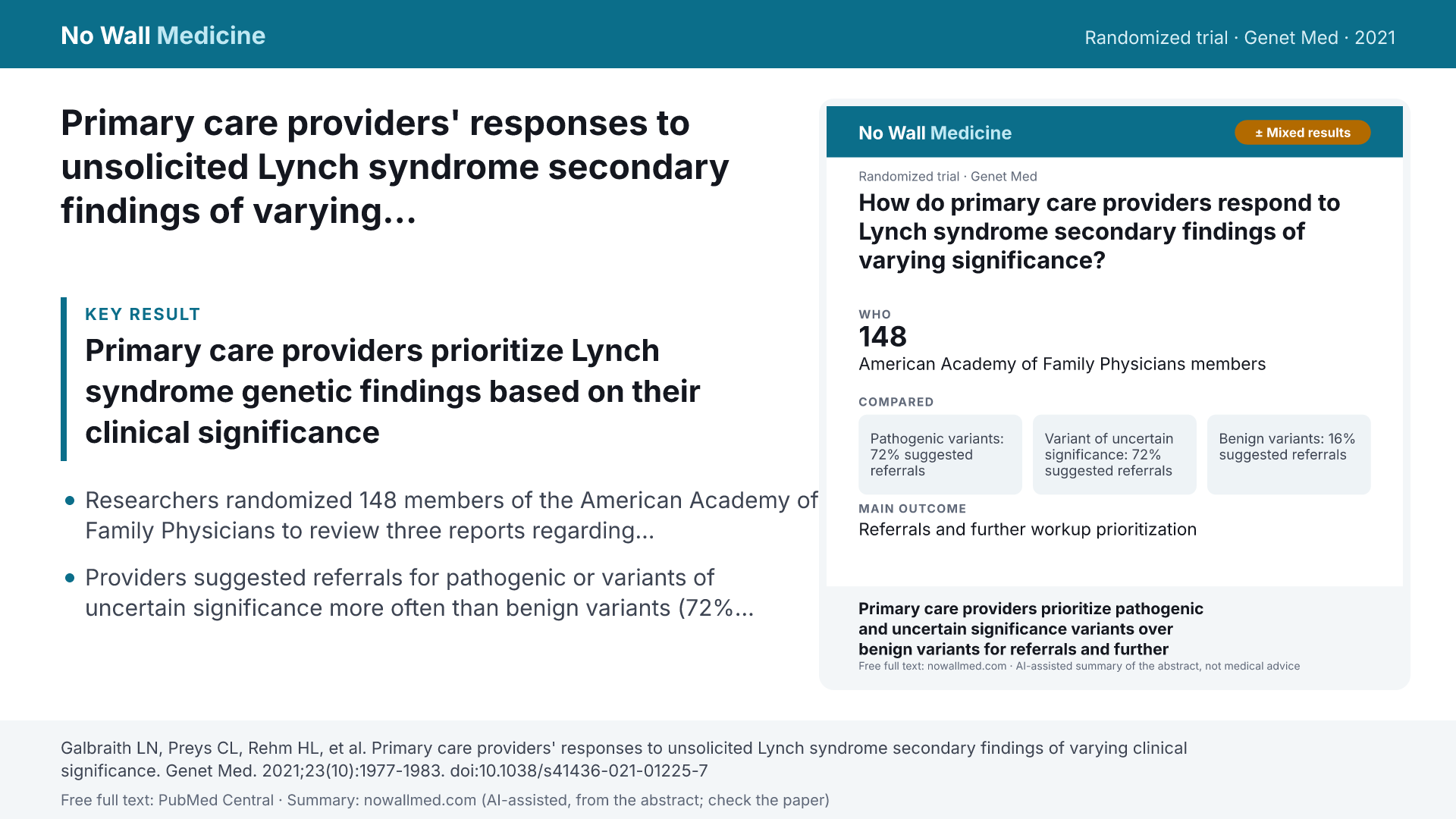
Primary care providers prioritize Lynch syndrome genetic findings based on their clinical significance
Primary care providers' responses to unsolicited Lynch syndrome secondary findings of varying clinical significance
Randomized trialMixed results
How do primary care providers respond to Lynch syndrome secondary findings of varying significance?
Who
148
American Academy of Family Physicians members
Compared
Pathogenic variants: 72% suggested referrals
Variant of uncertain significance: 72% suggested referrals
Benign variants: 16% suggested referrals
Main outcome
Referrals and further workup prioritization
Bottom line: Primary care providers prioritize pathogenic and uncertain significance variants over benign variants for referrals and further workup.
Genet Med · 2021-06-10 · Save PNG
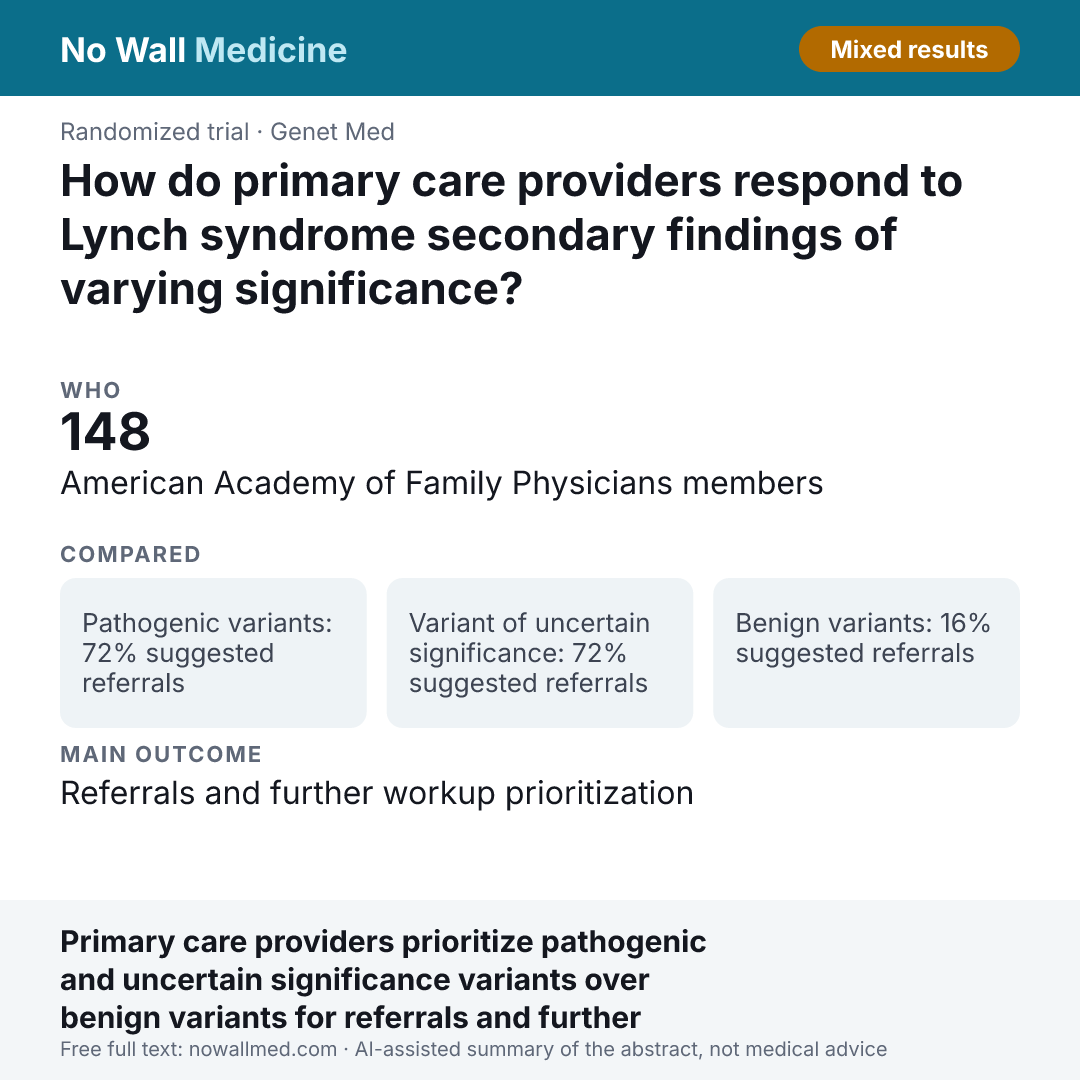
Clinical question: How do primary care providers respond to Lynch syndrome secondary findings of varying significance?
Key points
- Researchers randomized 148 members of the American Academy of Family Physicians to review three reports regarding Lynch syndrome, a genetic condition that increases cancer risk.
- Providers suggested referrals for pathogenic or variants of uncertain significance more often than benign variants (72% vs. 16%, p < 0.001).
- Providers were more likely to address further workup, such as a colonoscopy or upper endoscopy, for pathogenic or uncertain variants than for benign ones (43% vs. 4%, p < 0.001).
Headline and key points written with AI from the paper’s abstract, with every number checked against it. Read the paper before relying on them.
Was this summary helpful?
Subject terms
Headline, design, result, key points, caveat and citation as plain text.
Cite this article
Galbraith LN, Preys CL, Rehm HL, et al. Primary care providers' responses to unsolicited Lynch syndrome secondary findings of varying clinical significance. Genet Med. 2021;23(10):1977-1983. doi:10.1038/s41436-021-01225-7
Spotted a mistake? Suggest a correction