Residual disease after primary surgery is associated with worse survival in advanced endometrial cancer
Primary cytoreductive surgery for advanced stage endometrial cancer: a systematic review and meta-analysis
Systematic review and meta-analysisKey finding
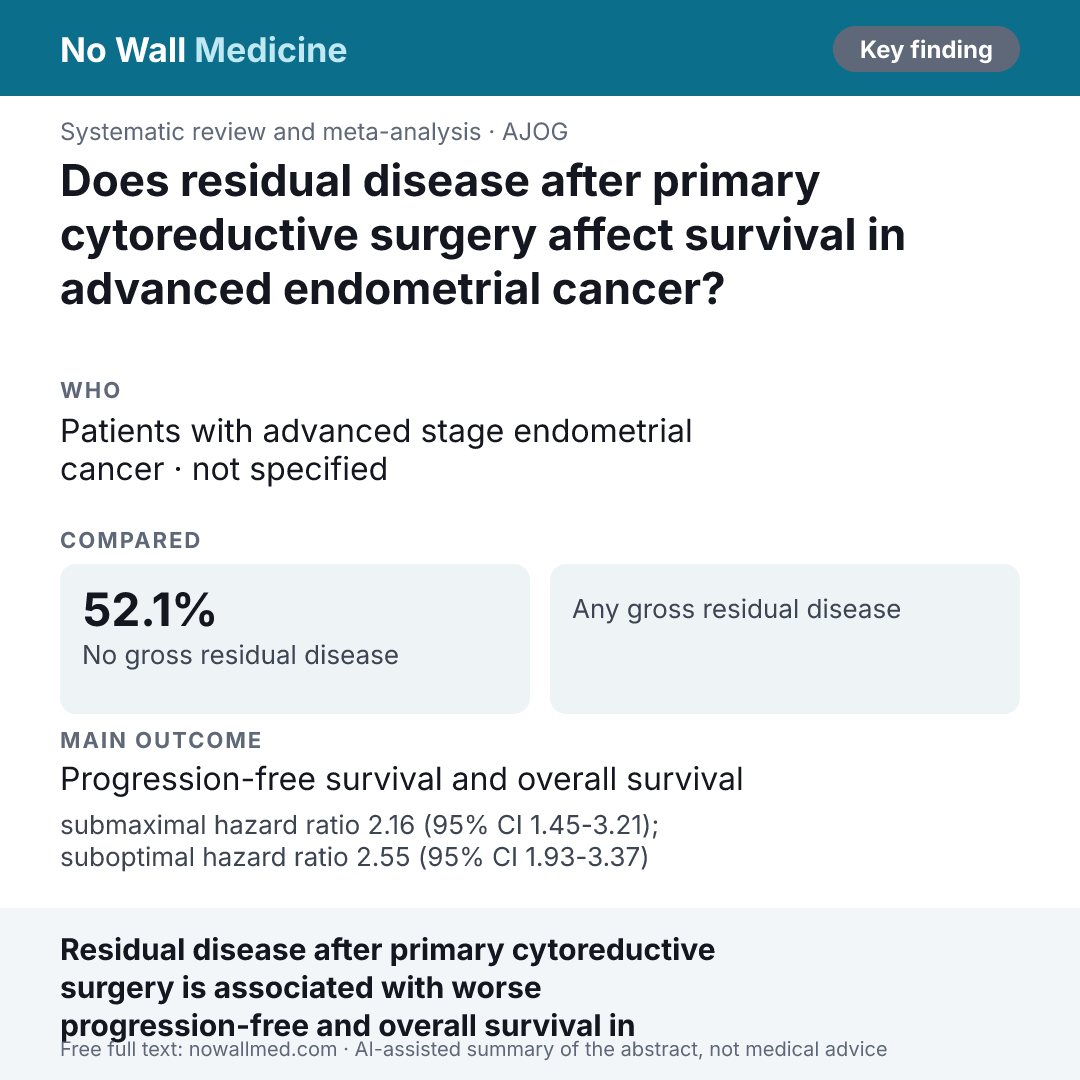
Does residual disease after primary cytoreductive surgery affect survival in advanced endometrial cancer?
Who
Patients with advanced stage endometrial cancer · not specified
Compared
52.1%No gross residual disease (n=1329 patients)
Any gross residual disease
Main outcome
Progression-free survival and overall survival
Result: submaximal hazard ratio 2.16 (95% CI 1.45-3.21); suboptimal hazard ratio 2.55 (95% CI 1.93-3.37)
Bottom line: Residual disease after primary cytoreductive surgery is associated with worse progression-free and overall survival in advanced endometrial cancer.
Limitation: little prospective evidence exists to guide the management thereof
AJOG · 2021-05-04 · Save PNG
Clinical question: Does residual disease after primary cytoreductive surgery affect survival in advanced endometrial cancer?
Why it matters: Little prospective evidence exists to guide the management of advanced stage endometrial cancer regarding the use of primary cytoreductive surgery.
Key points
- Researchers analyzed 34 studies involving patients with advanced stage endometrial cancer to evaluate the success of primary cytoreductive surgery, which is the removal of as much tumor as possible.
- In the meta-analysis, 52.1% of cases reached no gross residual disease and 75% reached less than 1 cm of residual disease.
- Leaving any gross residual disease or disease greater than or equal to 1 cm was associated with worse progression-free survival and overall survival rates.
Headline and key points written with AI from the paper’s abstract, with every number checked against it. Read the paper before relying on them.
Was this summary helpful?
Subject terms
Headline, design, result, key points, caveat and citation as plain text.
Cite this article
Albright BB, Monuszko KA, Kaplan SJ, et al. Primary cytoreductive surgery for advanced stage endometrial cancer: a systematic review and meta-analysis. Am J Obstet Gynecol. 2021;225(3):237.e1-237.e24. doi:10.1016/j.ajog.2021.04.254
Spotted a mistake? Suggest a correction