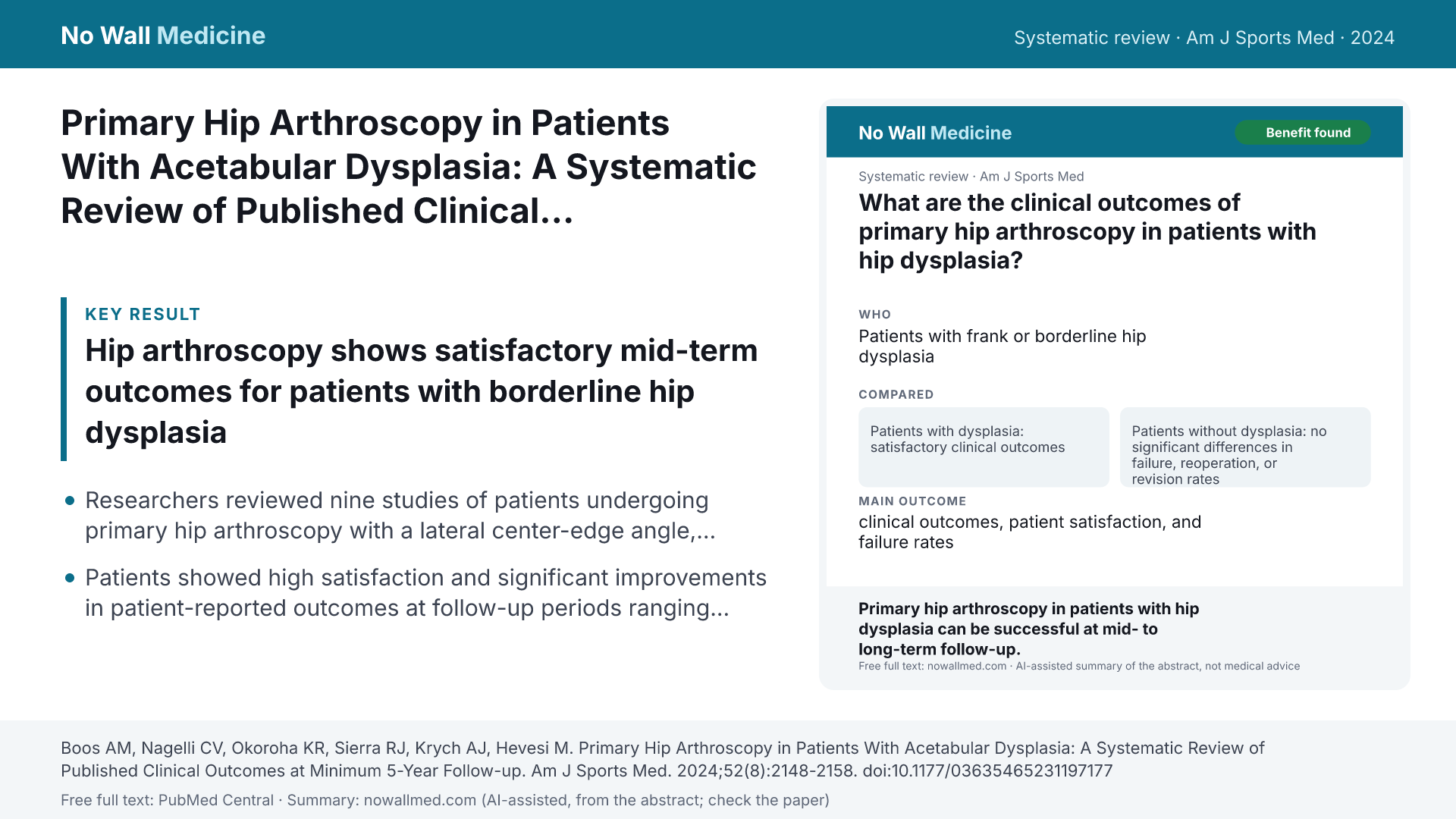
Hip arthroscopy shows satisfactory mid-term outcomes for patients with borderline hip dysplasia
Primary Hip Arthroscopy in Patients With Acetabular Dysplasia: A Systematic Review of Published Clinical Outcomes at Minimum 5-Year Follow-up
Systematic reviewBenefit found
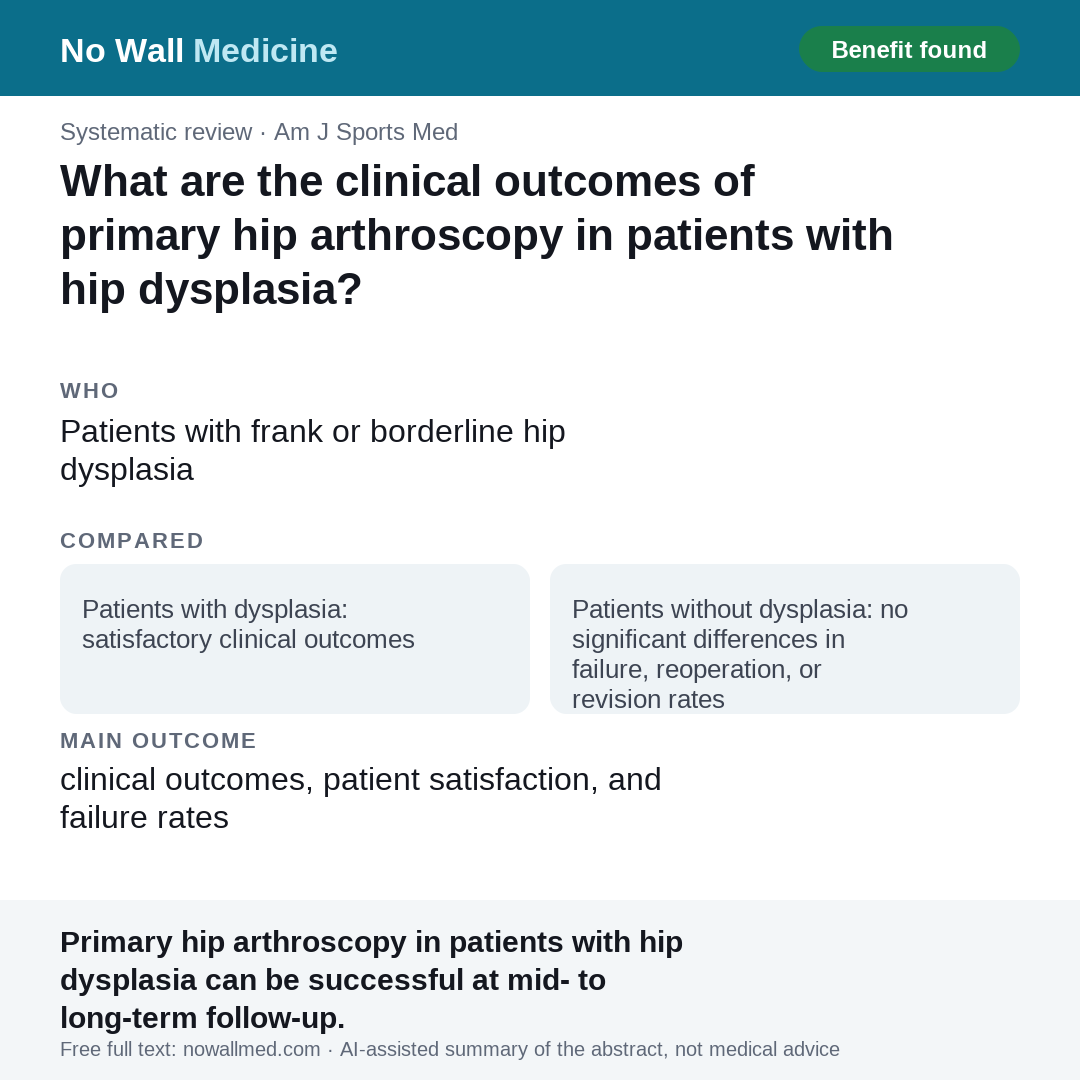
What are the clinical outcomes of primary hip arthroscopy in patients with hip dysplasia?
Who
Patients with frank or borderline hip dysplasia
Compared
Patients with dysplasia: satisfactory clinical outcomes
Patients without dysplasia: no significant differences in failure, reoperation, or revision rates
Main outcome
clinical outcomes, patient satisfaction, and failure rates
Bottom line: Primary hip arthroscopy in patients with hip dysplasia can be successful at mid- to long-term follow-up.
Limitation: Lateral center-edge angle is a singular, 2-dimensional measure that does not differentiate instability from impingement.
Am J Sports Med · 2024-02-09Download image
Clinical question: What are the clinical outcomes of primary hip arthroscopy in patients with hip dysplasia?
Why it matters: Mid-term clinical outcomes and failure rates for hip arthroscopy in patients with borderline hip dysplasia are inconsistent in existing data.
Key points
- Researchers reviewed nine studies of patients undergoing primary hip arthroscopy with a lateral center-edge angle, a measure of hip socket coverage, of less than 25°.
- Patients showed high satisfaction and significant improvements in patient-reported outcomes at follow-up periods ranging from 5 to 10 years.
- Outcomes, failure, reoperation, and revision rates were not significantly different between patients with dysplasia and those without dysplasia.
Limitation the authors note: The lateral center-edge angle is a single 2-dimensional radiographic measure that does not differentiate between hip instability and impingement.
Headline and key points written with AI from the paper’s abstract, with every number checked against it. Read the paper before relying on them.
Was this summary helpful?
Subject terms
Cite this article
Boos AM, Nagelli CV, Okoroha KR, Sierra RJ, Krych AJ, Hevesi M. Primary Hip Arthroscopy in Patients With Acetabular Dysplasia: A Systematic Review of Published Clinical Outcomes at Minimum 5-Year Follow-up. Am J Sports Med. 2024. doi:10.1177/03635465231197177
Spotted a mistake? Suggest a correction