Needle-knife fistulotomy was associated with higher success and lower pancreatitis rates in long papilla patients
Primary Needle-Knife Fistulotomy Versus Standard Transpapillary Technique for Cannulation of Long-Size Papilla: A Randomized Clinical Trial
Randomized clinical trialBenefit found
Is primary needle-knife fistulotomy safer and more effective than standard transpapillary technique for long-size papilla?
Who
260
Patients with intact long-size papilla
Compared
2.4%primary needle-knife fistulotomy
9.6%standard transpapillary technique
Main outcome
rate of postendoscopic retrograde cholangiopancreatography pancreatitis
Result: number needed to treat [95% confidence interval] = 13.9 [7.5-83.2]
Bottom line: Primary needle-knife fistulotomy is safer, easier, and more efficient than standard transpapillary technique for long-size papilla cannulation.
Clin Transl Gastroenterol · 2024-12-01Download image
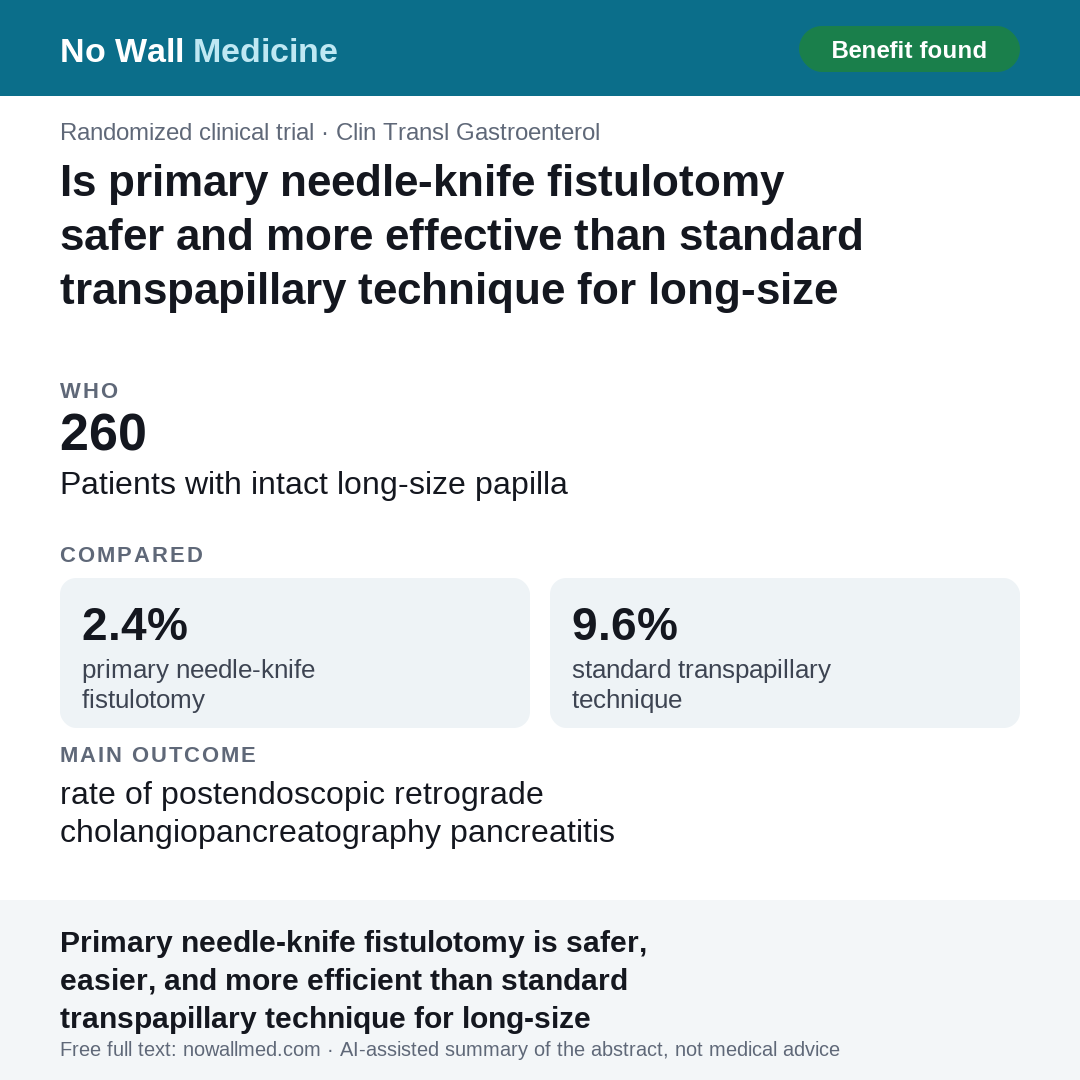
Clinical question: Is primary needle-knife fistulotomy safer and more effective than standard transpapillary technique for long-size papilla?
Why it matters: It was unknown how different cannulation methods compare regarding safety and effectiveness in patients with long-size papilla morphology.
Key points
- Researchers randomly assigned 260 patients with long-size papilla to either primary needle-knife fistulotomy or standard transpapillary cannulation, a method used to access the bile duct.
- Primary biliary cannulation success was 96.2% for the needle-knife group compared to 87.7% for the standard group, and pancreatitis occurred in 2.4% versus 9.6% of patients.
- The standard technique was associated with more cannulation attempts at 3.4 versus 2.5 and longer cannulation times of 258 seconds versus 187 seconds.
Headline and key points written with AI from the paper’s abstract, with every number checked against it. Read the paper before relying on them.
Was this summary helpful?
Subject terms
Cite this article
Sadeghi A, Arabpour E, Movassagh-Koolankuh S, Rastegar R, Moghadam PK, Omidvari S. Primary Needle-Knife Fistulotomy Versus Standard Transpapillary Technique for Cannulation of Long-Size Papilla: A Randomized Clinical Trial. Clin Transl Gastroenterol. 2024. doi:10.14309/ctg.0000000000000788
Spotted a mistake? Suggest a correction
Top studies every Monday
The week’s key trials and guidelines in your specialties, plus any topics you follow. By email, free.
Get the weekly digest