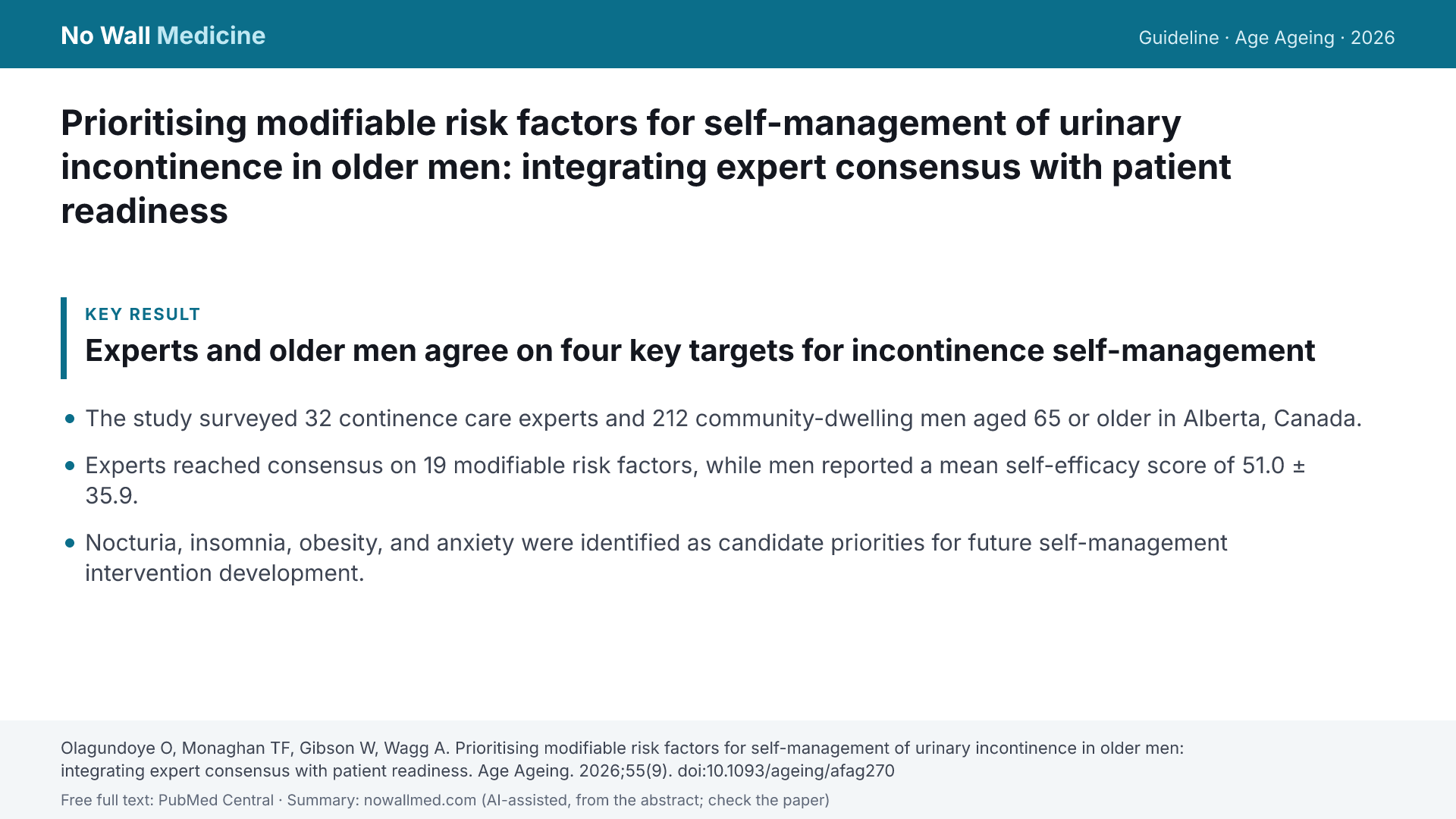
Experts and older men agree on four key targets for incontinence self-management
Prioritising modifiable risk factors for self-management of urinary incontinence in older men: integrating expert consensus with patient readiness
No newer version found (checked 2026-11-27). PubMed lists no update or withdrawal of this guideline. Issuing bodies sometimes publish updates elsewhere, so check their website before relying on it.
Key points
- The study surveyed 32 continence care experts and 212 community-dwelling men aged 65 or older in Alberta, Canada.
- Experts reached consensus on 19 modifiable risk factors, while men reported a mean self-efficacy score of 51.0 ± 35.9.
- Nocturia, insomnia, obesity, and anxiety were identified as candidate priorities for future self-management intervention development.
Headline and key points written with AI from the paper’s abstract, with every number checked against it. Read the paper before relying on them.
Was this summary helpful?
Subject terms
Headline, design, result, key points, caveat and citation as plain text.
Cite this article
Olagundoye O, Monaghan TF, Gibson W, Wagg A. Prioritising modifiable risk factors for self-management of urinary incontinence in older men: integrating expert consensus with patient readiness. Age Ageing. 2026;55(9). doi:10.1093/ageing/afag270
Spotted a mistake? Suggest a correction