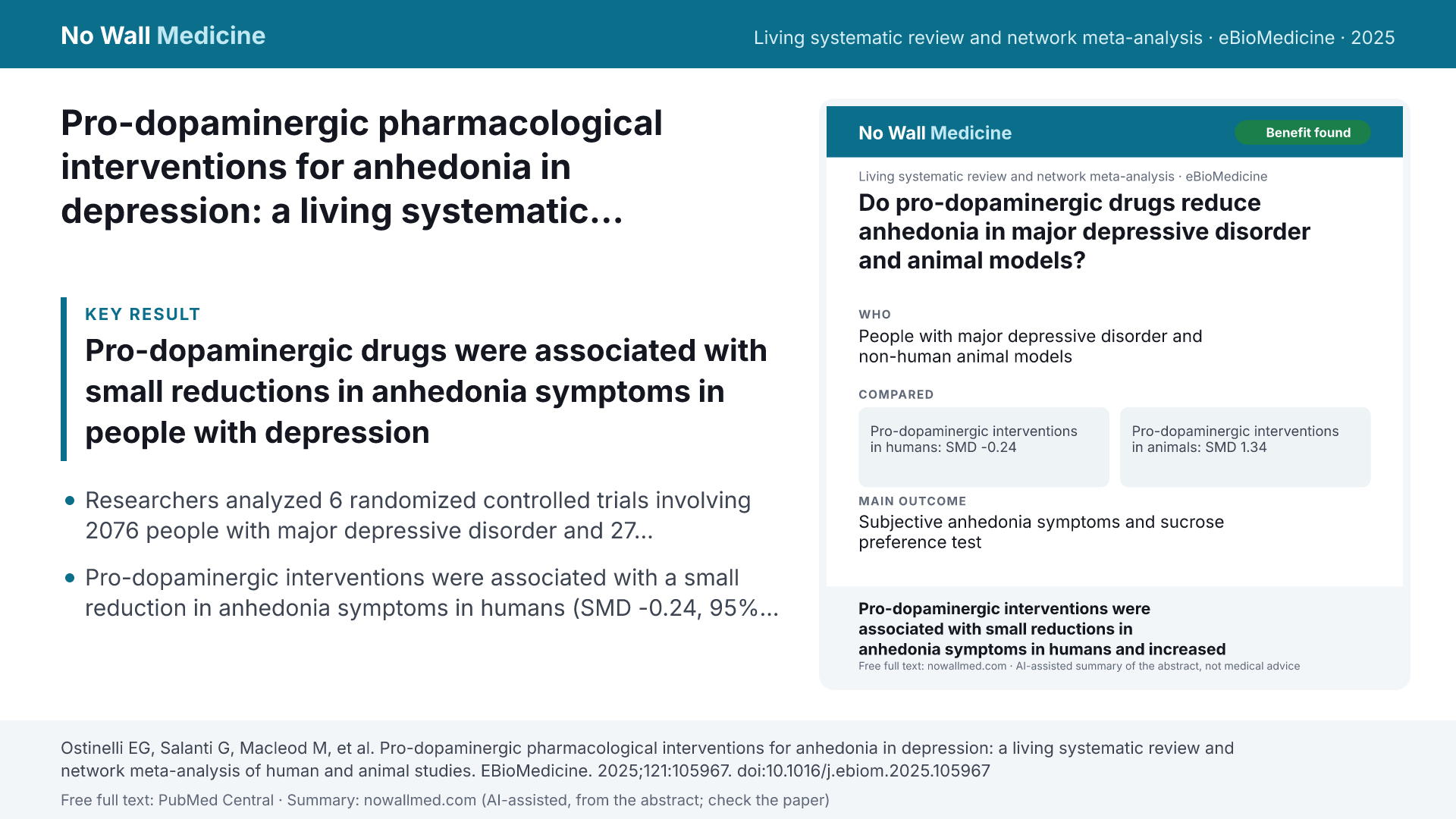
Pro-dopaminergic drugs were associated with small reductions in anhedonia symptoms in people with depression
Pro-dopaminergic pharmacological interventions for anhedonia in depression: a living systematic review and network meta-analysis of human and animal studies
Living systematic review and network meta-analysisBenefit found
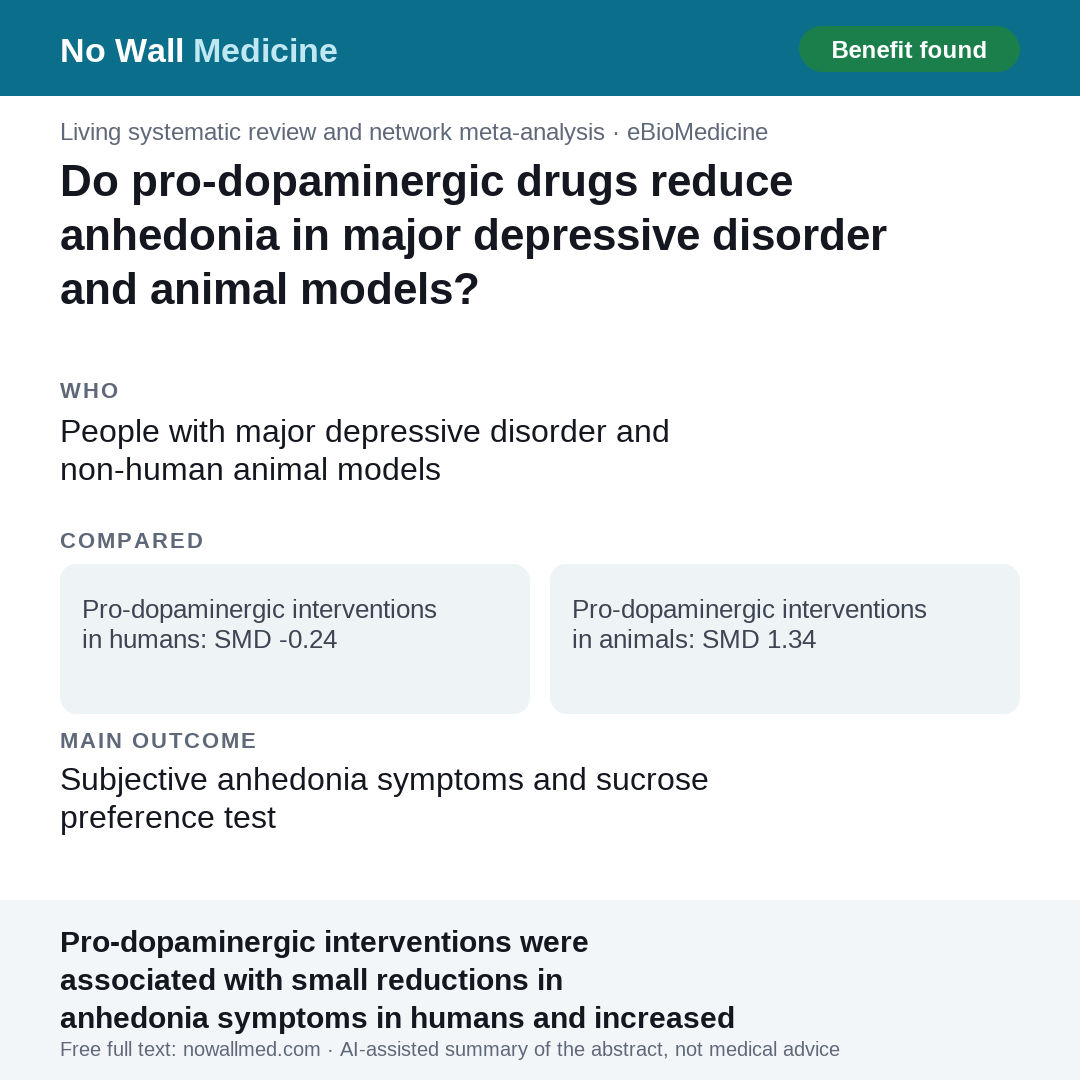
Do pro-dopaminergic drugs reduce anhedonia in major depressive disorder and animal models?
Who
People with major depressive disorder and non-human animal models
Compared
Pro-dopaminergic interventions in humans: SMD -0.24
Pro-dopaminergic interventions in animals: SMD 1.34
Main outcome
Subjective anhedonia symptoms and sucrose preference test
Result: SMD -0.24 (95% CI -0.46 to -0.03) in humans; SMD 1.34 (95% CI 0.88 to 1.79) in animals
Bottom line: Pro-dopaminergic interventions were associated with small reductions in anhedonia symptoms in humans and increased sucrose preference in animals.
Limitation: The precise neurobiological mechanisms of anhedonia are still poorly understood.
Funded by: Wellcome (GALENOS project)
eBioMedicine · 2025-10-29Download image
Clinical question: Do pro-dopaminergic drugs reduce anhedonia in major depressive disorder and animal models?
Why it matters: It is unclear whether drugs that target dopamine reduce anhedonia, which is the inability to feel pleasure, in people with major depressive disorder.
Key points
- Researchers analyzed 6 randomized controlled trials involving 2076 people with major depressive disorder and 27 animal studies to measure the effects of drugs targeting dopamine.
- Pro-dopaminergic interventions were associated with a small reduction in anhedonia symptoms in humans (SMD -0.24, 95% CI -0.46 to -0.03) and increased sucrose preference in animals (SMD 1.34, 0.88 to 1.79).
- In a network meta-analysis, some antidepressants with non-dopaminergic mechanisms showed a larger reduction in anhedonia symptoms than pro-dopaminergic drugs.
Limitation the authors note: The evidence was rated as low to moderate and data on reward and reinforcement tasks in humans were not found.
Headline and key points written with AI from the paper’s abstract, with every number checked against it. Read the paper before relying on them.
Was this summary helpful?
Subject terms
Cite this article
Ostinelli EG, Salanti G, Macleod M, et al. Pro-dopaminergic pharmacological interventions for anhedonia in depression: a living systematic review and network meta-analysis of human and animal studies. eBioMedicine. 2025. doi:10.1016/j.ebiom.2025.105967
Spotted a mistake? Suggest a correction