Proband-mediated interventions to increase disclosure of genetic risk in families with a BRCA or Lynch syndrome condition: a systematic review
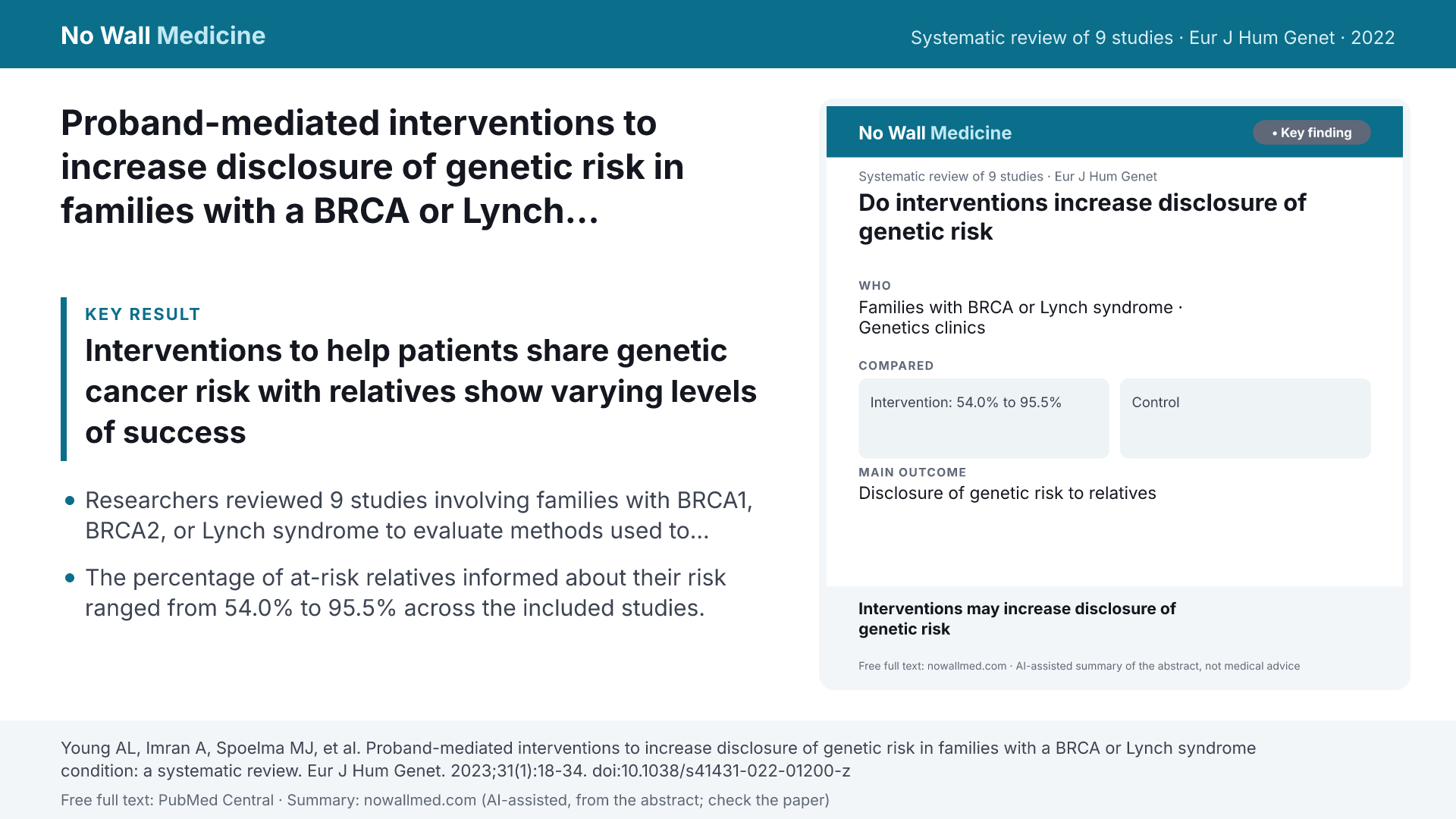
Key result: Interventions to help patients share genetic cancer risk with relatives show varying levels of success
Systematic review of 9 studiesKey finding
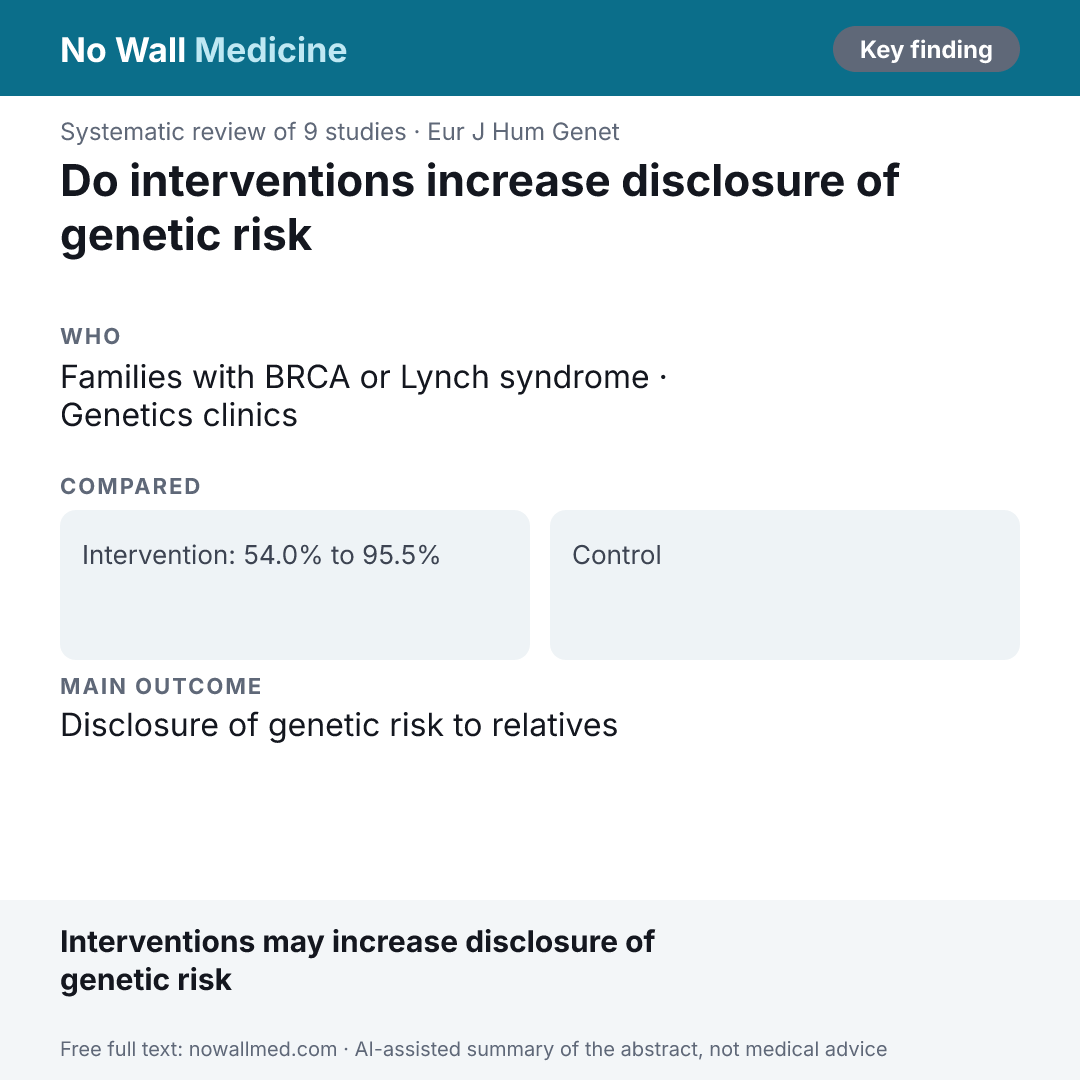
Do interventions increase disclosure of genetic risk
Who
Families with BRCA or Lynch syndrome · Genetics clinics
Compared
Intervention: 54.0% to 95.5%
Control
Main outcome
Disclosure of genetic risk to relatives
Bottom line: Interventions may increase disclosure of genetic risk
Eur J Hum Genet · 2022-10-17 · Save PNG
Key points
- Researchers reviewed 9 studies involving families with BRCA1, BRCA2, or Lynch syndrome to evaluate methods used to help patients disclose genetic risks to relatives.
- The percentage of at-risk relatives informed about their risk ranged from 54.0% to 95.5% across the included studies.
- Among those informed, 24.4-60.0% contacted a genetics clinic and 22.8-76.2% underwent genetic testing after receiving counseling.
Discussion prompts
- Would these patients look like yours? Who was left out?
- Is the main outcome one that matters to patients?
- Is the difference large enough to change what you do?
Cite: Young AL, Imran A, Spoelma MJ, et al. Proband-mediated interventions to increase disclosure of genetic risk in families with a BRCA or Lynch syndrome condition: a systematic review. Eur J Hum Genet. 2023;31(1):18-34. doi:10.1038/s41431-022-01200-z
Free full text: PubMed Central · Summary and visual abstract: nowallmed.com/a/proband-mediated-interventions-to-increase-disclosure-of-genetic-risk-1grxt0v/ (AI-assisted from the abstract; check the paper before relying on it).