Oral probiotic Bacillus subtilis reduced Staphylococcus aureus in the intestine and nose of adults
Probiotic for pathogen-specific Staphylococcus aureus decolonisation in Thailand: a phase 2, double-blind, randomised, placebo-controlled trial
Phase 2, double-blind, randomised, placebo-controlled trialBenefit found
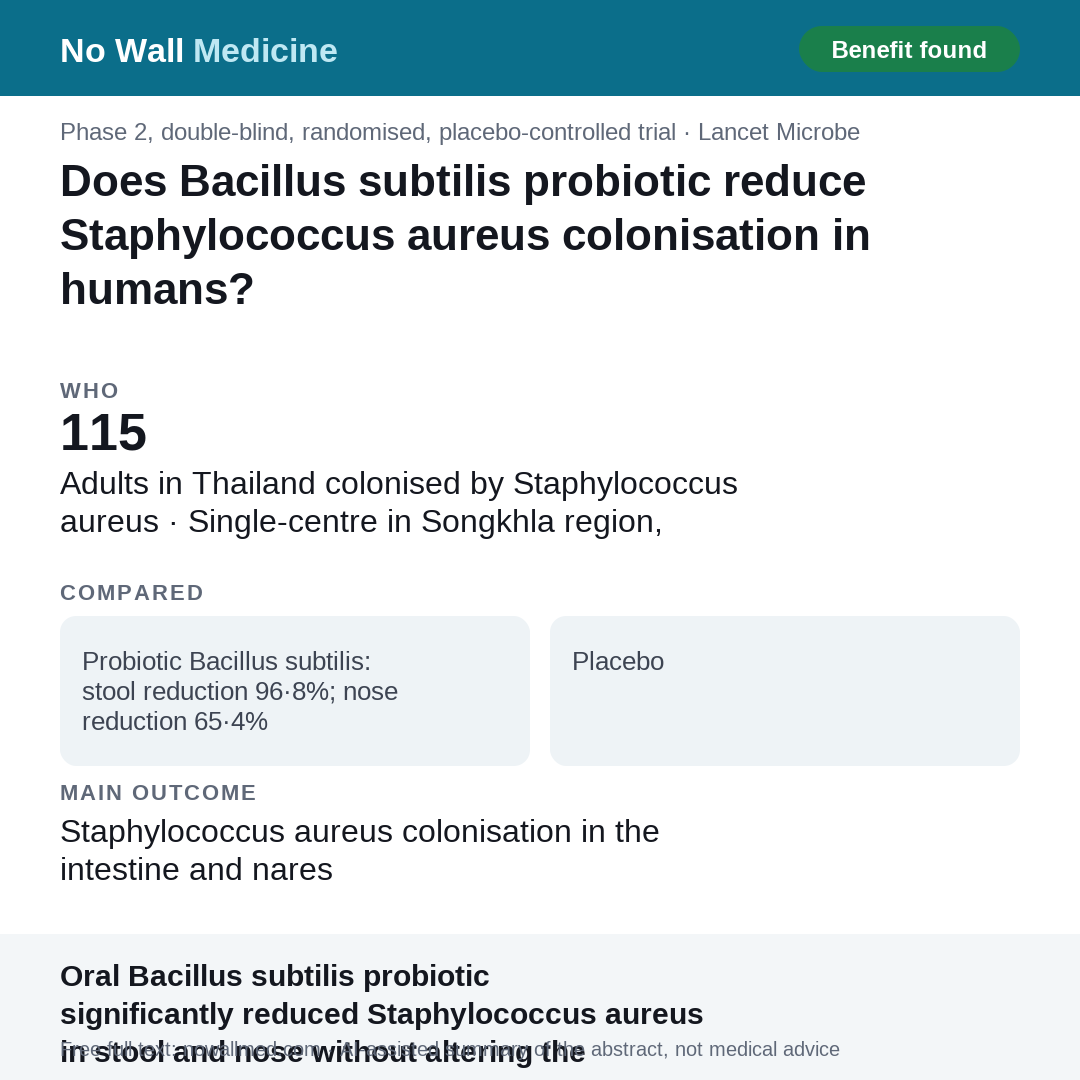
Does Bacillus subtilis probiotic reduce Staphylococcus aureus colonisation in humans?
Who
115
Adults in Thailand colonised by Staphylococcus aureus · Single-centre in Songkhla region, Thailand
Compared
Probiotic Bacillus subtilis: stool reduction 96·8%; nose reduction 65·4%
Placebo
Main outcome
Staphylococcus aureus colonisation in the intestine and nares
Bottom line: Oral Bacillus subtilis probiotic significantly reduced Staphylococcus aureus in stool and nose without altering the microbiota.
Funded by: National Research Council of Thailand and US National Institutes of Health
Lancet Microbe · 2023-01-13Download image
Clinical question: Does Bacillus subtilis probiotic reduce Staphylococcus aureus colonisation in humans?
Why it matters: Topical decolonization strategies have had little success and oral antibiotics are ill advised due to the risk of antibiotic resistance and microbiota eradication.
Key points
- The study randomized 115 adults colonized by Staphylococcus aureus to receive either 250 mg of Bacillus subtilis MB40 or a placebo once daily for 30 days.
- The probiotic resulted in a 96.8% reduction of Staphylococcus aureus in stool and a 65.4% reduction in the nose compared to the placebo.
- There were no differences in adverse effects or significant changes to the microbiota between the probiotic and placebo groups.
Headline and key points written with AI from the paper’s abstract, with every number checked against it. Read the paper before relying on them.
Was this summary helpful?
Abstract
Background
Decolonisation is considered a valuable means to reduce Staphylococcus aureus infection rates. However, previous topical strategies targeting the nose or skin had little success, and oral antibiotic-based decolonisation is ill advised because of eradication of the microbiota and development of antibiotic resistance. We previously showed that the probiotic Bacillus subtilis significantly diminished S aureus at the main intestinal colonisation site via specific bacterial interaction in mice; in this study, we tested this probiotic approach to control S aureus colonisation in humans. Methods
We did a single-centre, phase 2, double-blind, randomised, placebo-controlled trial in adults from the Songkhla region of Thailand who were colonised by S aureus. Eligible participants were adults (aged ≥18 years) without history of intestinal disease, antibiotic treatment, or hospital admission within the previous 90 days. Participants were excluded if they were pregnant, breastfeeding, taking probiotics, or had diarrhoea. Participants were allocated (1:1) to groups by computer randomisation in blocks of four, and research coordinators were masked to group allocation. Participants received 250 mg of probiotic B subtilis MB40 or placebo once per day for 30 days and S aureus colonisation was determined after the last dose was received. The primary outcome was colonisation by S aureus (continuous, mean decrease in colony-forming-unit count) in the intestine (by faecal counts) and nares (by nasal swabs) after intervention (30-day regimen of B subtilis probiotic). This trial is registered with the Thai Clinical Trials Registry, TCTR20210128003. Findings
The trial was done between Jan 29 and June 30, 2021, with enrolment taking place from Jan 29 to April 6, 2021. 115 participants were colonised by S aureus, either in the intestine (n=84), nose (n=50), or both (n=19), and were randomly assigned to treatment (n=55) and placebo groups (n=60). Oral probiotic B subtilis resulted in significant reduction of S aureus in stool (96·8%; p<0·0001) and nose (65·4%; p=0·0002). There were no differences in adverse effects or significant microbiome changes between the intervention and placebo groups. Interpretation
B subtilis probiotic eliminated more than 95% of the total S aureus colonising the human body without altering the microbiota. This probiotic strategy offers several key advantages over presently used decolonisation strategies for potential use in people with chronic or long-term risk of S aureus infection. Furthermore, by establishing a defining role of the intestinal colonisation site, our findings call for revisiting fundamental notions about S aureus colonisation. Funding
National Research Council of Thailand and US National Institutes of Health.
Abstract reproduced under the article’s CC BY NC ND licence.
Subject terms
Cite this article
Piewngam P, Khongthong S, Roekngam N, Theapparat Y, Sunpaweravong S, Faroongsarng D. Probiotic for pathogen-specific Staphylococcus aureus decolonisation in Thailand: a phase 2, double-blind, randomised, placebo-controlled trial. Lancet Microbe. 2023. doi:10.1016/S2666-5247(22)00322-6
Spotted a mistake? Suggest a correction
Top studies every Monday
The week’s key trials and guidelines in your specialties, plus any topics you follow. By email, free.
Get the weekly digest