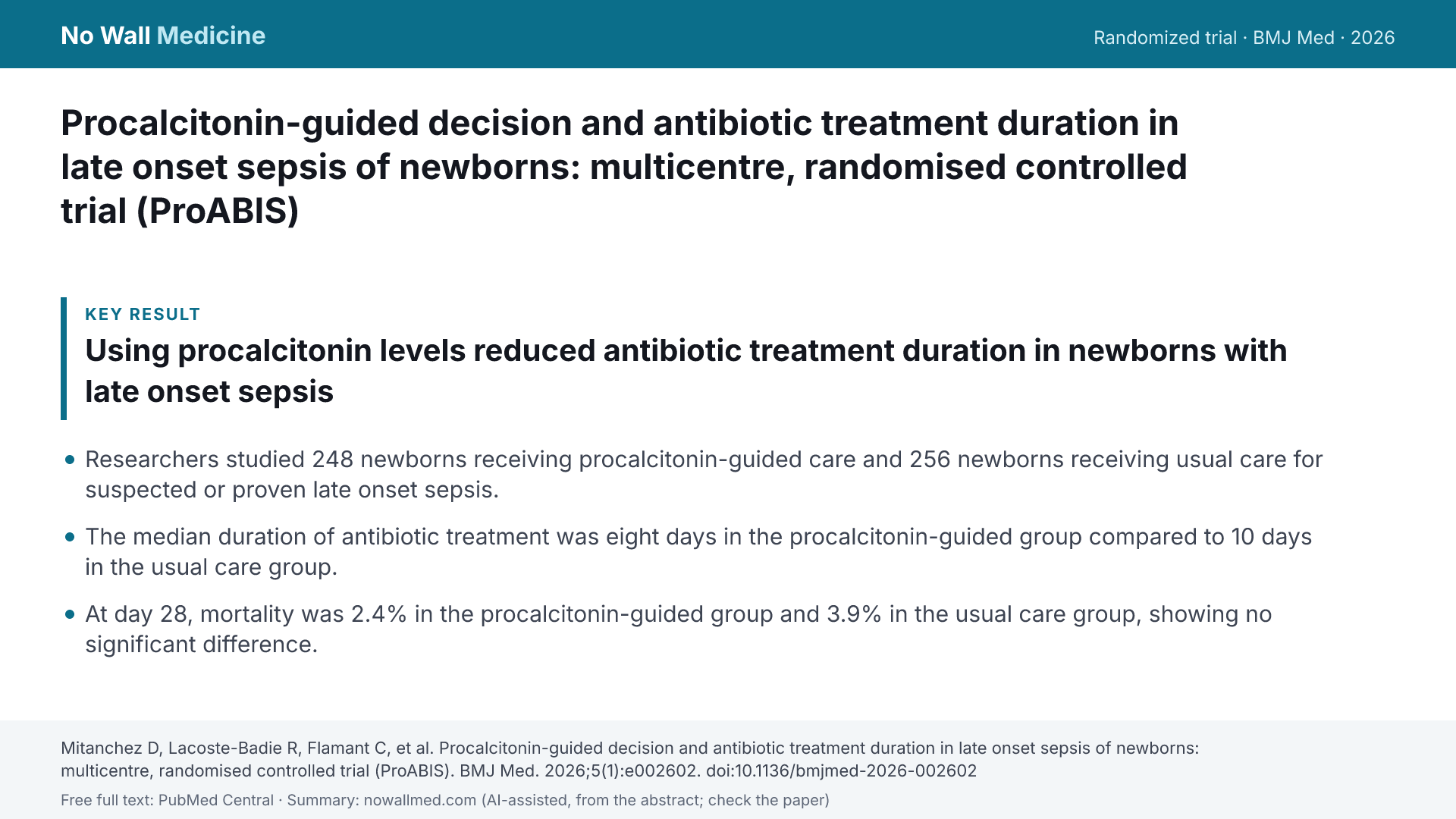
Using procalcitonin levels reduced antibiotic treatment duration in newborns with late onset sepsis
Procalcitonin-guided decision and antibiotic treatment duration in late onset sepsis of newborns: multicentre, randomised controlled trial (ProABIS)
Key points
- Researchers studied 248 newborns receiving procalcitonin-guided care and 256 newborns receiving usual care for suspected or proven late onset sepsis.
- The median duration of antibiotic treatment was eight days in the procalcitonin-guided group compared to 10 days in the usual care group.
- At day 28, mortality was 2.4% in the procalcitonin-guided group and 3.9% in the usual care group, showing no significant difference.
Headline and key points written with AI from the paper’s abstract, with every number checked against it. Read the paper before relying on them.
Was this summary helpful?
Abstract
Objective
To assess whether procalcitonin-guided decision making can safely reduce the duration of antibiotic treatment in neonatal late onset sepsis. Design
Prospective multicentre, randomised open label trial. Setting
33 level 3 and level 2B neonatology departments in France. Participants
Newborn babies born after 24 weeks' gestation, of postconceptional age 24-45 weeks and after 4 days of life, weighing more than 700 g, with suspected or proven late onset sepsis, requiring antibiotics for more than 48 hours, and without meningitis, septic shock, and deep-seated infection. Interventions
Participants were randomly assigned to procalcitonin-guided or usual care antibiotic treatment. In the procalcitonin-guided group, procalcitonin concentration was measured at randomisation and then every two days. A non-binding recommendation to discontinue antibiotics was given if the procalcitonin concentration was 0.5 µg/L or lower. In the usual care group, treatment was provided according to local protocols. Main outcome measures
The primary outcome was the duration of antibiotic treatment (under the superiority hypothesis). The key secondary outcome was non-inferiority for mortality (margin 3%) at day 28 after randomisation. Results
Between February 2019 and February 2023, 248 newborns were randomised to the procalcitonin-guided group and 256 to the usual care group. In the intention-to-treat analysis, the median duration of antibiotic treatment was eight days (interquartile range (IQR) 5.0-12.0) in the procalcitonin-guided group versus 10 days (8.0-13.0) in the usual care group (absolute difference between groups -2.0 (IQR -3.8 to -1.0), P<0.001). At day 28, the proportion of death was six of 248 newborns (2.4%) in the procalcitonin-guided group versus 10 of 256 (3.9%) in the usual care group (absolute difference between groups -1.5% (95% confidence interval (CI) -5.0 to 1.8). The proportion of recurrence was seven of 248 (2.8%) newborns in the procalcitonin-guided group versus 10 (3.9%) of 256 in the usual care group (absolute difference between groups -1.1% (95% CI -4.6 to 2.3). Conclusion
In this study population, the use of procalcitonin significantly reduced the duration of antibiotic treatment in neonatal late onset sepsis, without increasing mortality or serious adverse events. Trial registration
NCT03730636.
Abstract reproduced under the article’s CC BY NC licence.
Headline, design, result, key points, caveat and citation as plain text.
Cite this article
Mitanchez D, Lacoste-Badie R, Flamant C, et al. Procalcitonin-guided decision and antibiotic treatment duration in late onset sepsis of newborns: multicentre, randomised controlled trial (ProABIS). BMJ Med. 2026;5(1):e002602. doi:10.1136/bmjmed-2026-002602
Spotted a mistake? Suggest a correction