Enhanced rehabilitation transition program improved self-rated performance and satisfaction for stroke survivors
Process Evaluation of a Randomized Controlled Trial of an Enhanced Rehabilitation Transition Program for Stroke Survivors
Process evaluation of a randomized controlled trialBenefit found
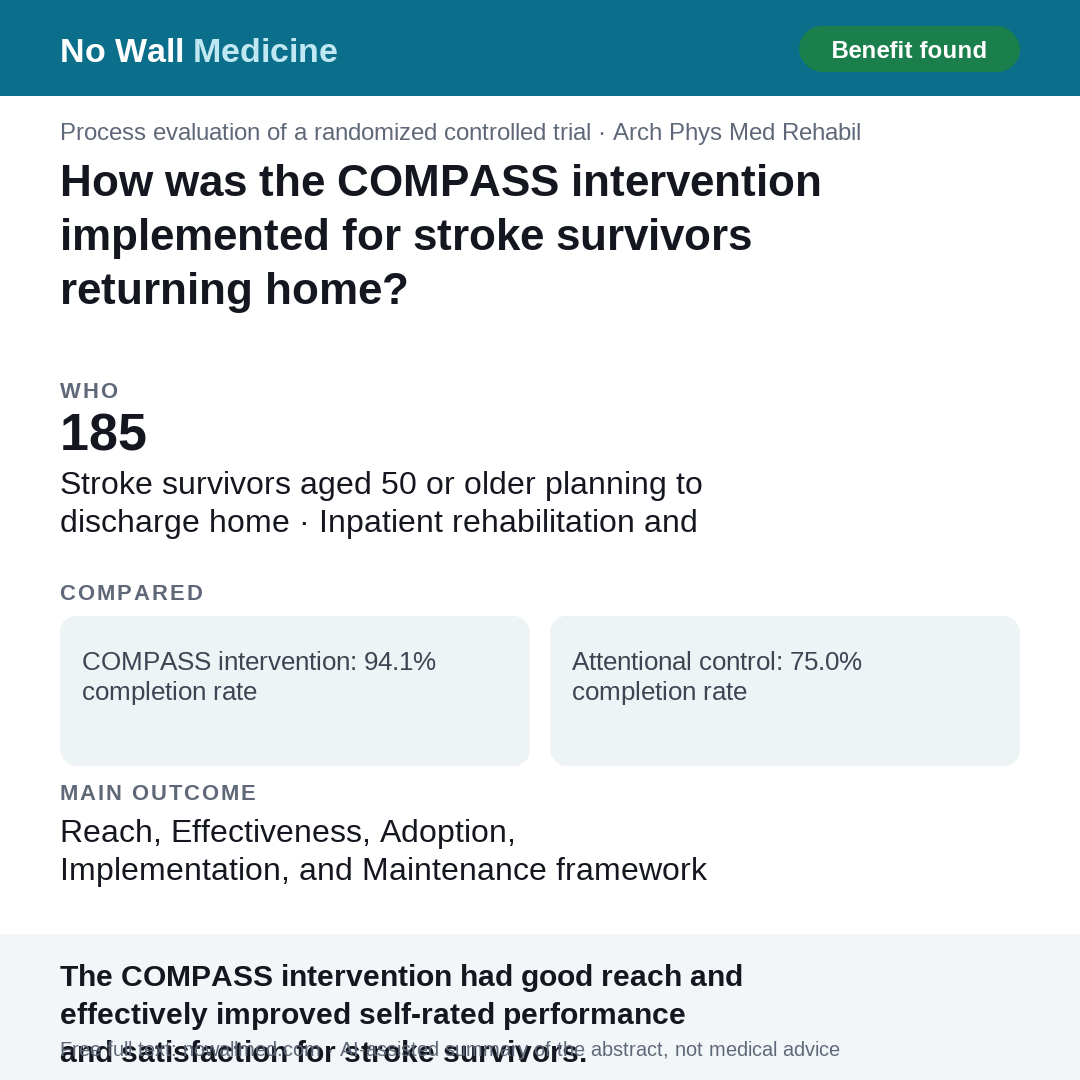
How was the COMPASS intervention implemented for stroke survivors returning home?
Who
185
Stroke survivors aged 50 or older planning to discharge home · Inpatient rehabilitation and participants' homes
Compared
COMPASS intervention: 94.1% completion rate
Attentional control: 75.0% completion rate
Main outcome
Reach, Effectiveness, Adoption, Implementation, and Maintenance framework components
Bottom line: The COMPASS intervention had good reach and effectively improved self-rated performance and satisfaction for stroke survivors.
Arch Phys Med Rehabil · 2025-11-06Download image
Clinical question: How was the COMPASS intervention implemented for stroke survivors returning home?
Why it matters: It was unknown how to effectively implement a transition program that helps stroke survivors move from inpatient rehabilitation to their homes.
In absolute numbers
COMPASS intervention: 94.1% · Attentional control: 75% → a difference of 19.1 percentage points, so about 6 people would need the treatment for 1 more to benefit (number needed to treat) over the trial’s follow-up.
Worked out by us from the two group results above, not reported by the authors. Check the paper for the exact outcome and timing.
Key points
- Researchers evaluated 185 stroke survivors aged 50 or older who were randomized to receive either the COMPASS intervention or stroke education.
- At 12-month follow-up, COMPASS participants showed greater improvements in self-rated performance, satisfaction, and barrier severity compared to the education group.
- The COMPASS intervention involved an average of 5.5 home visits and a median cost of $544 for equipment and labor.
Headline and key points written with AI from the paper’s abstract, with every number checked against it. Read the paper before relying on them.
Was this summary helpful?
Subject terms
Cite this article
Bollinger RM, Krauss MJ, Holden BM, Somerville EK, Hollingsworth H, Carter A. Process Evaluation of a Randomized Controlled Trial of an Enhanced Rehabilitation Transition Program for Stroke Survivors. Arch Phys Med Rehabil. 2025. doi:10.1016/j.apmr.2025.10.016
Spotted a mistake? Suggest a correction
Top studies every Monday
The week’s key trials and guidelines in your specialties, plus any topics you follow. By email, free.
Get the weekly digest