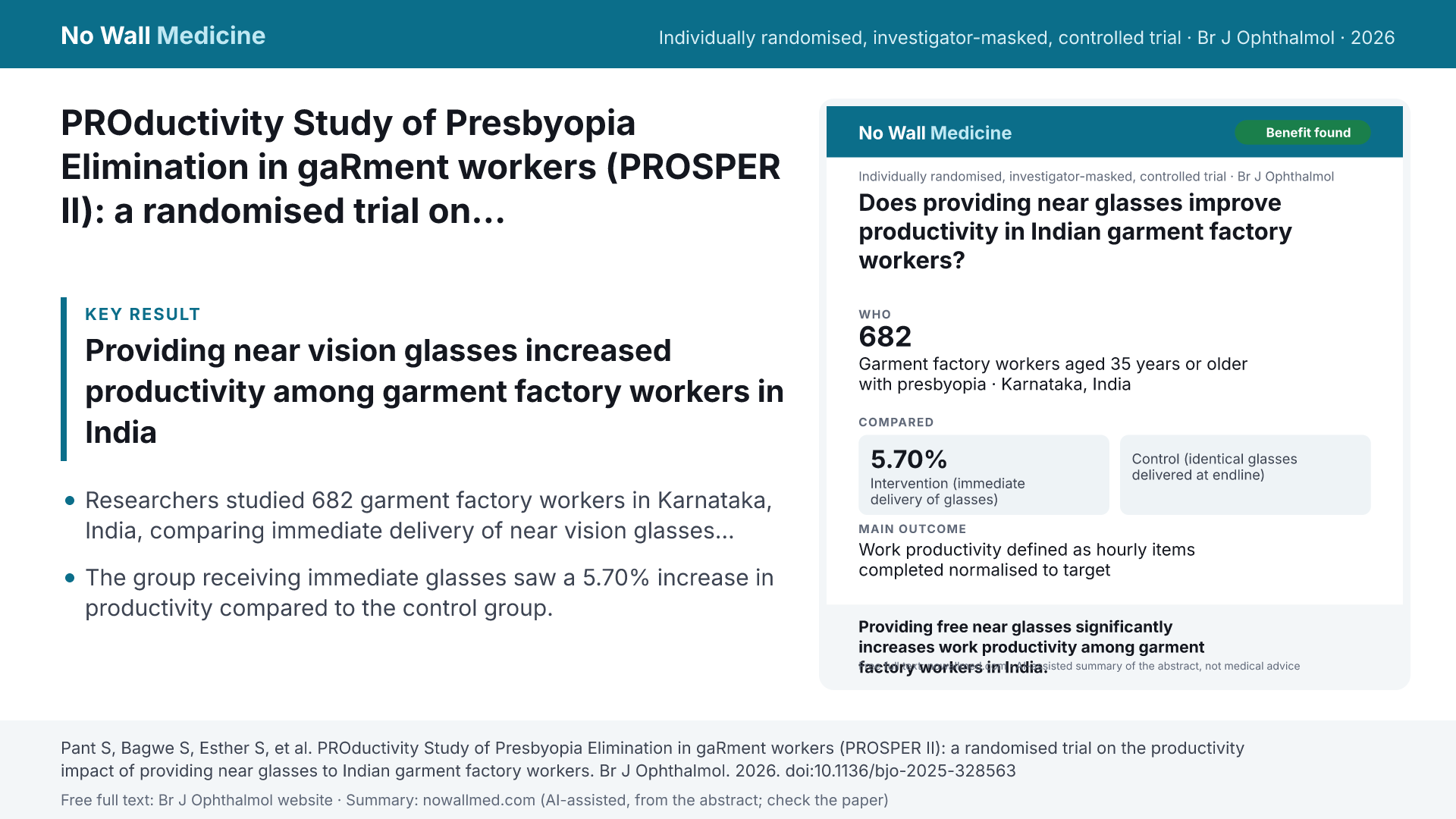
Providing near vision glasses increased productivity among garment factory workers in India
PROductivity Study of Presbyopia Elimination in gaRment workers (PROSPER II): a randomised trial on the productivity impact of providing near glasses to Indian garment factory workers
Individually randomised, investigator-masked, controlled trialBenefit found
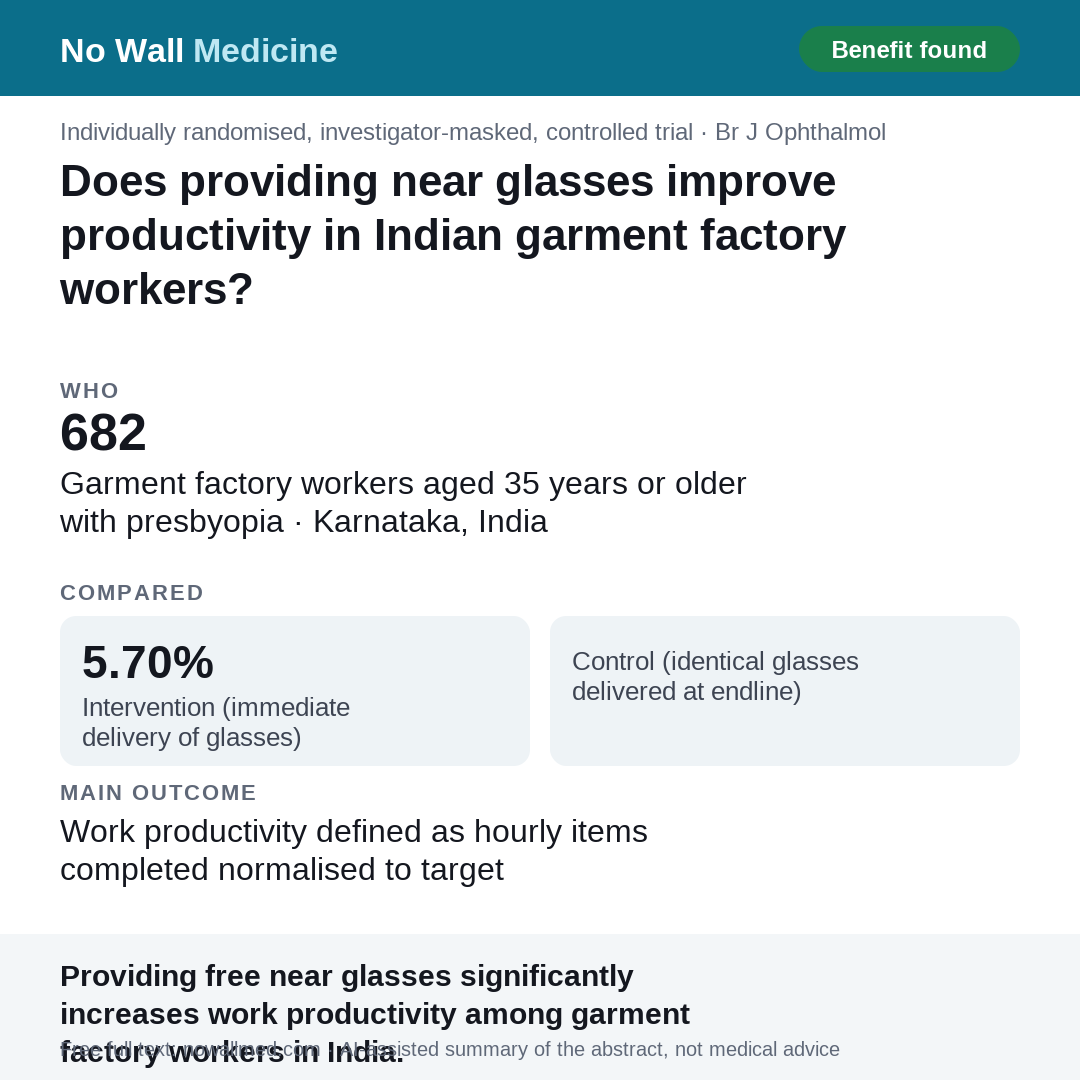
Does providing near glasses improve productivity in Indian garment factory workers?
Who
682
Garment factory workers aged 35 years or older with presbyopia · Karnataka, India
Compared
5.70%Intervention (immediate delivery of glasses) (95% CI 1.04% to 10.4%)
Control (identical glasses delivered at endline)
Main outcome
Work productivity defined as hourly items completed normalised to target
Result: 5.70% (95% CI 1.04% to 10.4%)
Bottom line: Providing free near glasses significantly increases work productivity among garment factory workers in India.
Br J Ophthalmol · 2026-04-27Download image
Clinical question: Does providing near glasses improve productivity in Indian garment factory workers?
Why it matters: While vision correction improves productivity in agriculture and crafts, its effects on productivity in manufacturing settings have remained unstudied.
Key points
- Researchers studied 682 garment factory workers in Karnataka, India, comparing immediate delivery of near vision glasses to receiving them at the end of the study.
- The group receiving immediate glasses saw a 5.70% increase in productivity compared to the control group.
- Workers in the lowest skill grade had significantly lower productivity compared to those in the highest skill grade.
Headline and key points written with AI from the paper’s abstract, with every number checked against it. Read the paper before relying on them.
Was this summary helpful?
Abstract
Background
Correction for presbyopia, the world's most common cause of vision impairment, significantly improves productivity in agriculture and crafts. However, effects on productivity in manufacturing remain unstudied. Methods
PROSPER II was an individually randomised, investigator-masked, controlled trial conducted in Karnataka, India. Eligible garment factory workers aged ≥35 years with presbyopia (better-eye near vision N6.3 or worse (Snellen 6/12), correctable to N4 (Snellen 6/7.5)) and not owning glasses were randomised (1:1) to intervention (immediate delivery of glasses suited to working distance) or control (identical glasses delivered at endline). The primary outcome was work productivity, defined as the hourly number of items completed, normalised to a factory target rate, over 12 weeks. Secondary outcomes included glasses wear adherence, visual function, and ROI. Results
Among 4990 potentially eligible workers, 3648 (73.1%) underwent eye examinations, and 682 (18.7%, mean age 41.0 years, 99.0% female) were enrolled and randomised (intervention: n=344, 50.4%; control: n=338, 49.6%). All participants completed 12-week observation. In panel regression models for the pre-specified primary analysis, intervention group assignment (difference=0.0325, 95% CI 0.006 to 0.060, p=0.017) was significantly associated with greater productivity. Compared with workers in the highest skill grade (A), those in the lowest grade (C) had significantly lower productivity (difference=-0.049, 95% CI -0.087 to -0.011, p=0.011). Glasses increased productivity in the intervention group relative to controls by 5.70% (95% CI 1.04% to 10.4%). Conclusions
Free near glasses confer a significant productivity benefit in this factory setting, and are substantially less costly than other successful interventions such as management training. Trial registration number
NCT04629820.
Abstract reproduced under the article’s CC BY NC licence.
Cite this article
Pant S, Bagwe S, Esther S, et al. PROductivity Study of Presbyopia Elimination in gaRment workers (PROSPER II): a randomised trial on the productivity impact of providing near glasses to Indian garment factory workers. Br J Ophthalmol. 2026. doi:10.1136/bjo-2025-328563
Spotted a mistake? Suggest a correction