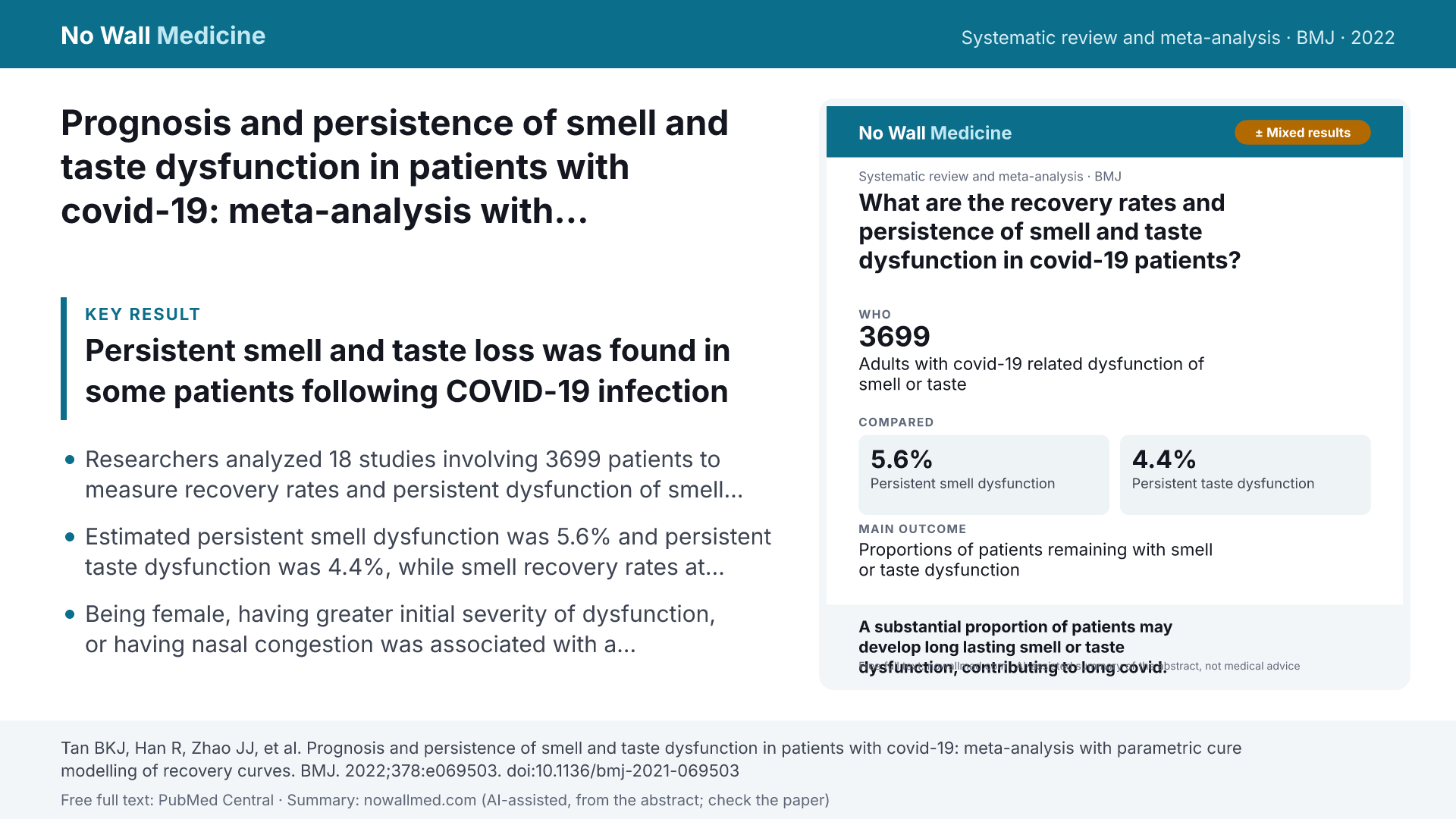
Persistent smell and taste loss was found in some patients following COVID-19 infection
Prognosis and persistence of smell and taste dysfunction in patients with covid-19: meta-analysis with parametric cure modelling of recovery curves
Systematic review and meta-analysisMixed results
What are the recovery rates and persistence of smell and taste dysfunction in covid-19 patients?
Who
3699
Adults with covid-19 related dysfunction of smell or taste
Compared
5.6%Persistent smell dysfunction (95% confidence interval 2.7% to 11.0%)
4.4%Persistent taste dysfunction (1.2% to 14.6%)
Main outcome
Proportions of patients remaining with smell or taste dysfunction
Bottom line: A substantial proportion of patients may develop long lasting smell or taste dysfunction, contributing to long covid.
Limitation: Sensitivity analyses suggest persistent dysfunction rates could be underestimates.
BMJ · 2022-07-27 · Save PNG
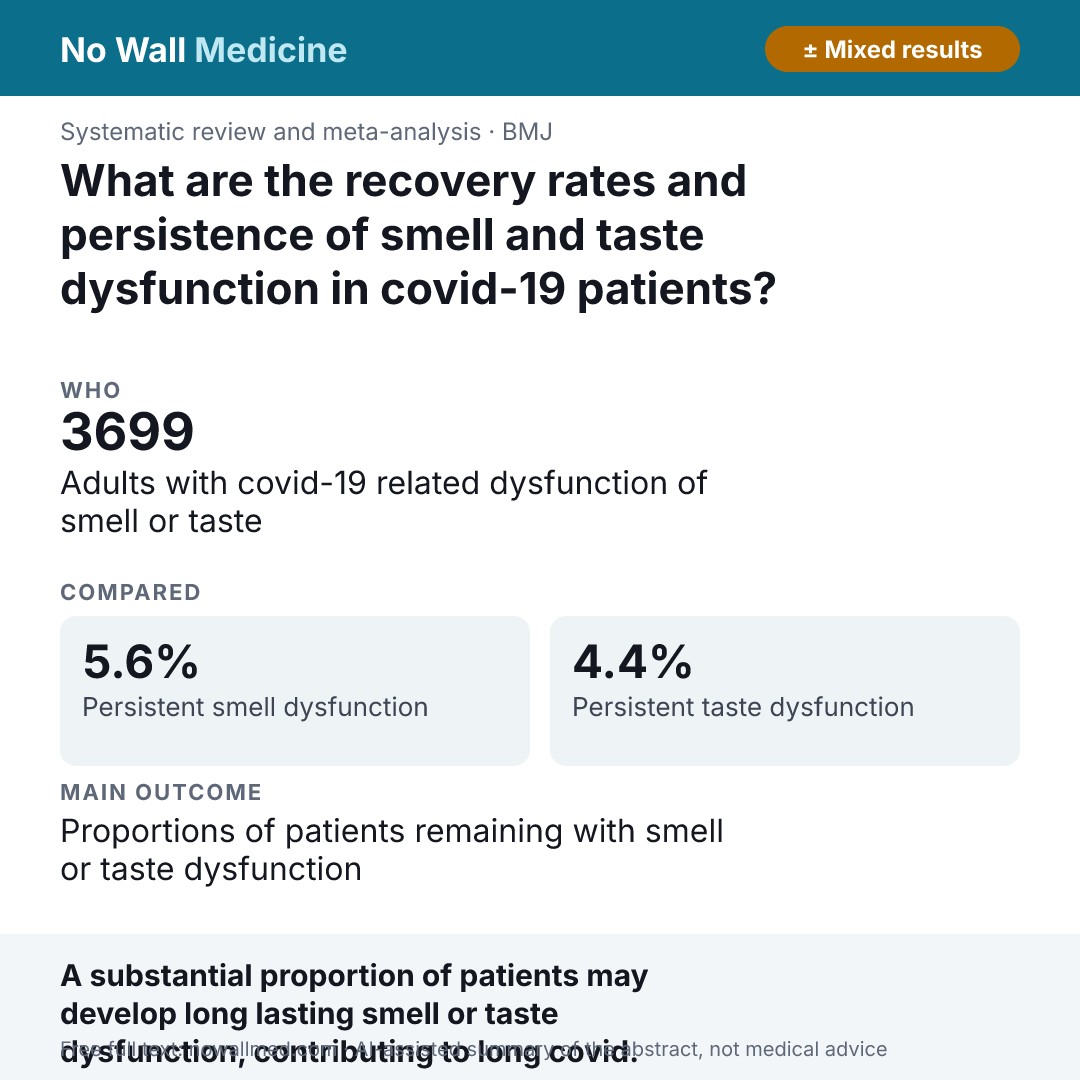
Clinical question: What are the recovery rates and persistence of smell and taste dysfunction in covid-19 patients?
Key points
- Researchers analyzed 18 studies involving 3699 patients to measure recovery rates and persistent dysfunction of smell and taste after COVID-19.
- Estimated persistent smell dysfunction was 5.6% and persistent taste dysfunction was 4.4%, while smell recovery rates at 180 days were 95.7%.
- Being female, having greater initial severity of dysfunction, or having nasal congestion was associated with a lower likelihood of recovering the sense of smell.
Limitation the authors note: Sensitivity analyses suggest that the estimated proportions of persistent dysfunction could be underestimates.
Headline and key points written with AI from the paper’s abstract, with every number checked against it. Read the paper before relying on them.
Was this summary helpful?
Abstract
Objective
To clarify in patients with covid-19 the recovery rate of smell and taste, proportion with persistent dysfunction of smell and taste, and prognostic factors associated with recovery of smell and taste. Design
Systematic review and meta-analysis. Data sources
PubMed, Embase, Scopus, Cochrane Library, and medRxiv from inception to 3 October 2021. Review methods
Two blinded reviewers selected observational studies of adults (≥18 years) with covid-19 related dysfunction of smell or taste. Descriptive prognosis studies with time-to-event curves and prognostic association studies of any prognostic factor were included. Data extraction and synthesis
Two reviewers extracted data, evaluated study bias using QUIPS, and appraised evidence quality using GRADE, following PRISMA and MOOSE reporting guidelines. Using iterative numerical algorithms, time-to-event individual patient data (IPD) were reconstructed and pooled to retrieve distribution-free summary survival curves, with recovery rates reported at 30 day intervals for participants who remained alive. To estimate the proportion with persistent smell and taste dysfunction, cure fractions from Weibull non-mixture cure models of plateaued survival curves were logit transformed and pooled in a two stage meta-analysis. Conventional aggregate data meta-analysis was performed to explore unadjusted associations of prognostic factors with recovery. Main outcome measures
The primary outcomes were the proportions of patients remaining with smell or taste dysfunction. Secondary outcomes were the odds ratios of prognostic variables associated with recovery of smell and taste. Results
18 studies (3699 patients) from 4180 records were included in reconstructed IPD meta-analyses. Risk of bias was low to moderate; conclusions remained unaltered after exclusion of four high risk studies. Evidence quality was moderate to high. Based on parametric cure modelling, persistent self-reported smell and taste dysfunction could develop in an estimated 5.6% (95% confidence interval 2.7% to 11.0%, I2=70%, τ2=0.756, 95% prediction interval 0.7% to 33.5%) and 4.4% (1.2% to 14.6%, I2=67%, τ2=0.684, 95% prediction interval 0.0% to 49.0%) of patients, respectively. Sensitivity analyses suggest these could be underestimates. At 30, 60, 90, and 180 days, respectively, 74.1% (95% confidence interval 64.0% to 81.3%), 85.8% (77.6% to 90.9%), 90.0% (83.3% to 94.0%), and 95.7% (89.5% to 98.3%) of patients recovered their sense of smell (I2=0.0-77.2%, τ2=0.006-0.050) and 78.8% (70.5% to 84.7%), 87.7% (82.0% to 91.6%), 90.3% (83.5% to 94.3%), and 98.0% (92.2% to 95.5%) recovered their sense of taste (range of I2=0.0-72.1%, τ2=0.000-0.015). Women were less likely to recover their sense of smell (odds ratio 0.52, 95% confidence interval 0.37 to 0.72, seven studies, I2=20%, τ2=0.0224) and taste (0.31, 0.13 to 0.72, seven studies, I2=78%, τ2=0.5121) than men, and patients with greater initial severity of dysfunction (0.48, 0.31 to 0.73, five studies, I2=10%, τ2<0.001) or nasal congestion (0.42, 0.18 to 0.97, three studies, I2=0%, τ2<0.001) were less likely to recover their sense of smell. Conclusions
A substantial proportion of patients with covid-19 might develop long lasting change in their sense of smell or taste. This could contribute to the growing burden of long covid. Systematic review registration
PROSPERO CRD42021283922.
Abstract reproduced under the article’s CC BY NC licence.
Subject terms
Headline, design, result, key points, caveat and citation as plain text.
Cite this article
Tan BKJ, Han R, Zhao JJ, et al. Prognosis and persistence of smell and taste dysfunction in patients with covid-19: meta-analysis with parametric cure modelling of recovery curves. BMJ. 2022;378:e069503. doi:10.1136/bmj-2021-069503
Spotted a mistake? Suggest a correction