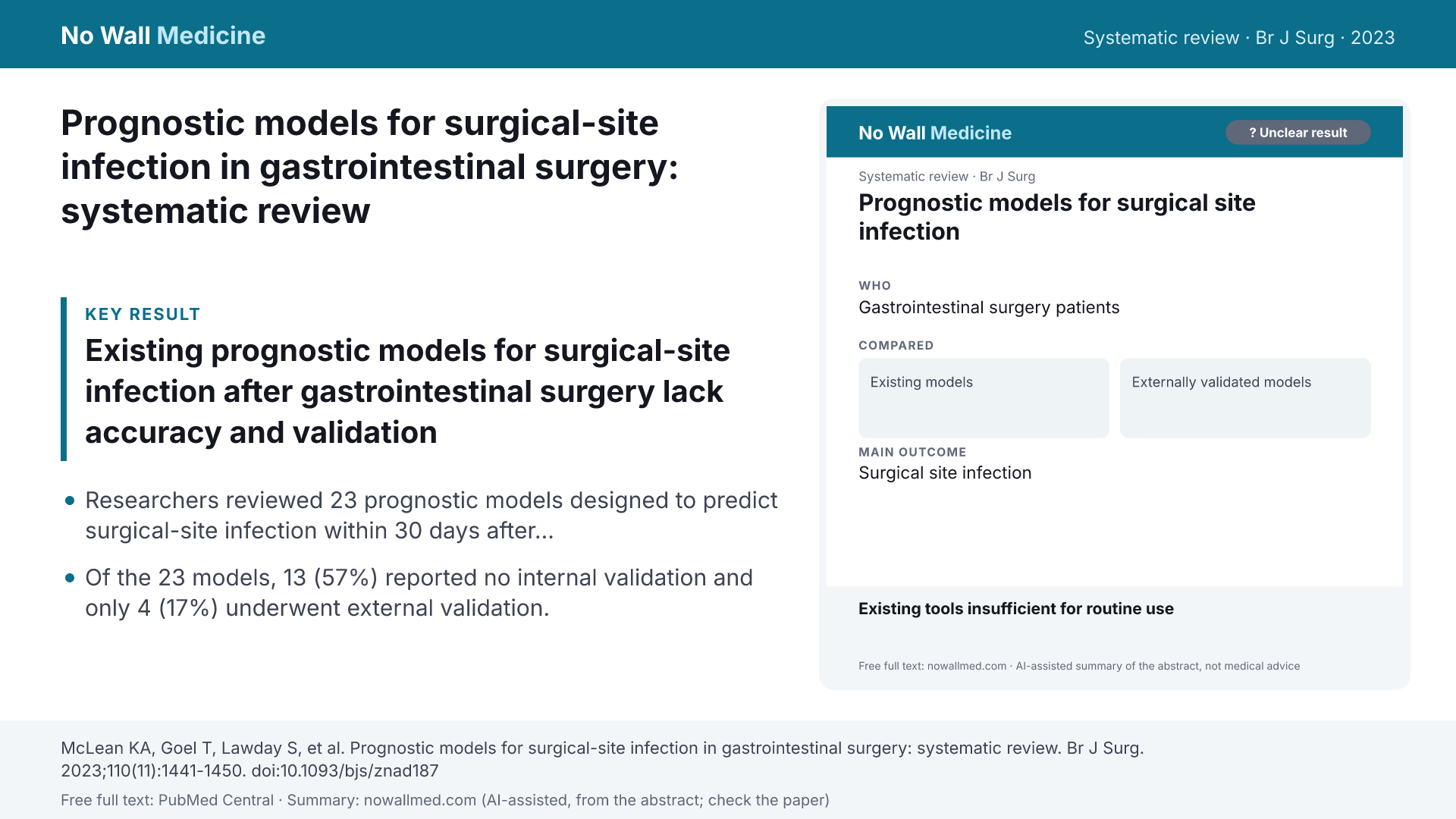
Existing prognostic models for surgical-site infection after gastrointestinal surgery lack accuracy and validation
Prognostic models for surgical-site infection in gastrointestinal surgery: systematic review
Systematic reviewUnclear result
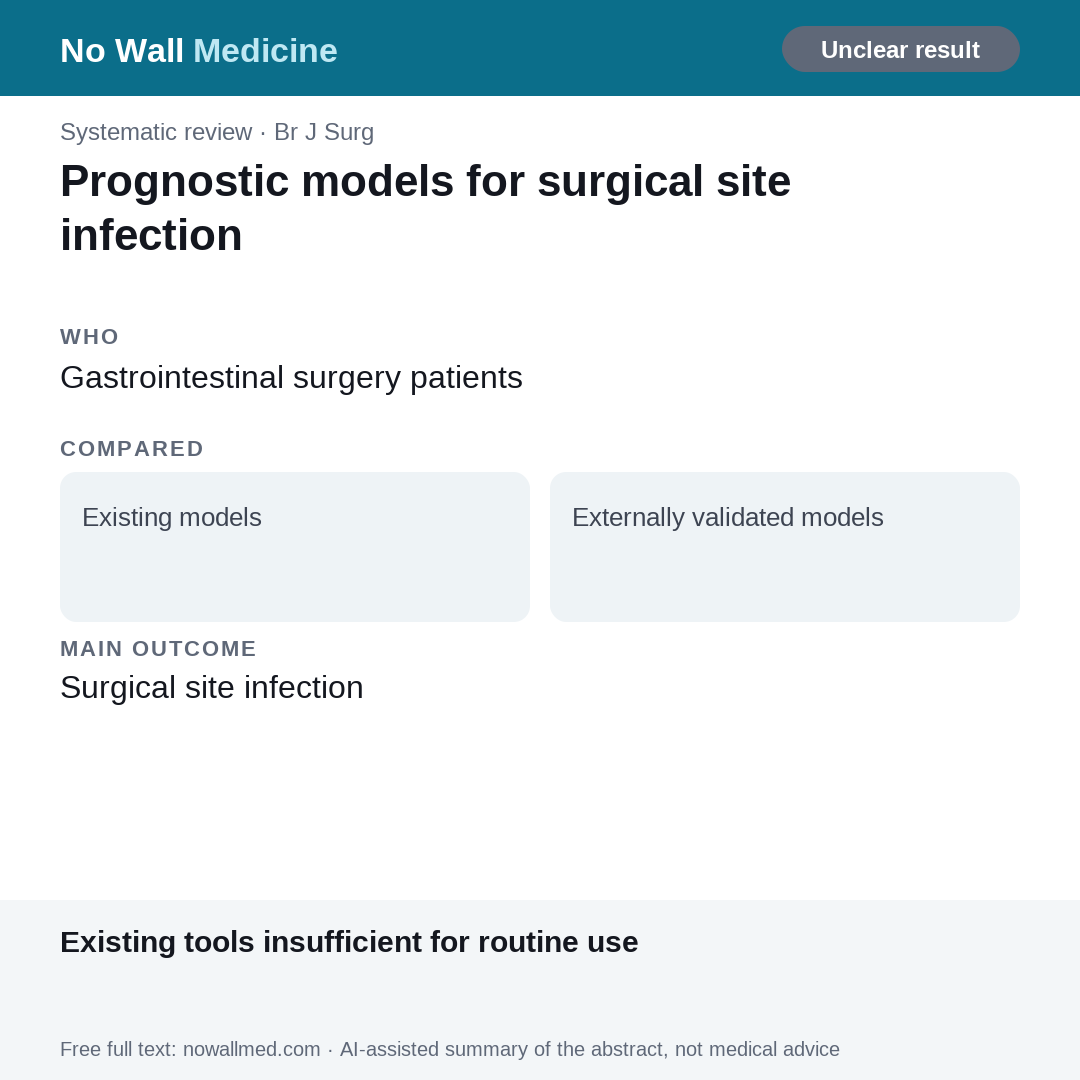
Prognostic models for surgical site infection
Who
Gastrointestinal surgery patients
Compared
Existing models
Externally validated models
Main outcome
Surgical site infection
Bottom line: Existing tools insufficient for routine use
Limitation: Substantial heterogeneity and bias
Br J Surg · 2023-07-12Download image
Key points
- Researchers reviewed 23 prognostic models designed to predict surgical-site infection within 30 days after gastrointestinal surgery.
- Of the 23 models, 13 (57%) reported no internal validation and only 4 (17%) underwent external validation.
- None of the four externally validated models showed good discrimination, defined as an area under the receiver operating characteristic curve greater than or equal to 0.7.
Limitation the authors note: All models demonstrated a high risk of bias due to the analytic approach and had low applicability to an undifferentiated gastrointestinal surgical population.
Headline and key points written with AI from the paper’s abstract, with every number checked against it. Read the paper before relying on them.
Was this summary helpful?
Subject terms
Headline, design, result, key points, caveat and citation as plain text.
Cite this article
McLean KA, Goel T, Lawday S, et al. Prognostic models for surgical-site infection in gastrointestinal surgery: systematic review. Br J Surg. 2023. doi:10.1093/bjs/znad187
Spotted a mistake? Suggest a correction