Extranodal extension and large lymph nodes linked to lower survival in skin cancer patients
Prognostic Subgroups for Disease-Free Survival With Cutaneous Squamous Cell Carcinoma of the Head and Neck: A Secondary Analysis of a Randomized Clinical Trial
Secondary analysis of a randomized phase 3 trialBenefit found
Which subgroups have poor disease-free survival following postoperative radiotherapy?
Who
310
Patients with high-risk cutaneous squamous cell carcinoma of the head and neck · Multiple centers in Australia
Compared
56%High-risk group (95% CI, 45%-66%)
75%Non-high-risk group (95% CI, 68%-81%)
Main outcome
Disease-free survival
Result: hazard ratio 2.0 (95% CI, 1.3-3.1)
Bottom line: Patients with extranodal extension and nodal size ≥22 mm have significantly worse disease-free survival.
JAMA Otolaryngol · 2025-08-30Download image
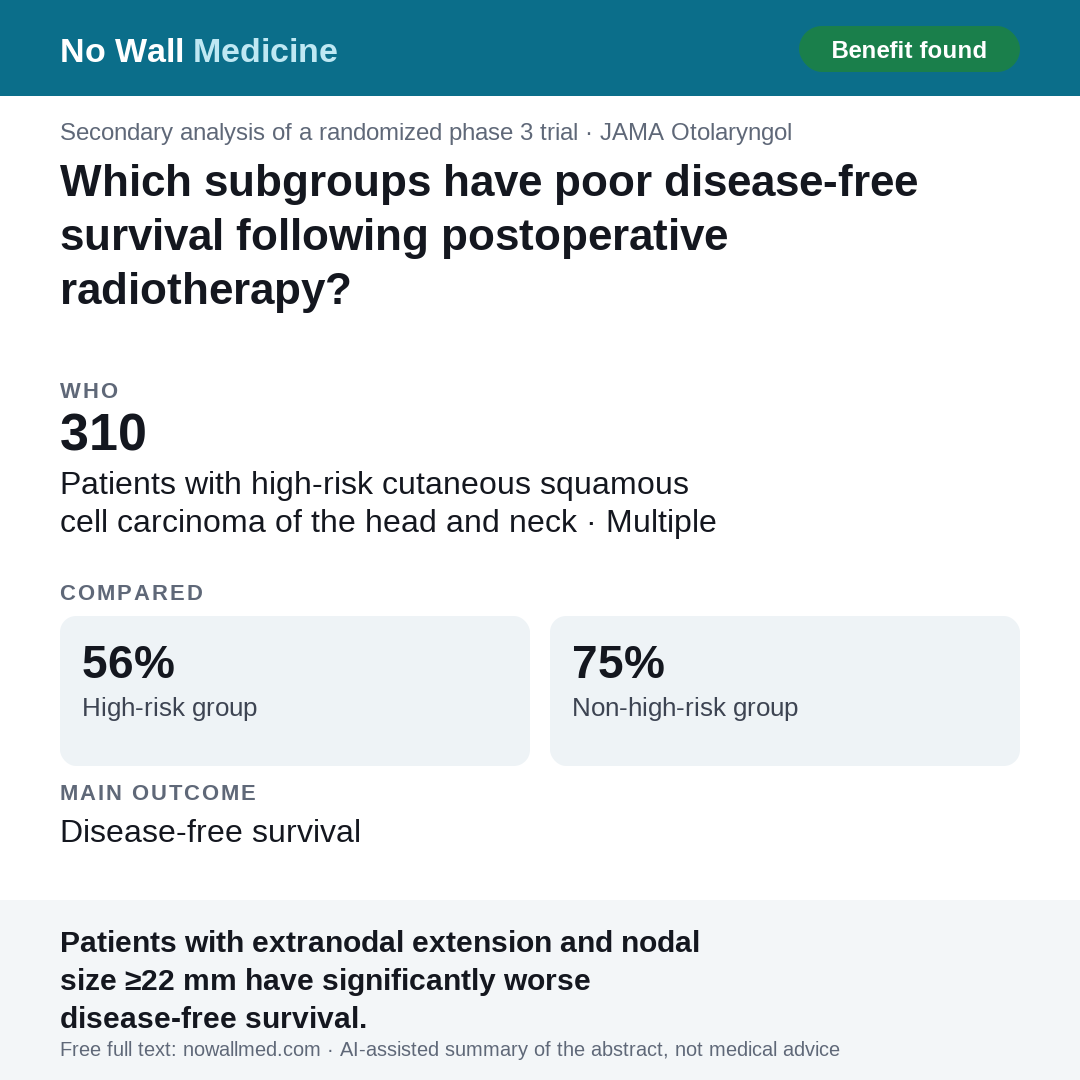
Clinical question: Which subgroups have poor disease-free survival following postoperative radiotherapy?
Why it matters: Identifying specific patient subgroups with poor disease-free survival is necessary to optimize future adjuvant treatment strategies for cutaneous squamous cell carcinoma.
Key points
- Researchers analyzed 310 patients from a randomized trial who received postoperative radiotherapy for high-risk cutaneous squamous cell carcinoma of the head and neck.
- A high-risk group with extranodal extension and lymph nodes 22 mm or larger had a 5-year disease-free survival rate of 56%.
- The high-risk group had a 5-year overall survival rate of 59% compared to 85% in the non-high-risk group.
Headline and key points written with AI from the paper’s abstract, with every number checked against it. Read the paper before relying on them.
Was this summary helpful?
Subject terms
Cite this article
Porceddu SV, Connolly E, Bressel M, Wratten C, Liu HY, Rischin D. Prognostic Subgroups for Disease-Free Survival With Cutaneous Squamous Cell Carcinoma of the Head and Neck: A Secondary Analysis of a Randomized Clinical Trial. JAMA Otolaryngol. 2025. doi:10.1001/jamaoto.2025.2110
Spotted a mistake? Suggest a correction
Top studies every Monday
The week’s key trials and guidelines in your specialties, plus any topics you follow. By email, free.
Get the weekly digest