Longer cervical length was associated with lower rates of spontaneous preterm birth in twin pregnancies
Prognostic value of cervical length for spontaneous preterm birth in asymptomatic women with twin pregnancy: meta-analysis of individual participant data
Obstetrics & GynecologyAdult and pediatric
Meta-analysis of individual participant dataKey finding
What is the prognostic value of cervical length for spontaneous preterm birth in twin pregnancy?
Who
6437
Asymptomatic women with twin pregnancy · Eight countries
Compared
Each 1 mm increase in cervical length: 4.0% reduction in spontaneous preterm birth before 37 weeks
Each 1 mm increase in cervical length: 6.8% reduction in spontaneous preterm birth before 34 weeks
Main outcome
Spontaneous preterm birth before 37 weeks
Result: hazard ratio 0.96 (95% confidence interval 0.95 to 0.97)
Bottom line: Each 1 mm increase in cervical length is associated with a reduced risk of spontaneous preterm birth in twin pregnancies.
Limitation: No specific cervical length can reliably predict or exclude all spontaneous preterm births.
BMJ Med · 2025-04-16 · Save PNG
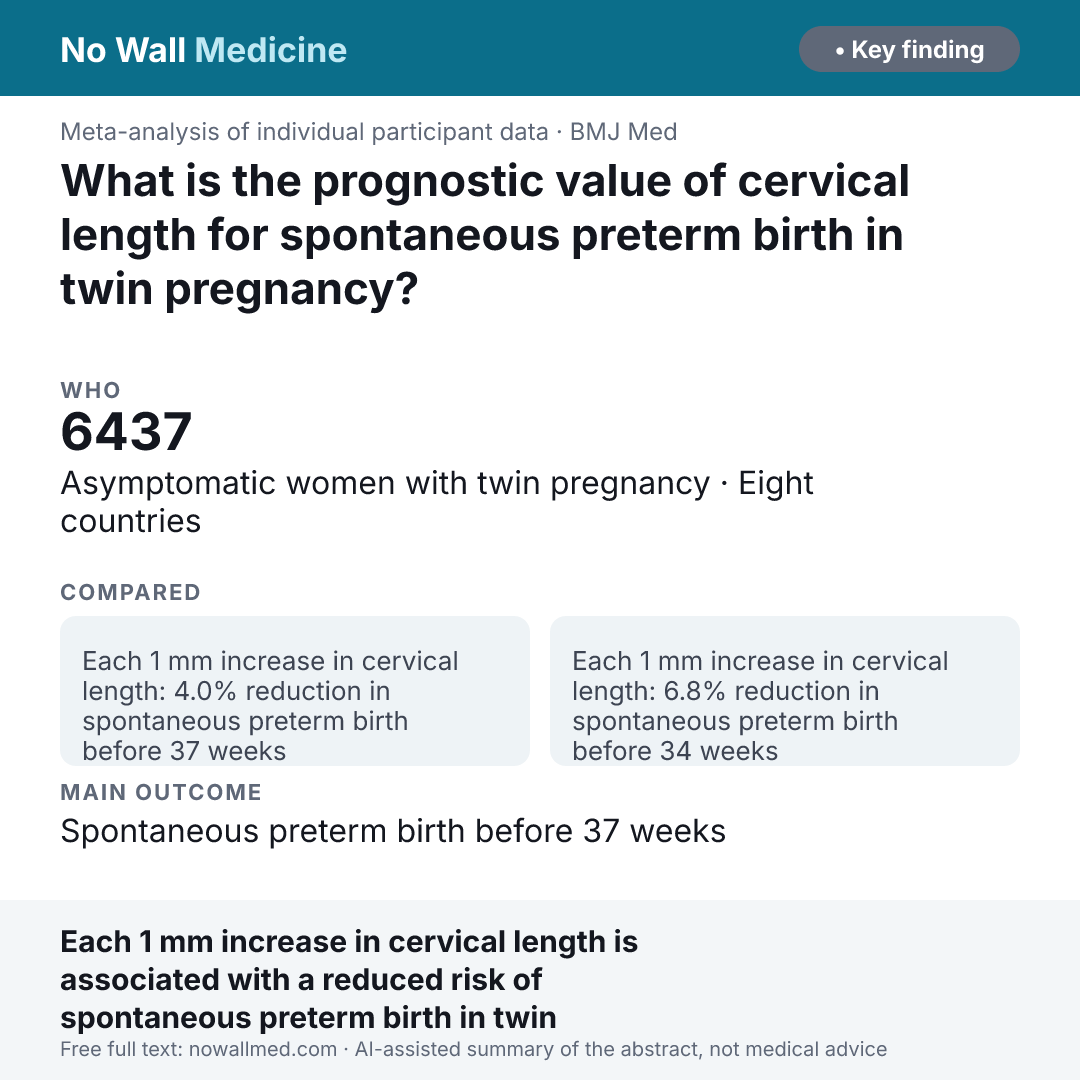
Clinical question: What is the prognostic value of cervical length for spontaneous preterm birth in twin pregnancy?
Why it matters: The prognostic value of mid-trimester cervical length for spontaneous preterm birth in asymptomatic women with twin pregnancy needed to be quantified.
Key points
- Researchers performed a meta-analysis of individual participant data from 29 studies involving 6437 women with twin pregnancies.
- Each 1 mm increase in cervical length was associated with a 4.0% reduction in spontaneous preterm birth before 37 weeks (hazard ratio 0.96, 95% confidence interval 0.95 to 0.97).
- A 1 mm increase in cervical length was also associated with a 6.8% reduction in spontaneous preterm birth before 34 weeks (hazard ratio 0.93, 95% confidence interval 0.92 to 0.95).
Headline and key points written with AI from the paper’s abstract, with every number checked against it. Read the paper before relying on them.
Was this summary helpful?
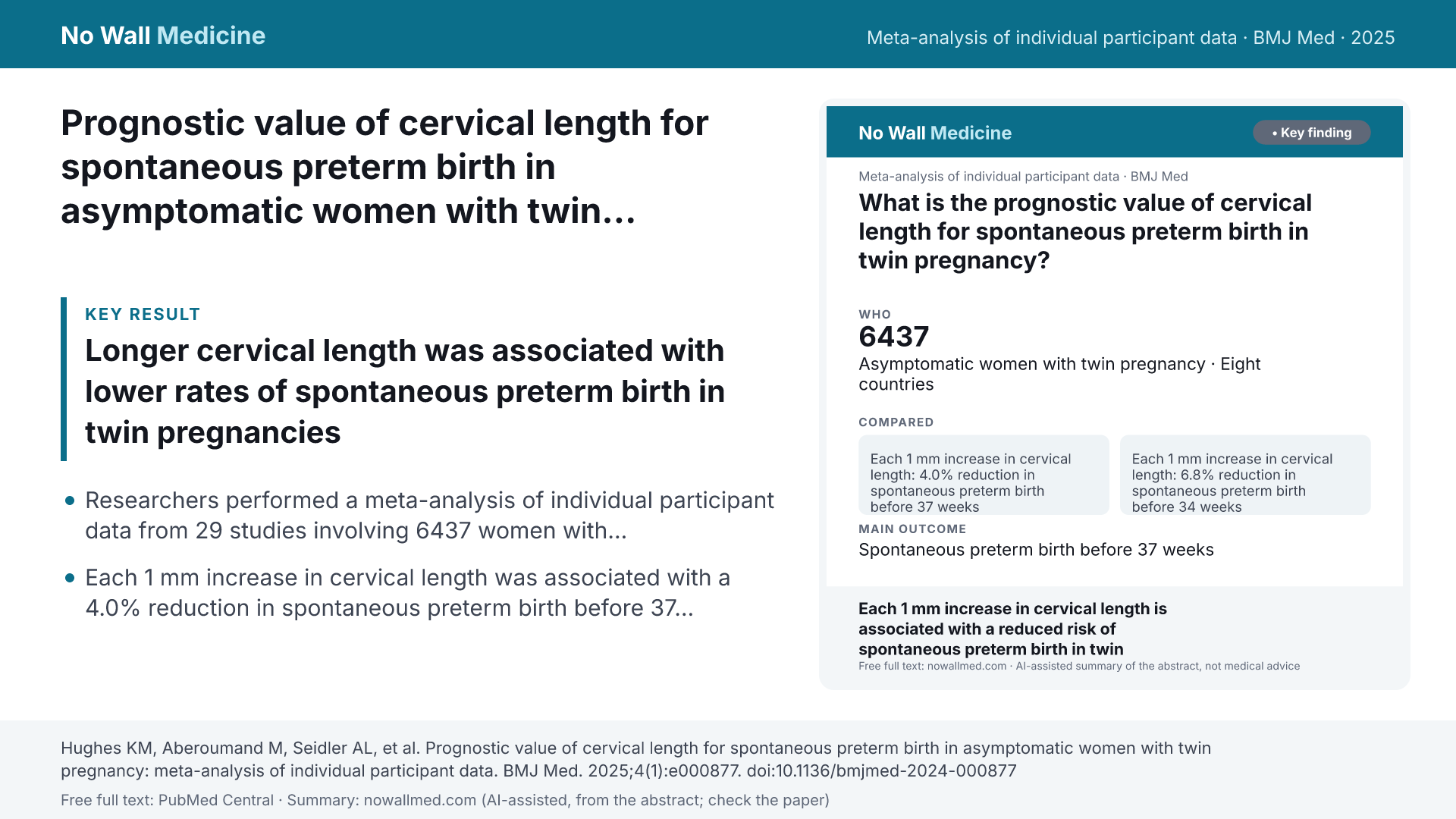
Abstract
Objective
To quantify the prognostic value of mid-trimester cervical length for spontaneous preterm birth in asymptomatic women with twin pregnancy and to assess whether other factors may modify any association. Designs
A two stage meta-analysis of individual participant data in a Cox proportional hazard model was performed using cervical length as a continuous variable. Data sources
Medline, Embase, Cochrane, and LILACS, among others, were searched to identify eligible studies; the search was from 1 January 2000 to 30 September 2020. Risk of bias was assessed with the QUIPS tool. Studies were from eight countries between 2001 and 2018. Eligibility criteria
Individual participant data were sought for eligible studies that reported mid-trimester (defined between 16 and 26 weeks) transvaginal sonographic cervical length and also gestational age at birth in asymptomatic women with twin pregnancy. The primary outcome was spontaneous preterm birth before 37 weeks. Results
Among 29 eligible studies, authors of 17 studies provided individual participant data for 6437 women with a twin pregnancy (69.1% of individual participant data). Mean cervical length measurement was 39 mm (SD=9, range 1-74 mm). 2889 women (44.9%) delivered before 37 weeks' gestation, and 934 (14.9%) delivered before 34 weeks. Each 1 mm increase in cervical length was associated with a 4.0% reduction in the rate of spontaneous preterm birth before 37 weeks (hazard ratio 0.96 (95% confidence interval 0.95 to 0.97)), and a 6.8% reduction in the rate of spontaneous preterm birth before 34 weeks' gestation (0.93 (0.92 to 0.95)). The prognostic value remained stable in models adjusting for different sets of variables. Conclusion
The prognostic value of cervical length for spontaneous preterm birth in twin pregnancy is on a continuous scale. No specific cervical length has been identified that can reliably predict or exclude all spontaneous preterm births. Study registration
CRD42020146987.
Abstract reproduced under the article’s CC BY licence.
Headline, design, result, key points, caveat and citation as plain text.
Cite this article
Hughes KM, Aberoumand M, Seidler AL, et al. Prognostic value of cervical length for spontaneous preterm birth in asymptomatic women with twin pregnancy: meta-analysis of individual participant data. BMJ Med. 2025;4(1):e000877. doi:10.1136/bmjmed-2024-000877
Spotted a mistake? Suggest a correction