Circulating tumor DNA levels are associated with higher recurrence risk in operable lung cancer patients
Prognostic value of circulating tumor DNA in operable non-small cell lung cancer: a systematic review and reconstructed individual patient-data based meta-analysis
Reconstructed individual patient-data based meta-analysisBenefit found
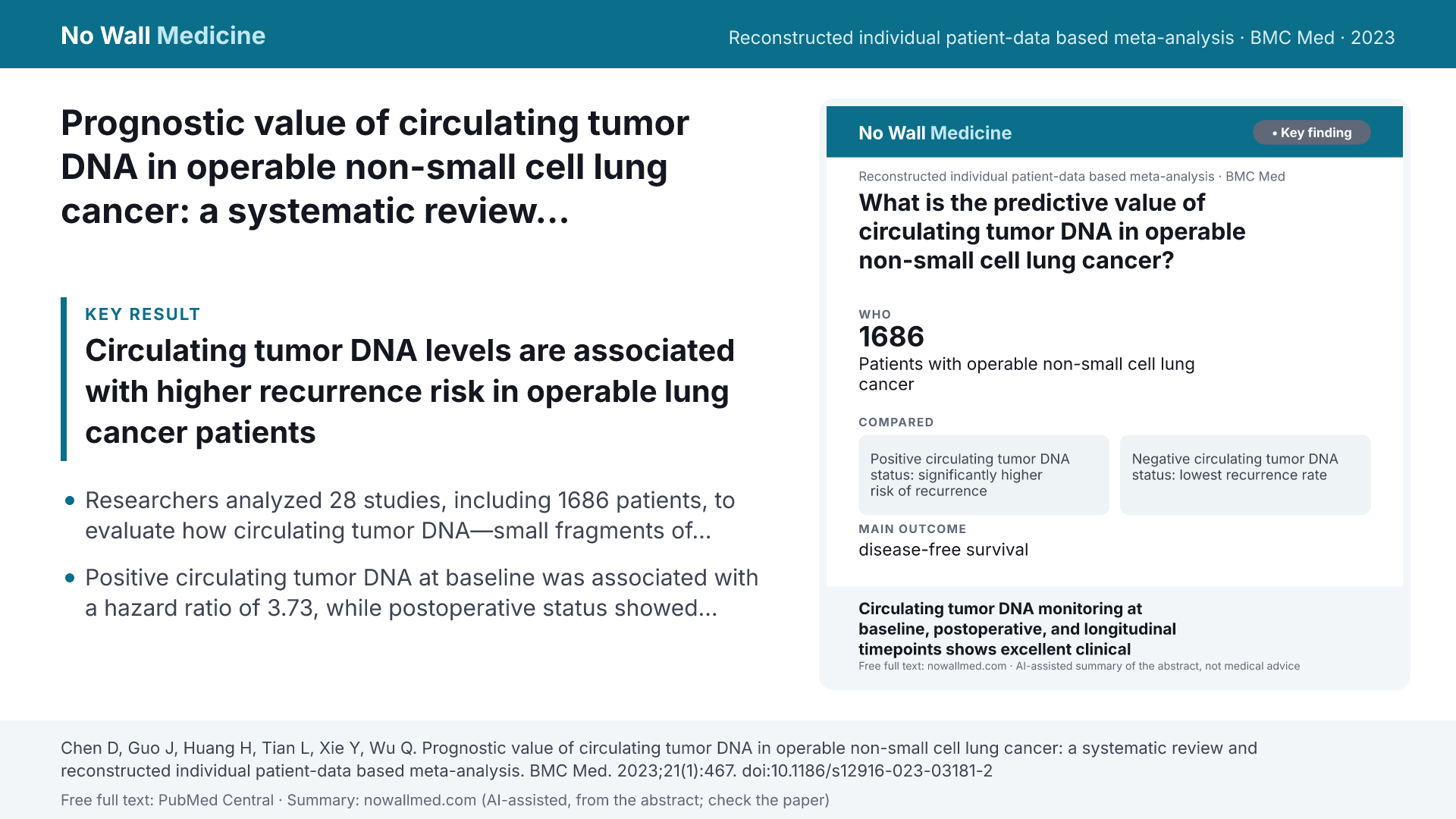
What is the predictive value of circulating tumor DNA in operable non-small cell lung cancer?
Who
1686
Patients with operable non-small cell lung cancer
Compared
Positive circulating tumor DNA status: significantly higher risk of recurrence
Negative circulating tumor DNA status: lowest recurrence rate
Main outcome
disease-free survival
Result: hazard ratio 3.73 (95% CI 2.95 to 4.72) at baseline
Bottom line: Circulating tumor DNA monitoring at baseline, postoperative, and longitudinal timepoints shows excellent clinical significance for predicting recurrence.
BMC Med · 2023-11-27Download image

Clinical question: What is the predictive value of circulating tumor DNA in operable non-small cell lung cancer?
Why it matters: It was unknown how well monitoring circulating tumor DNA at different stages of treatment could predict the risk of cancer returning in patients with operable non-small cell lung cancer.
Key points
- Researchers analyzed 28 studies, including 1686 patients, to evaluate how circulating tumor DNA—small fragments of DNA released by cancer cells into the blood—predicts outcomes in lung cancer.
- Positive circulating tumor DNA at baseline was associated with a hazard ratio of 3.73, while postoperative status showed a hazard ratio of 3.96 and longitudinal status showed 12.33.
- Patients who remained negative for circulating tumor DNA had the lowest recurrence rate, and changing from positive to negative status between baseline and after surgery was associated with longer disease-free survival.
Headline and key points written with AI from the paper’s abstract, with every number checked against it. Read the paper before relying on them.
Was this summary helpful?
Subject terms
Cite this article
Chen D, Guo J, Huang H, Tian L, Xie Y, Wu Q. Prognostic value of circulating tumor DNA in operable non-small cell lung cancer: a systematic review and reconstructed individual patient-data based meta-analysis. BMC Med. 2023. doi:10.1186/s12916-023-03181-2
Spotted a mistake? Suggest a correction