Machine learning on brain scans may predict poor neurological outcomes better than manual measurements
Prognostic value of machine learning for brain computed tomography as a predictor of neurologic outcomes after cardiac arrest: a systematic review and meta-analysis
Systematic review and meta-analysisBenefit found
How accurate are machine learning, automatic, and manual gray-to-white matter ratio for predicting neurological outcomes?
Who
1594
Patients after cardiac arrest
Compared
Machine learning: pooled AUC, 0.813
Manual gray-to-white matter ratio: pooled AUC, 0.755
Automatic gray-to-white matter ratio: pooled AUC, 0.832
Main outcome
Predicting poor neurological outcomes using Cerebral Performance Category Scale
Result: machine learning vs manual: pooled DOR, 14.02 (95% CI, 6.51-30.18)
Bottom line: Machine learning outperforms manual gray-to-white matter ratio and is comparable to automatic measurement for predicting poor neurological outcomes.
Scand J Trauma Resusc Emerg Med · 2026-01-30Download image
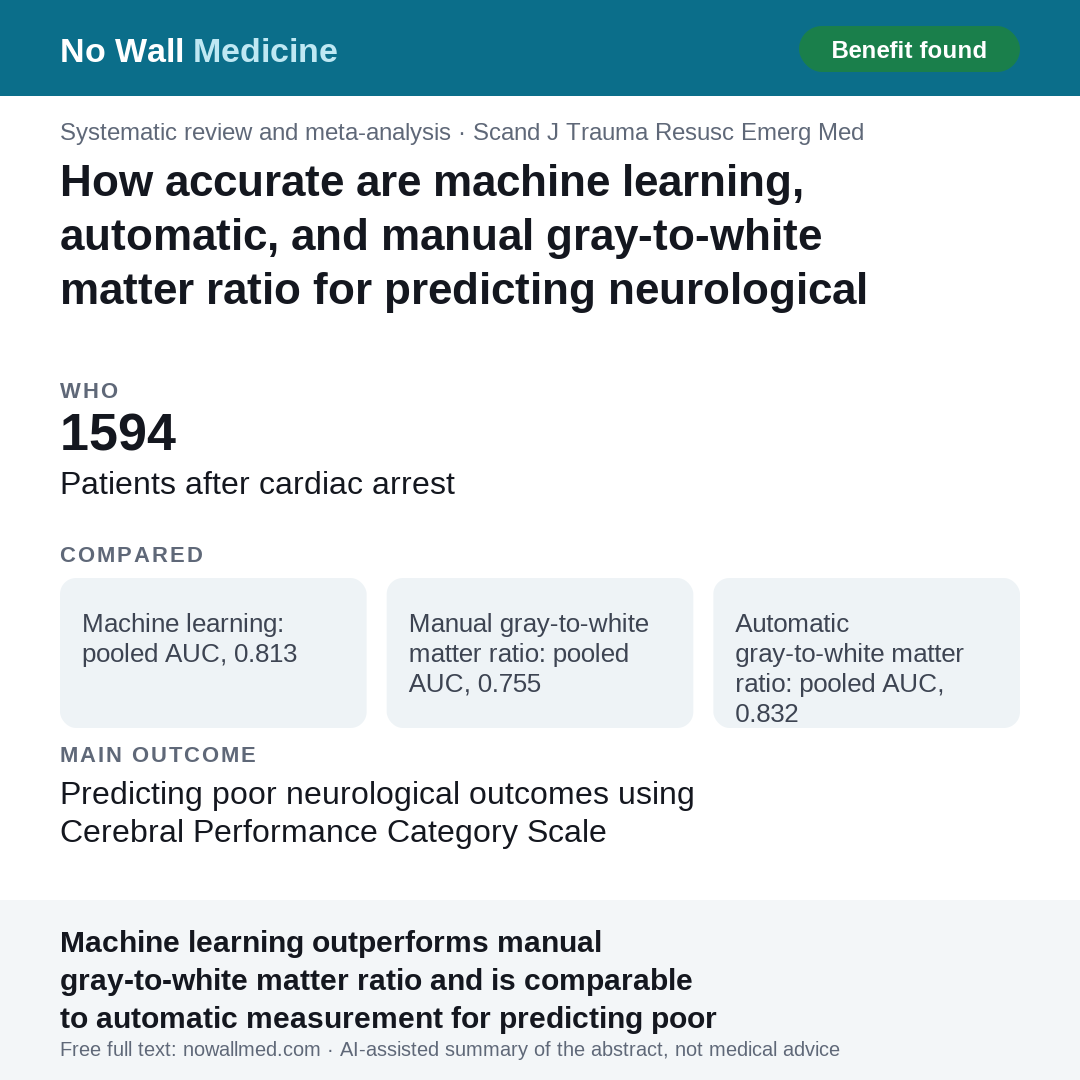
Clinical question: How accurate are machine learning, automatic, and manual gray-to-white matter ratio for predicting neurological outcomes?
Why it matters: It is unknown if automated methods like machine learning are superior to manual gray-to-white matter ratio measurements for predicting neurological outcomes after cardiac arrest.
Key points
- Researchers analyzed 1594 patients from seven observational studies to compare machine learning, automatic gray-to-white matter ratio, and manual gray-to-white matter ratio on brain computed tomography.
- Machine learning had a pooled area under the curve of 0.813, which was significantly higher than the 0.755 seen with manual gray-to-white matter ratio measurements.
- Machine learning showed statistically equivalent diagnostic accuracy to automatic gray-to-white matter ratio measurement, which had a pooled area under the curve of 0.832.
Headline and key points written with AI from the paper’s abstract, with every number checked against it. Read the paper before relying on them.
Topics
Cite this article
Yoo KH, Lee J, Kim W, Kim B, Chin EJ, Kim JG. Prognostic value of machine learning for brain computed tomography as a predictor of neurologic outcomes after cardiac arrest: a systematic review and meta-analysis. Scand J Trauma Resusc Emerg Med. 2026. doi:10.1186/s13049-026-01565-w
Spotted a mistake? Suggest a correction