Program of intensive support in emergency departments for care partners of cognitively impaired patients: A randomized controlled trial
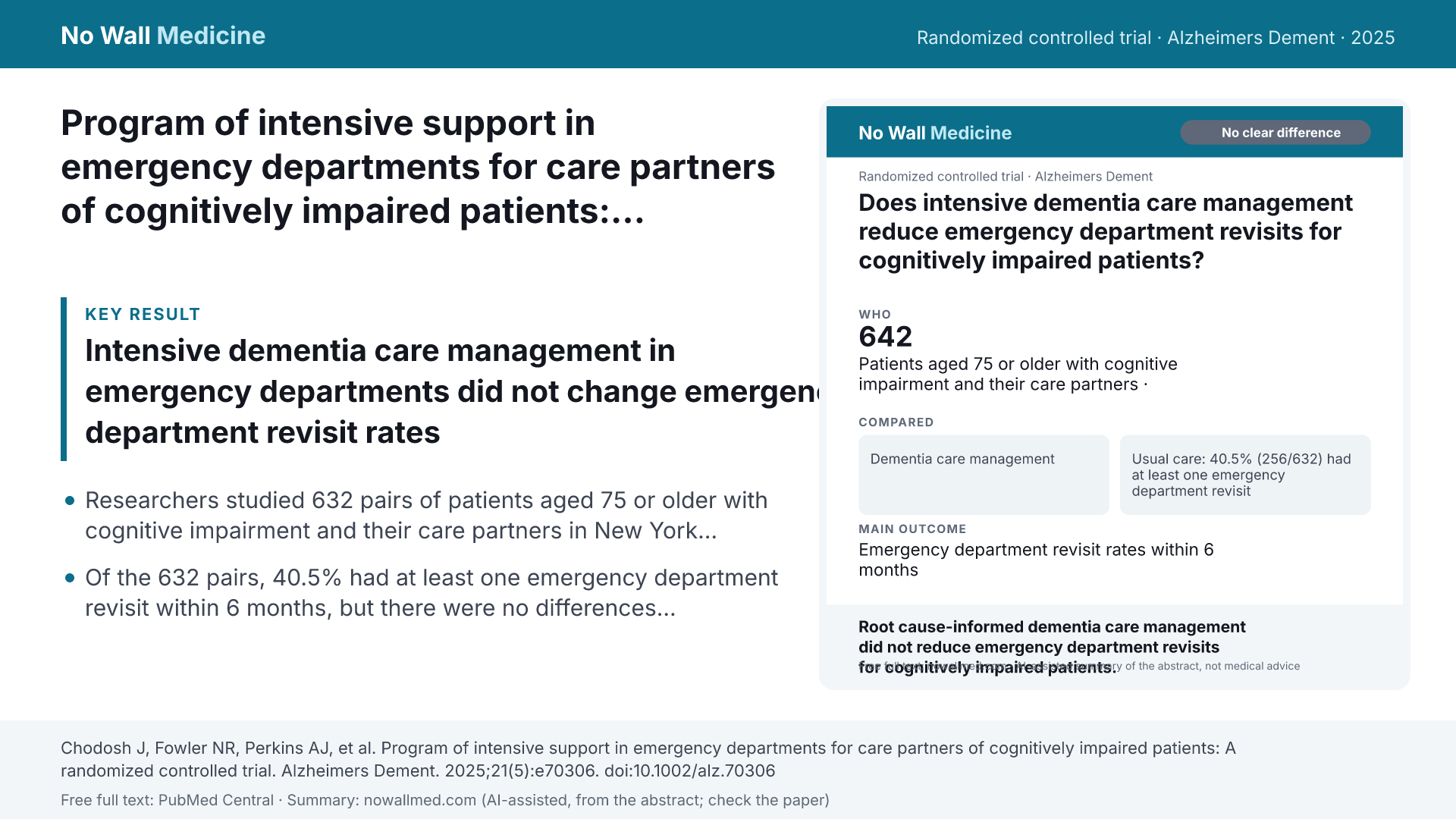
Key result: Intensive dementia care management in emergency departments did not change emergency department revisit rates
Randomized controlled trialNo clear difference
Does intensive dementia care management reduce emergency department revisits for cognitively impaired patients?
Who
642
Patients aged 75 or older with cognitive impairment and their care partners · Academically affiliated emergency departments in New York and Indiana
Compared
Dementia care management
Usual care: 40.5% (256/632) had at least one emergency department revisit
Main outcome
Emergency department revisit rates within 6 months
Bottom line: Root cause-informed dementia care management did not reduce emergency department revisits for cognitively impaired patients.
Alzheimers Dement · 2025-05-22
Key points
- Researchers studied 632 pairs of patients aged 75 or older with cognitive impairment and their care partners in New York and Indiana.
- Of the 632 pairs, 40.5% had at least one emergency department revisit within 6 months, but there were no differences between the intervention and usual care groups.
- The program did not show differences in care partner activation or symptoms of depression or anxiety at 3 or 6 months.
Discussion prompts
- Would these patients look like yours? Who was left out?
- Is the main outcome one that matters to patients?
- Is the difference large enough to change what you do?
Cite: Chodosh J, Fowler NR, Perkins AJ, et al. Program of intensive support in emergency departments for care partners of cognitively impaired patients: A randomized controlled trial. Alzheimers Dement. 2025;21(5):e70306. doi:10.1002/alz.70306
Free full text: PubMed Central · Summary and visual abstract: nowallmed.com/a/program-of-intensive-support-in-emergency-departments-for-care-mu3wxb/ (AI-assisted from the abstract; check the paper before relying on it).