Progressive exercise and corticosteroid injections showed no long-term benefit for rotator cuff disorders
Progressive exercise compared with best practice advice, with or without corticosteroid injection, for the treatment of patients with rotator cuff disorders (GRASP): a multicentre, pragmatic, 2 × 2 factorial, randomised controlled trial
Pragmatic, multicentre, 2x2 factorial, randomised controlled trialNo clear difference
Is progressive exercise or corticosteroid injection more effective for rotator cuff disorders?
Who
708
Adults aged 18 years or older with a rotator cuff disorder · 20 UK National Health Service trusts
Compared
Progressive exercise
Best practice advice
Corticosteroid injection then progressive exercise
Corticosteroid injection then best practice advice
Main outcome
Shoulder Pain and Disability Index score over 12 months
Result: adjusted mean difference -0·66 (99% CI -4·52 to 3·20)
Bottom line: Progressive exercise and corticosteroid injections provided no long-term benefit for shoulder pain and function in rotator cuff disorders.
Funded by: UK National Institute for Health Research Technology Assessment Programme
Lancet · 2021-07-12Download image
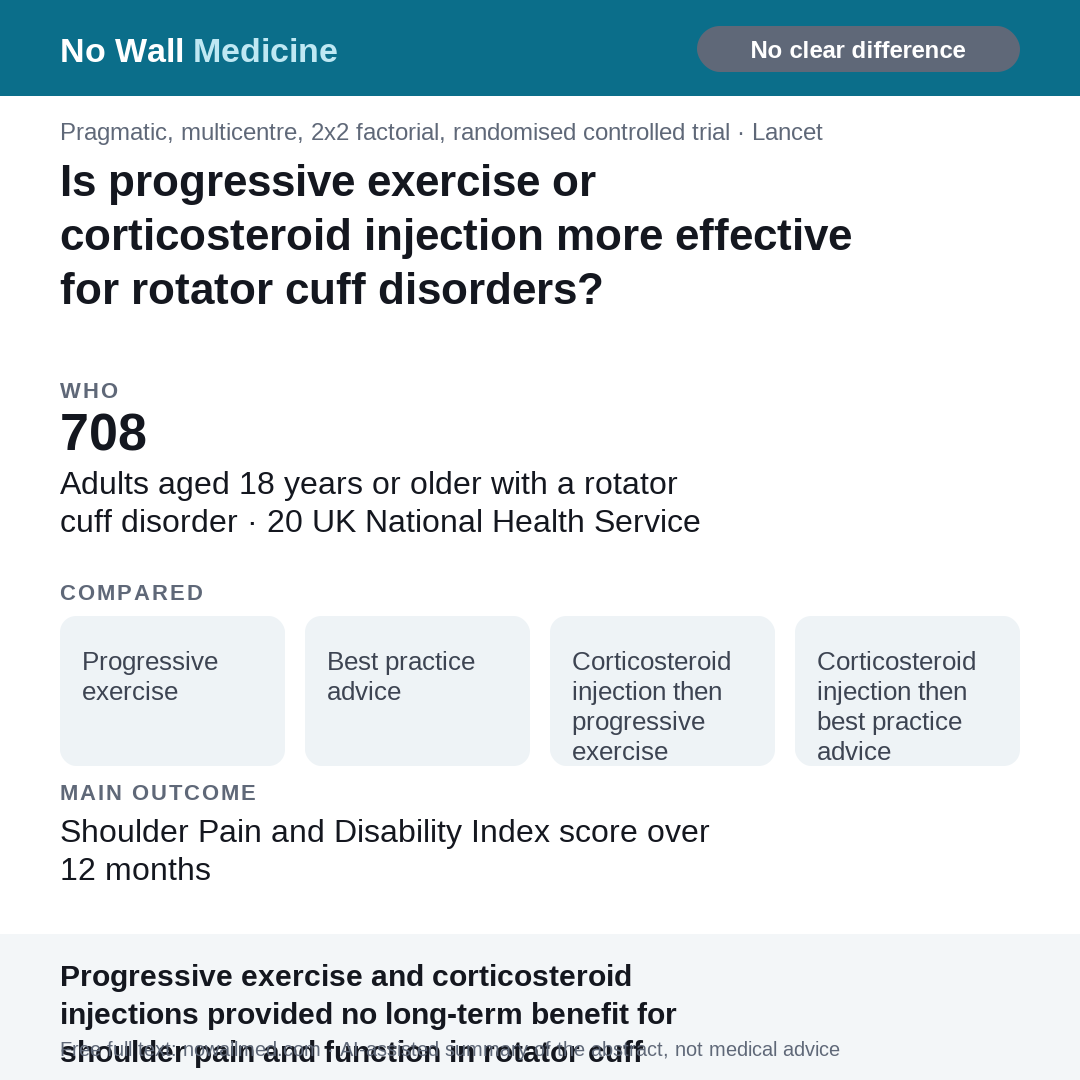
Clinical question: Is progressive exercise or corticosteroid injection more effective for rotator cuff disorders?
Why it matters: The clinical effectiveness of progressive exercise programs and corticosteroid injections for treating rotator cuff disorders is uncertain.
Key points
- The study randomized 708 adults with rotator cuff disorders into four groups to compare progressive exercise, physiotherapy advice, or corticosteroid injections.
- Over 12 months, there was no significant difference in Shoulder Pain and Disability Index scores between progressive exercise and best practice advice.
- No significant difference in Shoulder Pain and Disability Index scores was found when comparing patients who received corticosteroid injections to those who did not.
Headline and key points written with AI from the paper’s abstract, with every number checked against it. Read the paper before relying on them.
Was this summary helpful?
Abstract
Background
Corticosteroid injections and physiotherapy exercise programmes are commonly used to treat rotator cuff disorders but the treatments' effectiveness is uncertain. We aimed to compare the clinical effectiveness and cost-effectiveness of a progressive exercise programme with a single session of best practice physiotherapy advice, with or without corticosteroid injection, in adults with a rotator cuff disorder. Methods
In this pragmatic, multicentre, superiority, randomised controlled trial (2 × 2 factorial), we recruited patients from 20 UK National Health Service trusts. We included patients aged 18 years or older with a rotator cuff disorder (new episode within the past 6 months). Patients were excluded if they had a history of significant shoulder trauma (eg, dislocation, fracture, or full-thickness tear requiring surgery), neurological disease affecting the shoulder, other shoulder conditions (eg, inflammatory arthritis, frozen shoulder, or glenohumeral joint instability), received corticosteroid injection or physiotherapy for shoulder pain in the past 6 months, or were being considered for surgery. Patients were randomly assigned (centralised computer-generated system, 1:1:1:1) to progressive exercise (≤6 sessions), best practice advice (one session), corticosteroid injection then progressive exercise, or corticosteroid injection then best practice advice. The primary outcome was the Shoulder Pain and Disability Index (SPADI) score over 12 months, analysed on an intention-to-treat basis (statistical significance set at 1%). The trial was registered with the International Standard Randomised Controlled Trial Register, ISRCTN16539266, and EuDRACT, 2016-002991-28. Findings
Between March 10, 2017, and May 2, 2019, we screened 2287 patients. 708 patients were randomly assigned to progressive exercise (n=174), best practice advice (n=174), corticosteroid injection then progressive exercise (n=182), or corticosteroid injection then best practice advice (n=178). Over 12 months, SPADI data were available for 166 (95%) patients in the progressive exercise group, 164 (94%) in the best practice advice group, 177 (97%) in the corticosteroid injection then progressive exercise group, and 175 (98%) in the corticosteroid injection then best practice advice group. We found no evidence of a difference in SPADI score between progressive exercise and best practice advice when analysed over 12 months (adjusted mean difference -0·66 [99% CI -4·52 to 3·20]). We also found no evidence of a difference between corticosteroid injection compared with no injection when analysed over 12 months (-1·11 [-4·47 to 2·26]). No serious adverse events were reported. Interpretation
Progressive exercise was not superior to a best practice advice session with a physiotherapist in improving shoulder pain and function. Subacromial corticosteroid injection provided no long-term benefit in patients with rotator cuff disorders. Funding
UK National Institute for Health Research Technology Assessment Programme.
Abstract reproduced under the article’s CC BY licence.
Subject terms
Cite this article
Hopewell S, Keene DJ, Marian IR, Dritsaki M, Heine P, Cureton L. Progressive exercise compared with best practice advice, with or without corticosteroid injection, for the treatment of patients with rotator cuff disorders (GRASP): a multicentre, pragmatic, 2 × 2 factorial, randomised controlled trial. Lancet. 2021. doi:10.1016/S0140-6736(21)00846-1
Spotted a mistake? Suggest a correction
Top studies every Monday
The week’s key trials and guidelines in your specialties, plus any topics you follow. By email, free.
Get the weekly digest