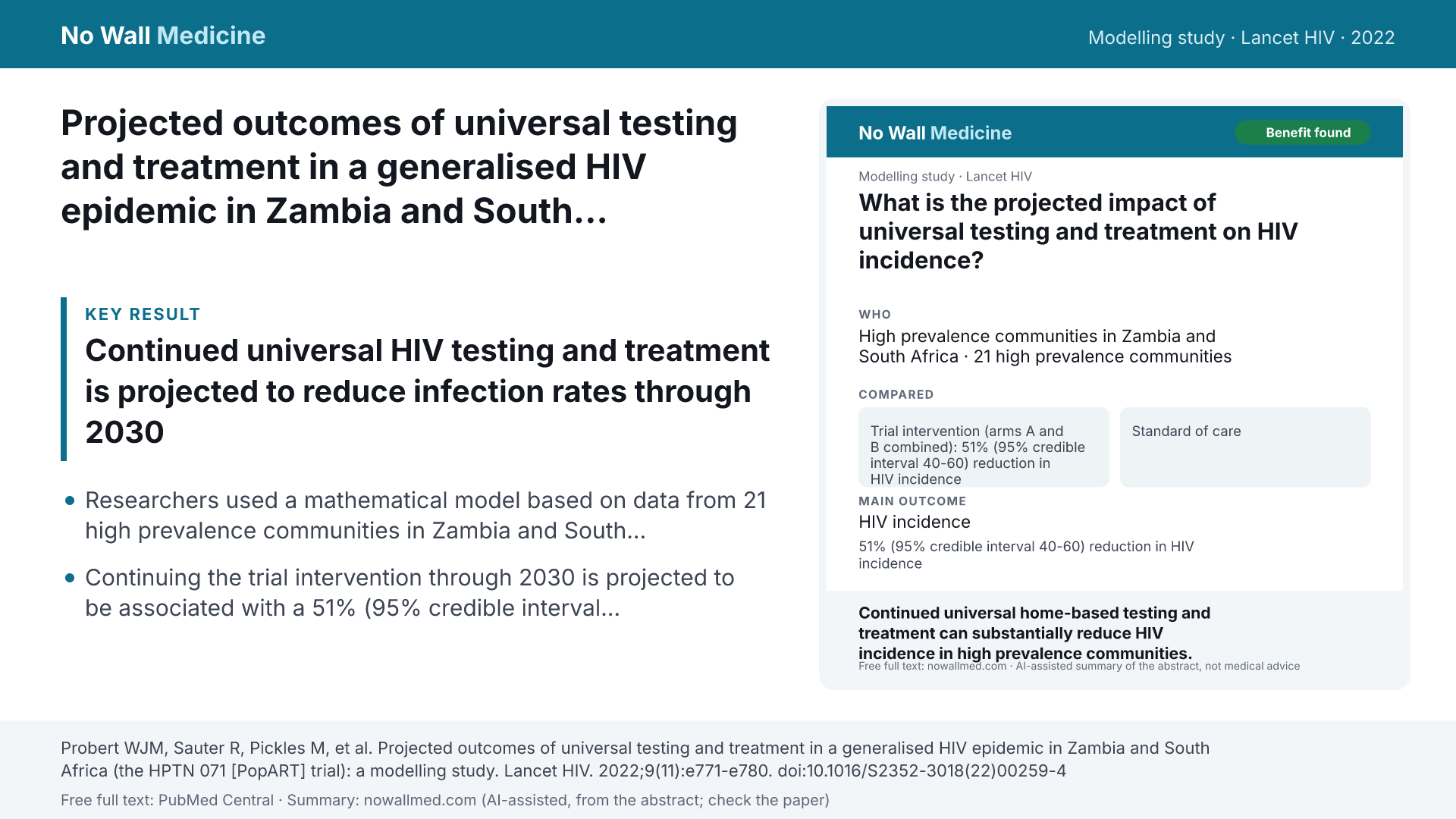
Continued universal HIV testing and treatment is projected to reduce infection rates through 2030
Projected outcomes of universal testing and treatment in a generalised HIV epidemic in Zambia and South Africa (the HPTN 071 [PopART] trial): a modelling study
Modelling studyBenefit found
What is the projected impact of universal testing and treatment on HIV incidence?
Who
High prevalence communities in Zambia and South Africa · 21 high prevalence communities in Zambia and South Africa
Compared
Trial intervention (arms A and B combined): 51% (95% credible interval 40-60) reduction in HIV incidence
Standard of care
Main outcome
HIV incidence
Result: 51% (95% credible interval 40-60) reduction in HIV incidence
Bottom line: Continued universal home-based testing and treatment can substantially reduce HIV incidence in high prevalence communities.
Funded by: National Institute of Allergy and Infectious Diseases and others
Lancet HIV · 2022-11-05Download image
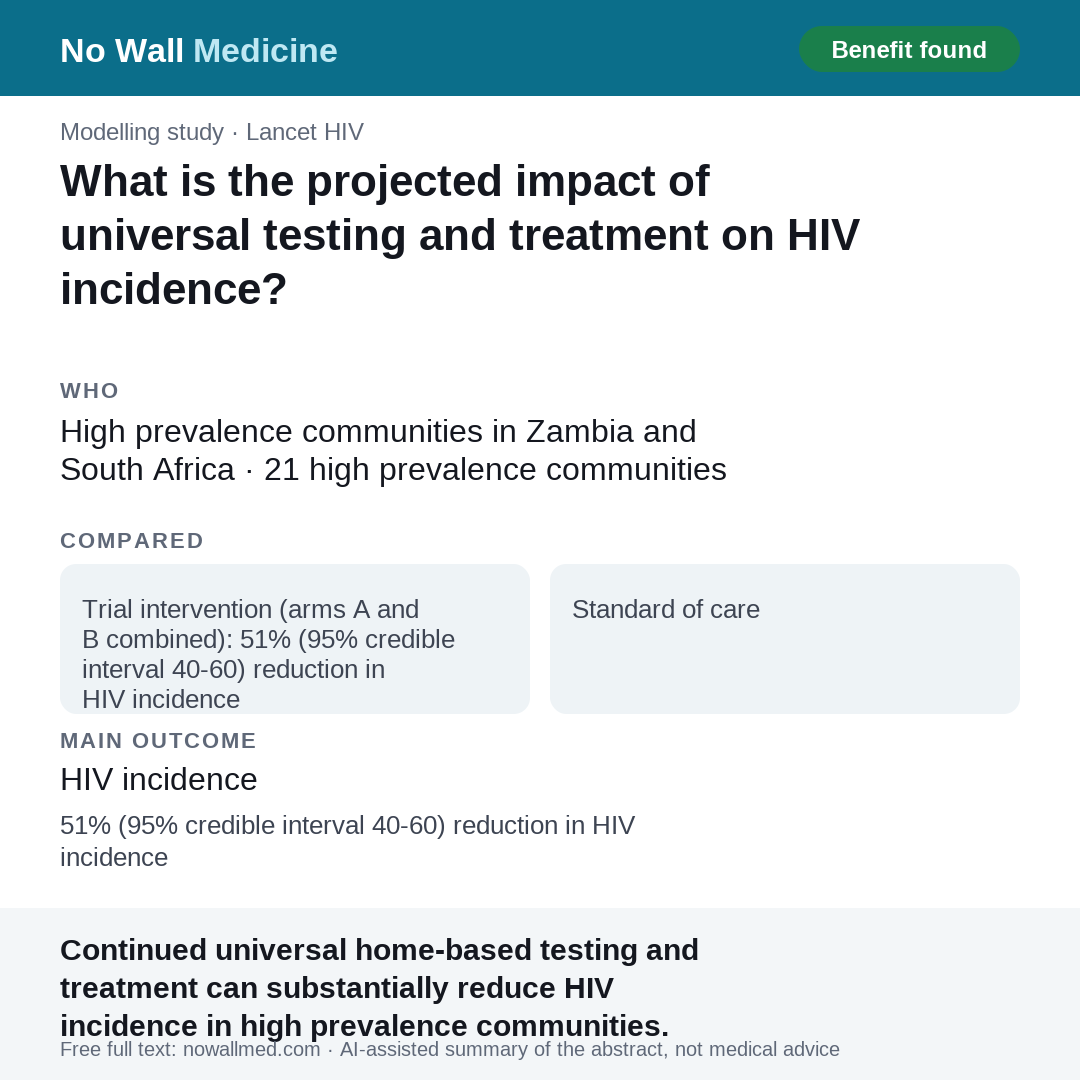
Clinical question: What is the projected impact of universal testing and treatment on HIV incidence?
Why it matters: The long-term impact of universal home-based testing and treatment on the rate of new HIV infections is unknown.
Key points
- Researchers used a mathematical model based on data from 21 high prevalence communities in Zambia and South Africa participating in the PopART trial.
- Continuing the trial intervention through 2030 is projected to be associated with a 51% (95% credible interval 40-60) reduction in HIV incidence compared to standard care.
- The model accounted for home-based testing, counseling, and the uptake of antiretroviral therapy, which is medication used to manage HIV.
Headline and key points written with AI from the paper’s abstract, with every number checked against it. Read the paper before relying on them.
Was this summary helpful?
Abstract
Background
The long-term impact of universal home-based testing and treatment as part of universal testing and treatment (UTT) on HIV incidence is unknown. We made projections using a detailed individual-based model of the effect of the intervention delivered in the HPTN 071 (PopART) cluster-randomised trial. Methods
In this modelling study, we fitted an individual-based model to the HIV epidemic and HIV care cascade in 21 high prevalence communities in Zambia and South Africa that were part of the PopART cluster-randomised trial (intervention period Nov 1, 2013, to Dec 31, 2017). The model represents coverage of home-based testing and counselling by age and sex, delivered as part of the trial, antiretroviral therapy (ART) uptake, and any changes in national guidelines on ART eligibility. In PopART, communities were randomly assigned to one of three arms: arm A received the full PopART intervention for all individuals who tested positive for HIV, arm B received the intervention with ART provided in accordance with national guidelines, and arm C received standard of care. We fitted the model to trial data twice using Approximate Bayesian Computation, once before data unblinding and then again after data unblinding. We compared projections of intervention impact with observed effects, and for four different scenarios of UTT up to Jan 1, 2030 in the study communities. Findings
Compared with standard of care, a 51% (95% credible interval 40-60) reduction in HIV incidence is projected if the trial intervention (arms A and B combined) is continued from 2020 to 2030, over and above a declining trend in HIV incidence under standard of care. Interpretation
A widespread and continued commitment to UTT via home-based testing and counselling can have a substantial effect on HIV incidence in high prevalence communities. Funding
National Institute of Allergy and Infectious Diseases, US President's Emergency Plan for AIDS Relief, International Initiative for Impact Evaluation, Bill & Melinda Gates Foundation, National Institute on Drug Abuse, and National Institute of Mental Health.
Abstract reproduced under the article’s CC BY licence.
Subject terms
Cite this article
Probert WJM, Sauter R, Pickles M, et al. Projected outcomes of universal testing and treatment in a generalised HIV epidemic in Zambia and South Africa (the HPTN 071 [PopART] trial): a modelling study. Lancet HIV. 2022. doi:10.1016/S2352-3018(22)00259-4
Spotted a mistake? Suggest a correction