Prolonged mass azithromycin distribution is associated with increased gut macrolide resistance determinants in Niger
Prolonged mass azithromycin distributions and macrolide resistance determinants among preschool children in Niger: A sub-study of a cluster-randomized trial (MORDOR)
Cluster-randomized trial sub-studyMixed results
Does prolonged mass azithromycin distribution increase macrolide resistance determinants in the gut?
Who
5,340
Children 1 to 59 months in Niger · Niger
Compared
Recently randomized to azithromycin
Recently randomized to placebo
Main outcome
macrolide resistance determinants in the gut
Result: fold change 2.18 (95% CI 1.5 to 3.51)
Bottom line: Mass azithromycin distribution increased gut macrolide resistance determinants, but resistance may plateau after 2 to 3 years of treatment.
Limitation: absence of phenotypic characterization, no complete placebo arm, and no monitoring outside of Niger
PLOS Med · 2024-05-06Download image
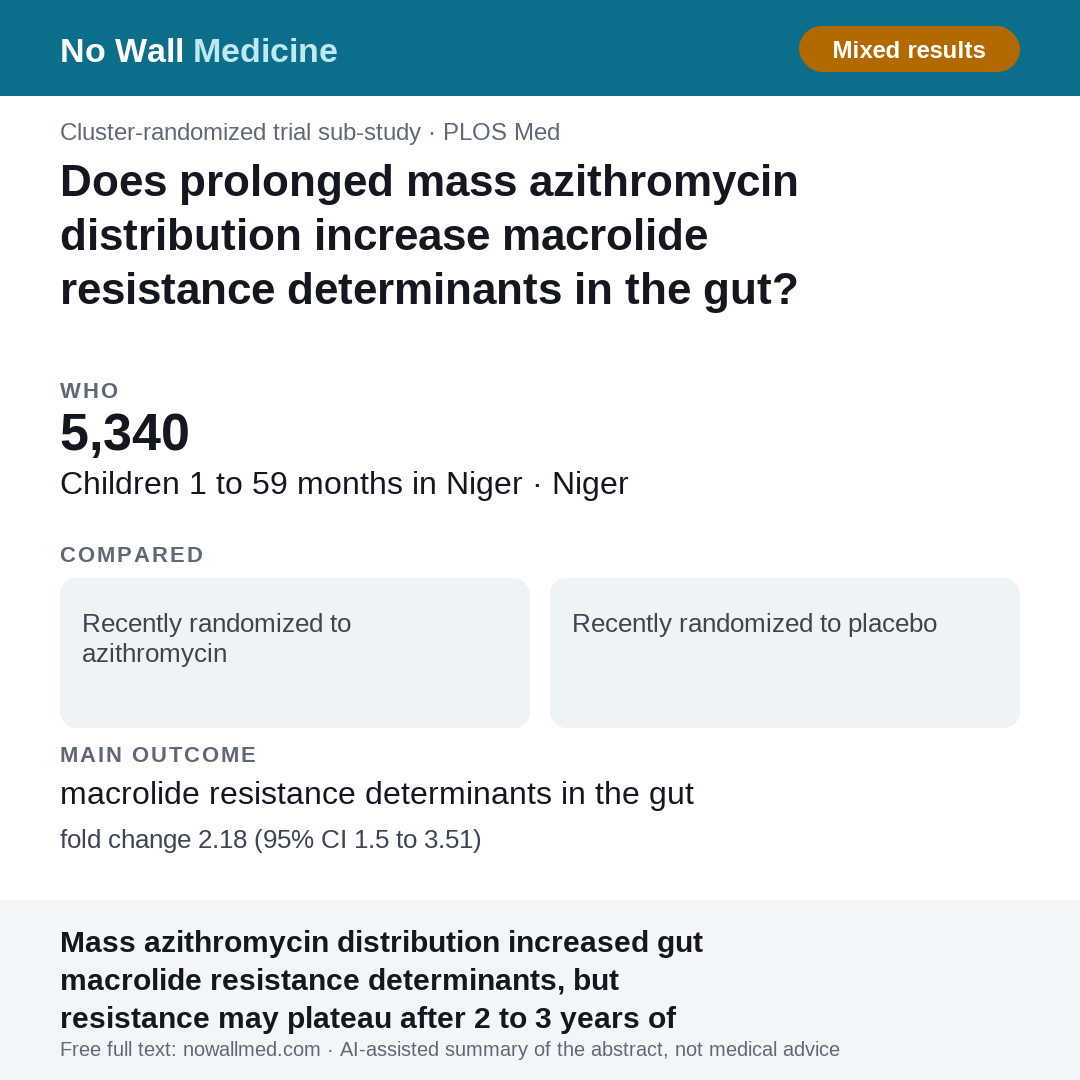
Clinical question: Does prolonged mass azithromycin distribution increase macrolide resistance determinants in the gut?
Why it matters: It is unknown if increasing the duration of mass azithromycin distribution in large settings leads to higher levels of antibiotic resistance in the gut.
Key points
- Researchers studied 5,340 children aged 1 to 59 months across 163 communities in Niger to measure antibiotic resistance in the gut.
- Communities recently randomized to azithromycin had a 2.18 fold change in macrolide resistance determinants compared to those randomized to placebo.
- No significant difference in macrolide resistance was found between communities treated for 4.5 years versus 2.5 years, or between those treated for 3 years versus 1 year.
Limitation the authors note: The authors stated the study lacked phenotypic characterization of resistance, did not have a complete placebo arm, and lacked monitoring outside of Niger.
Headline and key points written with AI from the paper’s abstract, with every number checked against it. Read the paper before relying on them.
Was this summary helpful?
Subject terms
Cite this article
Arzika AM, Abdou A, Maliki R, Beido N, Kadri B, Harouna AN. Prolonged mass azithromycin distributions and macrolide resistance determinants among preschool children in Niger: A sub-study of a cluster-randomized trial (MORDOR). PLOS Med. 2024. doi:10.1371/journal.pmed.1004386
Spotted a mistake? Suggest a correction
Top studies every Monday
The week’s key trials and guidelines in your specialties, plus any topics you follow. By email, free.
Get the weekly digest