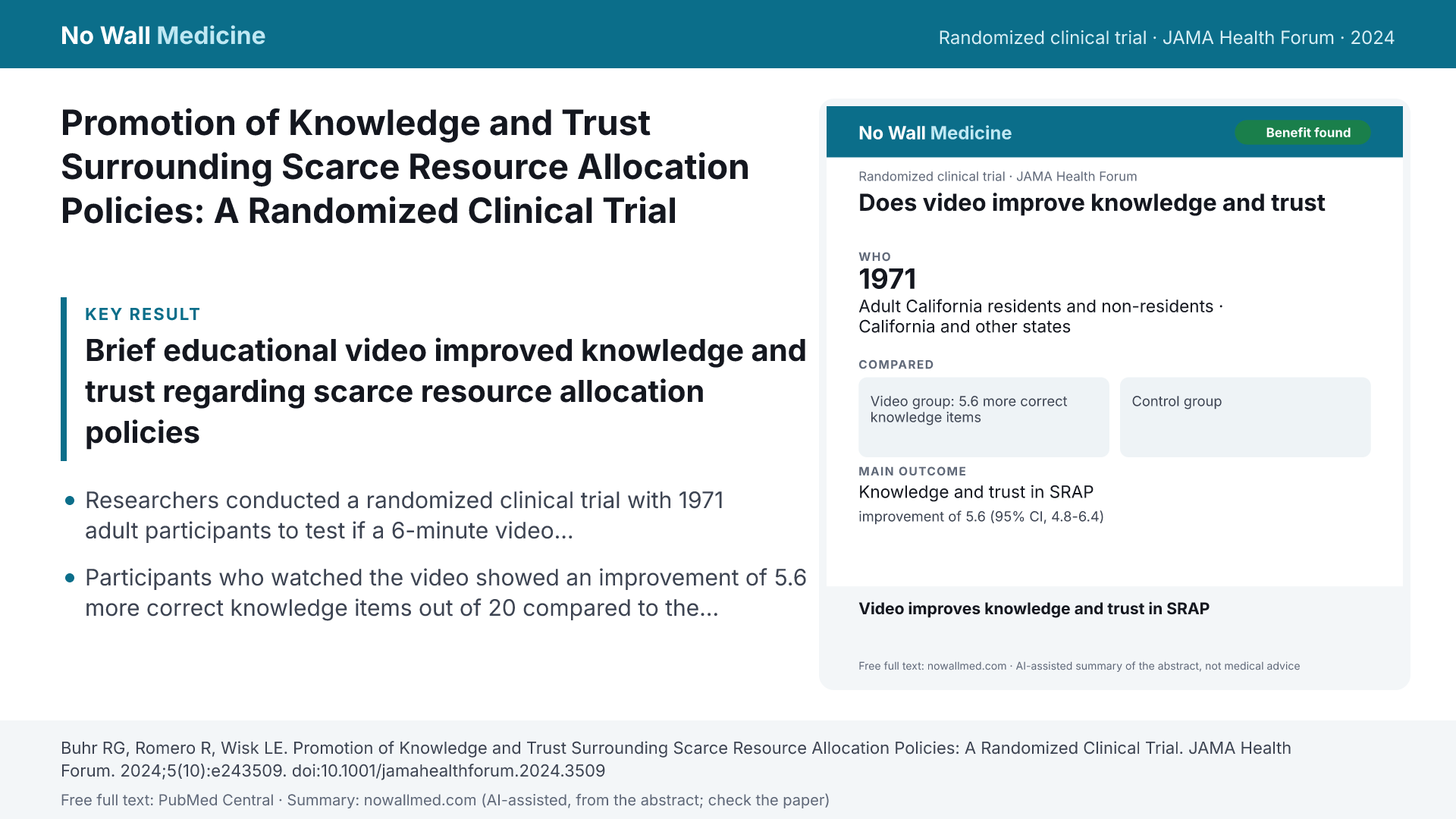
Brief educational video improved knowledge and trust regarding scarce resource allocation policies
Promotion of Knowledge and Trust Surrounding Scarce Resource Allocation Policies: A Randomized Clinical Trial
Randomized clinical trialBenefit found
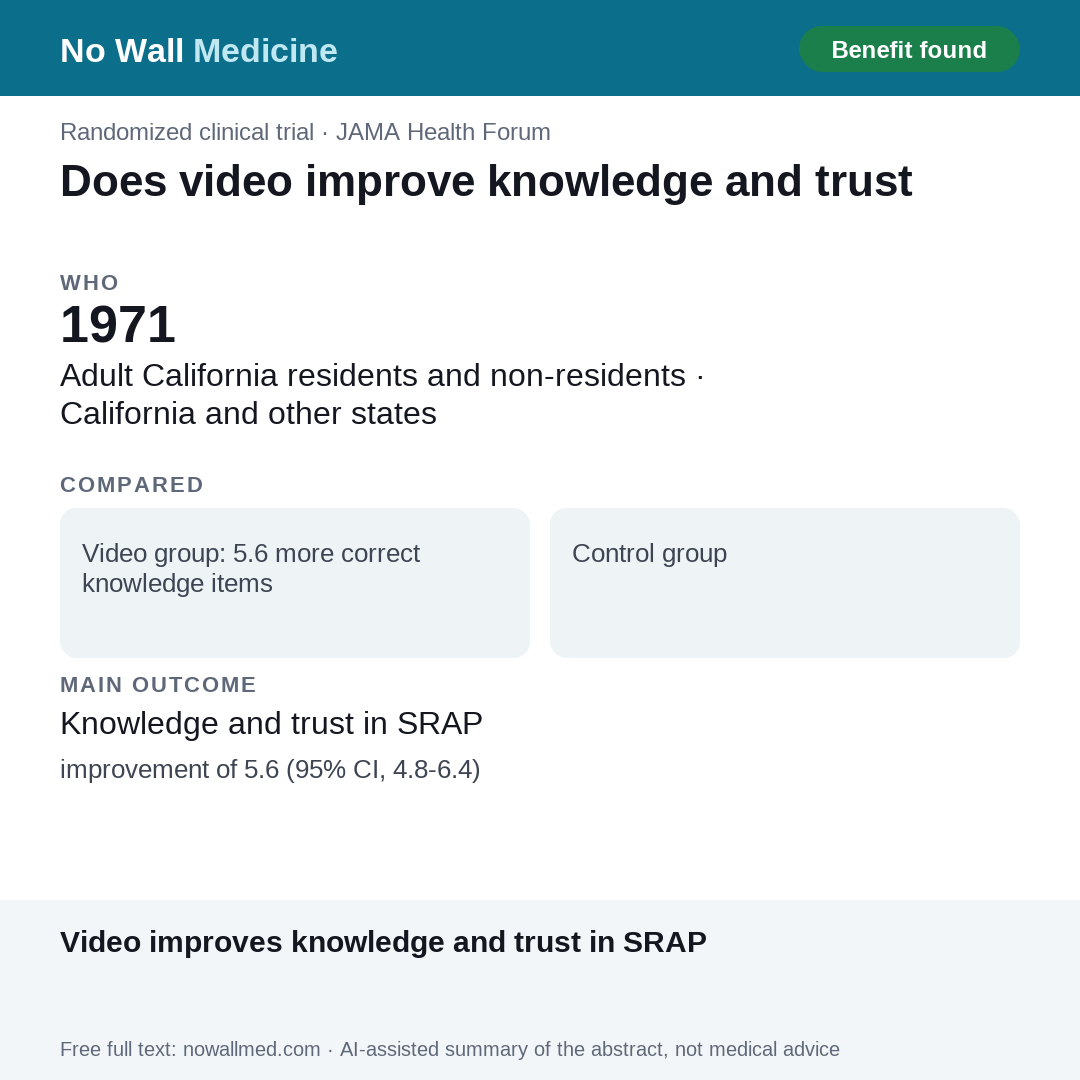
Does video improve knowledge and trust
Who
1971
Adult California residents and non-residents · California and other states
Compared
Video group: 5.6 more correct knowledge items
Control group
Main outcome
Knowledge and trust in SRAP
Result: improvement of 5.6 (95% CI, 4.8-6.4)
Bottom line: Video improves knowledge and trust in SRAP
JAMA Health Forum · 2024-10-04Download image
Why it matters: It was unknown if a brief educational video could improve public knowledge and trust in how health systems implement policies for allocating scarce resources during a pandemic.
Key points
- Researchers conducted a randomized clinical trial with 1971 adult participants to test if a 6-minute video improved understanding of scarce resource allocation policies.
- Participants who watched the video showed an improvement of 5.6 more correct knowledge items out of 20 compared to the control group.
- The video was associated with significant improvements in trust regarding fairness, consistency, honesty, and transparency, but did not significantly change reported anxiety.
Headline and key points written with AI from the paper’s abstract, with every number checked against it. Read the paper before relying on them.
Was this summary helpful?
Subject terms
Cite this article
Buhr RG, Romero R, Wisk LE. Promotion of Knowledge and Trust Surrounding Scarce Resource Allocation Policies: A Randomized Clinical Trial. JAMA Health Forum. 2024. doi:10.1001/jamahealthforum.2024.3509
Spotted a mistake? Suggest a correction