Background
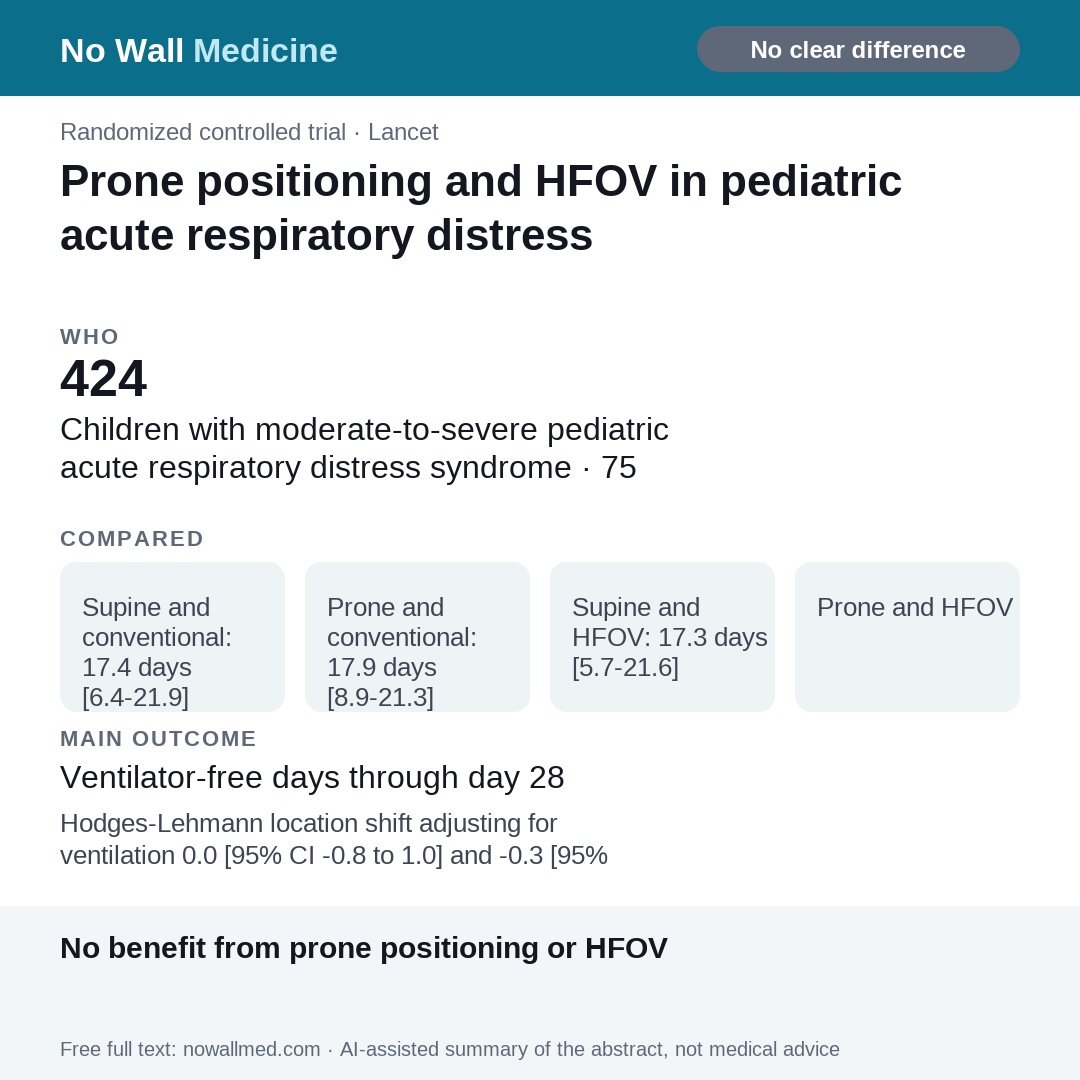
Data on prone positioning and high-frequency oscillatory ventilation (HFOV) used separately or in combination in patients with paediatric acute respiratory distress syndrome (PARDS) are inconclusive, leading to wide practice variability. We aimed to compare the effects of prone positioning with supine positioning and the effects of HFOV with conventional mechanical ventilation on ventilator-free days in children with early, moderate-to-severe PARDS. Methods
PROSpect was an international, two-by-two factorial, response-adaptive, phase 3, randomised controlled trial done in 75 paediatric intensive care units in 18 countries. Eligible patients were aged 2 weeks to 20 years, and were intubated and mechanically ventilated for less than 96 h before meeting criteria for moderate-to-severe PARDS. Patients were centrally randomly assigned using a web-based system to supine positioning and conventional mechanical ventilation, prone positioning and conventional mechanical ventilation, supine positioning and HFOV, or prone positioning and HFOV. Initially, the allocation was 1:1:1:1 stratified by age group and direct or indirect lung injury using a permuted block design with blocks of four and eight. Response-adaptive randomisation updates were planned to adjust allocation probabilities 28 days after 300 patients were randomly assigned and then 28 days after every 100 additional patients. Given the nature of the interventions, masking was not possible. The primary outcome was ventilator-free days through to day 28 among all randomly assigned participants. Safety was assessed prospectively by daily monitoring for the occurrence of prespecified adverse events. This study was registered with ClinicalTrials.gov (NCT03896763) and is closed to enrolment. Findings
Between May 1, 2019 and Jan 13, 2026, 1045 patients were eligible for enrolment. The trial was stopped early for futility and slow enrolment after 424 of 600 planned patients were recruited. 126 patients were randomly assigned to the supine and conventional mechanical ventilation group, 130 to the prone and conventional mechanical ventilation group, 90 to the supine and HFOV group, and 78 to the prone and HFOV group. Median age was 3·3 years (IQR 1·1-10·1), 211 (50%) patients were female, and 213 (50%) were male. There were no significant differences in ventilator-free days between prone and supine positioning (median 17·9 days [IQR 8·9-21·3] vs 17·4 days [6·4-21·9]; Hodges-Lehmann location shift adjusting for ventilation 0·0 [95% CI -0·8 to 1·0]) or between HFOV and conventional mechanical ventilation (17·3 [5·7-21·6] vs 18·0 [9·9-21·5]; Hodges-Lehmann location shift adjusting for positioning -0·3 [95% CI -1·5 to 0·5]). 41 (10%) patients had died at day 28, without group differences. Plugging or obstruction of the artificial airway occurred more frequently with prone than supine positioning (14 events in 12 [6%] of 188 patients vs three events in three [2%] of 197 patients; 0·74 [95% CI 0·44-1·26] vs 0·15 [0·05-0·47] events per 100 artificial airway days; rate ratio 4·83 [95% CI 1·38-16·82]). Stage 2 or worse immobility-related pressure injuries also occurred more frequently with prone versus supine positioning (12 [6%] vs two [1%]; relative risk 6·13 [95% CI 1·45-25·97]). Haemodynamic instability occurred more frequently with HFOV than conventional mechanical ventilation (41 events in 19 [13%] of 141 patients vs 38 events in 22 [9%] of 244 patients; 2·21 [95% CI 1·63-3·00] vs 1·22 [0·89-1·68] events per 100 paediatric intensive care unit days; rate ratio 1·84 [95% CI 1·18-2·87]). One serious adverse event, an unwitnessed self-extubation followed by cardiopulmonary arrest, occurred in a patient in the prone and conventional mechanical ventilation group. Interpretation
We found no evidence to support prone positioning or HFOV as first-line strategies to improve ventilator-free days in patients with early, moderate-to-severe PARDS. Thus, the routine use of these strategies in this population is not recommended. Funding
US National Institutes of Health/National Heart, Lung, and Blood Institute.
Abstract reproduced under the article’s CC BY NC ND licence.
Exploring outcomes and insights from joint agency response investigations for children with learning disabilities who die unexpectedly: an observational study
Prevalence, clinical characteristics and management of female genital mutilation in paediatric and adolescent patients: a retrospective cohort analysis from a clinic in Vienna, Austria
Evolution of the clinical profile and cardiac outcomes of multisystem inflammatory syndrome in children (MIS-C) across three COVID-19 waves in Central Kerala: a cross-sectional study