Visual abstractsVisuals
Randomized trialCritical Care · Aug 20, 2026

High-flow nasal oxygen reduced the severity of respiratory complications after lung cancer surgery

Prophylactic high-flow nasal oxygen vs. conventional oxygen for prevention of postoperative respiratory complications: a randomized trial

Lin R, Huang Y, Yu G, Lei M, Chen Y, Xiang C, et al
Critical CareAdult
Single-center, open-label randomized controlled trialBenefit found
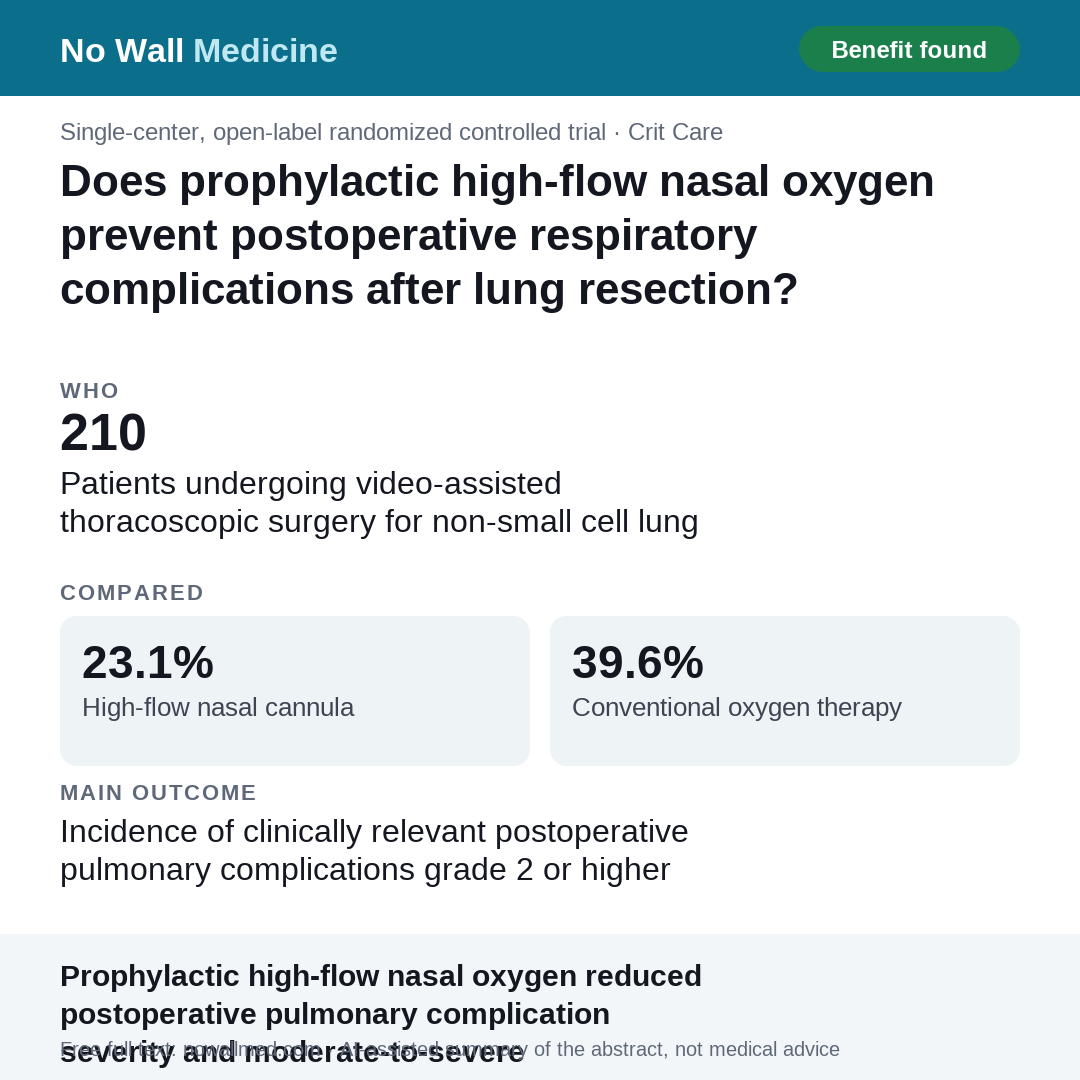
Does prophylactic high-flow nasal oxygen prevent postoperative respiratory complications after lung resection?
Who
210
Patients undergoing video-assisted thoracoscopic surgery for non-small cell lung cancer · Single-center
Compared
23.1%High-flow nasal cannula
39.6%Conventional oxygen therapy
Main outcome
Incidence of clinically relevant postoperative pulmonary complications grade 2 or higher
Result: ordinal OR, 0.50 (95% CI, 0.28-0.91)
Bottom line: Prophylactic high-flow nasal oxygen reduced postoperative pulmonary complication severity and moderate-to-severe complications after lung resection.
Crit Care · 2026-08-20Download image

Clinical question: Does prophylactic high-flow nasal oxygen prevent postoperative respiratory complications after lung resection?

Why it matters: The role of using high-flow nasal cannula as a preventive measure to stop respiratory deterioration after lung surgery remains uncertain.

In absolute numbers

High-flow nasal cannula: 23.1% · Conventional oxygen therapy: 39.6% → a difference of 16.5 percentage points, so about 7 people would need the treatment for 1 more to benefit (number needed to treat) over the trial’s follow-up.

Worked out by us from the two group results above, not reported by the authors. Check the paper for the exact outcome and timing.

Key points

Limitation the authors note: This was a single-center, open-label randomized controlled trial.

Headline and key points written with AI from the paper’s abstract, with every number checked against it. Read the paper before relying on them.
Read the full paper free at PubMed Central ↗

Topics

Humans; Oxygen Inhalation Therapy; Postoperative Complications; Female; Aged; Male; Middle Aged; China; Oxygen; Logistic Models

DOI: 10.1186/s13054-026-06205-4 · PubMed: 42864673 · Registered: ChiCTR2200063161

Spotted a mistake? Suggest a correction

More in Critical Care

Meta-analysisCrit Care · Nov 19, 2026 · Critical Care

Corticosteroids in sepsis have conflicting mortality conclusions in reviews

Discordant evidence on corticosteroids in sepsis: a meta-research study

ResearchPediatricResuscitation · Nov 17, 2026 · Critical Care

Eighty-nine percent of infants survived 28 days after chest compressions at birth in 2024

Survival after neonatal chest compressions at birth: Temporal trends and prognostic factors in a population-based cohort, Queensland, Australia

ResearchResuscitation · Nov 17, 2026 · Critical Care

Bystanders attaching AEDs had highest 30-day survival rate of 28 percent

Survival after out of hospital cardiac arrest in relation to AED usage in a multi response system including AED equipped drones

ResearchResuscitation · Nov 17, 2026 · Critical Care

Foreign body airway obstruction caused 1.1% of out-of-hospital cardiac arrests

Out-of-hospital cardiac arrests due to foreign body airway obstruction: A CanROC registry, retrospective cohort study

ResearchResuscitation · Nov 17, 2026 · Critical Care

Commercially available multimodal LLMs for EEG-based prognostication after cardiac arrest