Anti-VEGF injections and NSAID eye drops were associated with lower macular edema risk after cataract surgery
Prophylactic interventions for preventing macular edema after cataract surgery in patients with diabetes: A Bayesian network meta-analysis of randomized controlled trials
Bayesian network meta-analysis of 17 randomized controlled trialsBenefit found
Which prophylactic interventions prevent macular edema after cataract surgery in diabetes patients?
Who
2566
patients with diabetes who underwent cataract surgery
Compared
placebo or steroid eye drop alone
additional topical nonsteroidal anti-inflammatory drugs: OR=0·221 (1 month), OR=0·370 (3 months)
additional intravitreal anti-vascular endothelial growth factor injections: OR=0·151 (1 month), OR=0·203 (3 months)
Main outcome
postoperative macular edema and best-corrected visual acuity
Result: anti-VEGF: OR 0·151 (95%CI, 0·037-0·413) at 1 month
Bottom line: Additional anti-vascular endothelial growth factor injections or topical nonsteroidal anti-inflammatory drugs reduce macular edema risk after cataract surgery.
Limitation: moderate risk of bias
Funded by: Research and Development of Special; Beijing Municipal Science & Technology Commission
eClinicalMedicine · 2022-05-20Download image
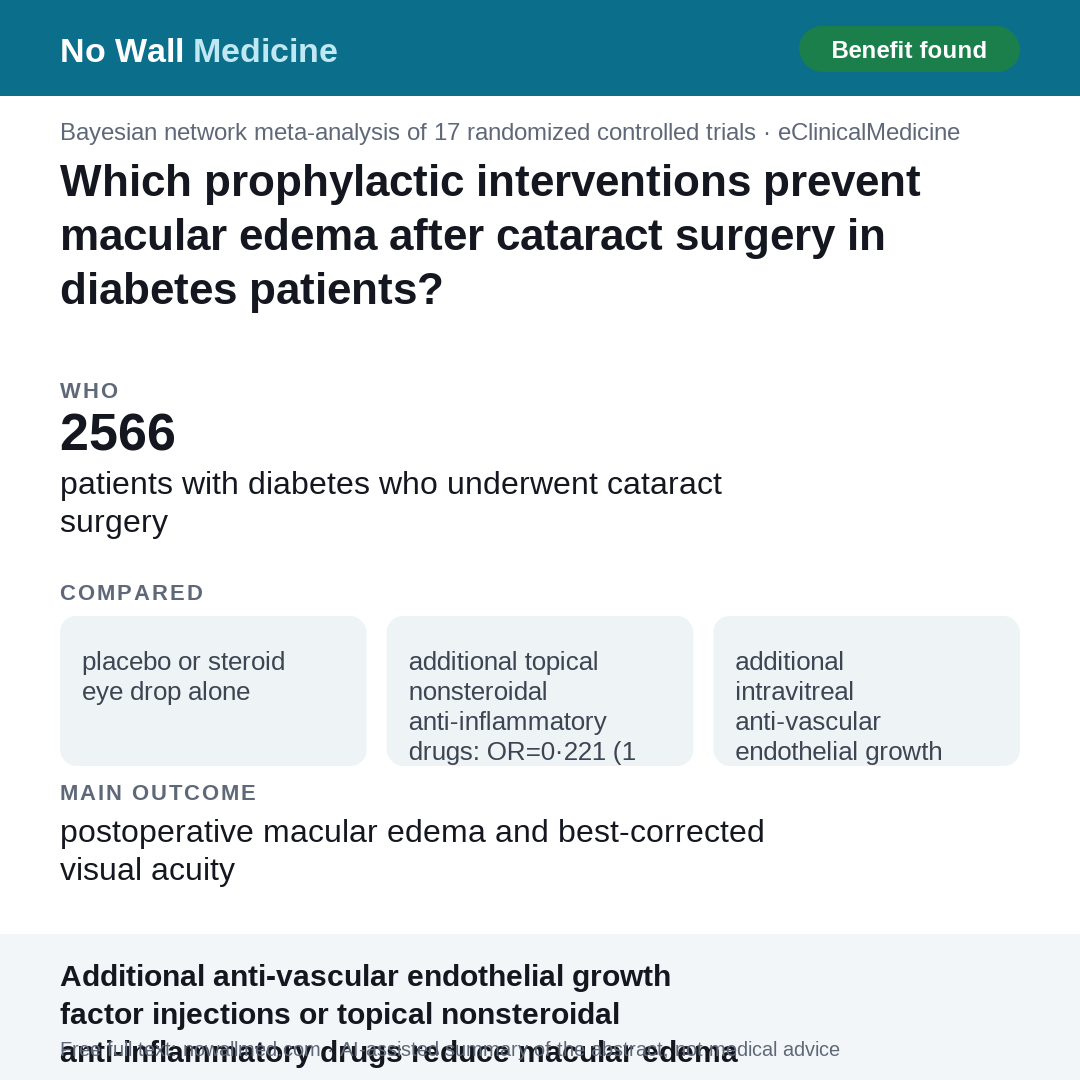
Clinical question: Which prophylactic interventions prevent macular edema after cataract surgery in diabetes patients?
Why it matters: It is unknown which prophylactic interventions are most effective for improving anatomical and visual outcomes in diabetic patients after cataract surgery.
Key points
- Researchers analyzed 2566 participants from 17 randomized controlled trials to compare different preventative treatments for diabetic patients undergoing cataract surgery.
- Compared to placebo or steroid eye drops alone, additional topical nonsteroidal anti-inflammatory drugs (NSAIDs) or anti-vascular endothelial growth factor (anti-VEGF) injections were associated with a lower risk of macular edema at 1 month and 3 months.
- Additional anti-VEGF injections were associated with better best-corrected visual acuity at 1 month (mean difference of LogMAR: -0.083) and 3 months (mean difference of LogMAR: -0.061).
Headline and key points written with AI from the paper’s abstract, with every number checked against it. Read the paper before relying on them.
Cite this article
Zhang R, Dong L, Yang Q, Liu Y, Li H, Zhou W. Prophylactic interventions for preventing macular edema after cataract surgery in patients with diabetes: A Bayesian network meta-analysis of randomized controlled trials. eClinicalMedicine. 2022. doi:10.1016/j.eclinm.2022.101463
Spotted a mistake? Suggest a correction
Top studies every Monday
The week’s key trials and guidelines in your specialties, plus any topics you follow. By email, free.
Get the weekly digest