Prophylactic terlipressin infusion was associated with lower rates of severe postreperfusion syndrome in liver transplant patients
Prophylactic terlipressin infusion for severe postreperfusion syndrome in patients undergoing deceased donor liver transplantation: the TIPS-DDLT randomized controlled trial
Single-center, randomized, double-blind trialBenefit found
Does prophylactic terlipressin infusion reduce severe postreperfusion syndrome in deceased donor liver transplantation?
Who
64
Adults undergoing deceased donor liver transplantation · Single-center
Compared
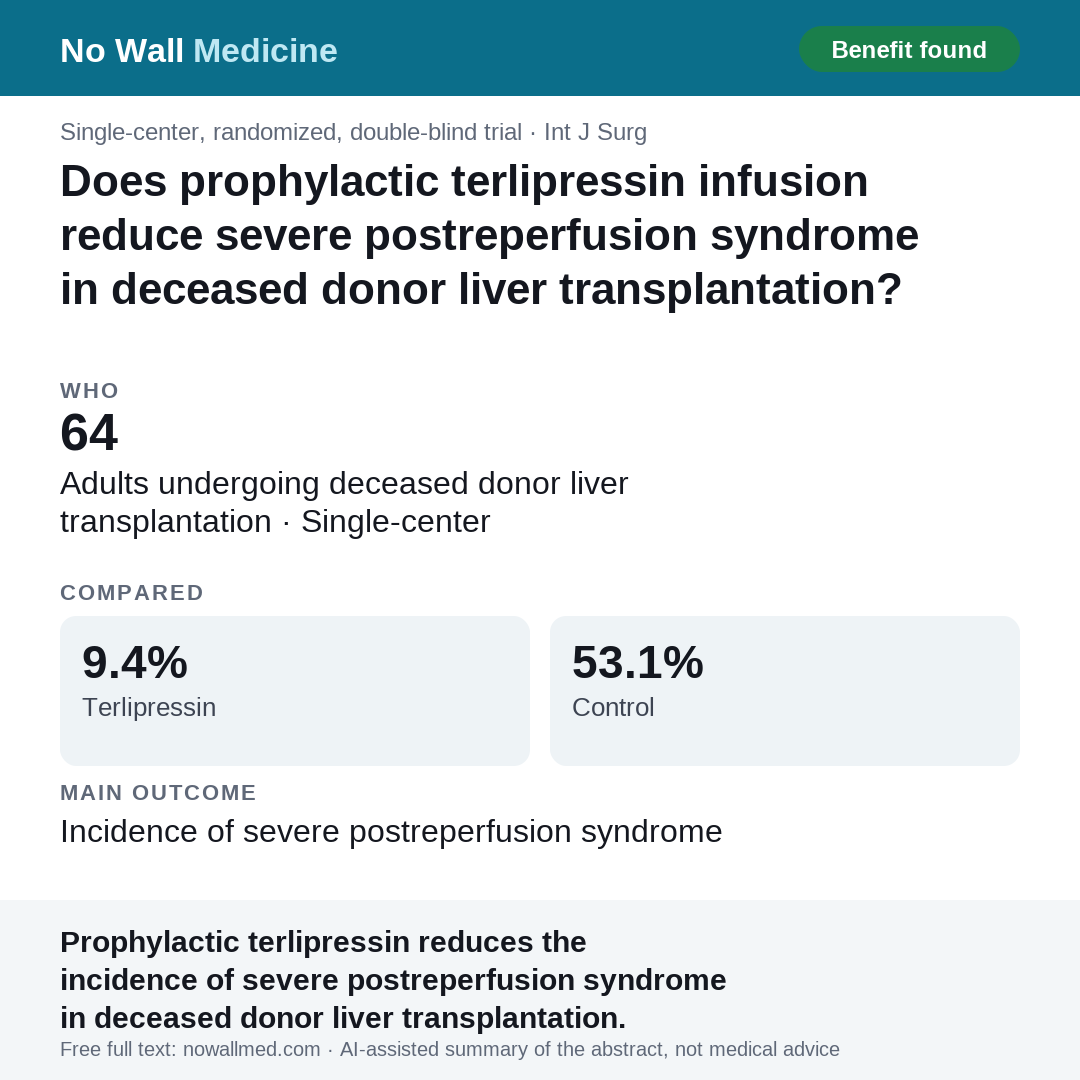
9.4%Terlipressin
53.1%Control
Main outcome
Incidence of severe postreperfusion syndrome
Result: OR, 0.09 (95% CI, 0.02-0.36)
Bottom line: Prophylactic terlipressin reduces the incidence of severe postreperfusion syndrome in deceased donor liver transplantation.
Limitation: Concerns remain regarding elevated pulmonary capillary wedge pressure.
Int J Surg · 2023-07-01Download image
Clinical question: Does prophylactic terlipressin infusion reduce severe postreperfusion syndrome in deceased donor liver transplantation?
Why it matters: It was unknown if giving terlipressin before blood flow is restored could prevent severe postreperfusion syndrome during deceased donor liver transplantation.
Key points
- Researchers conducted a randomized trial with 64 adults undergoing deceased donor liver transplantation, comparing 1 mg of terlipressin to a placebo.
- The incidence of severe postreperfusion syndrome, a critical drop in blood pressure after blood flow is restored, was 9.4% in the terlipressin group versus 53.1% in the control group.
- Terlipressin was associated with longer postoperative mechanical ventilation time and increased pulmonary capillary wedge pressure, which is a measure of pressure in the heart's left atrium.
Headline and key points written with AI from the paper’s abstract, with every number checked against it. Read the paper before relying on them.
Was this summary helpful?
Subject terms
Cite this article
Zhang L, Tian M, Sun LY, Zhu ZJ. Prophylactic terlipressin infusion for severe postreperfusion syndrome in patients undergoing deceased donor liver transplantation: the TIPS-DDLT randomized controlled trial. Int J Surg. 2023. doi:10.1097/JS9.0000000000000431
Spotted a mistake? Suggest a correction
Top studies every Monday
The week’s key trials and guidelines in your specialties, plus any topics you follow. By email, free.
Get the weekly digest