Tranexamic acid reduced postpartum hemorrhage in women with placenta praevia undergoing caesarean delivery
Prophylactic tranexamic acid for the prevention of postpartum haemorrhage in women with placenta praevia: multicentre, double blind, randomised, placebo controlled, phase 3 trial
Randomised, double blind, placebo controlled, phase 3 studyBenefit found
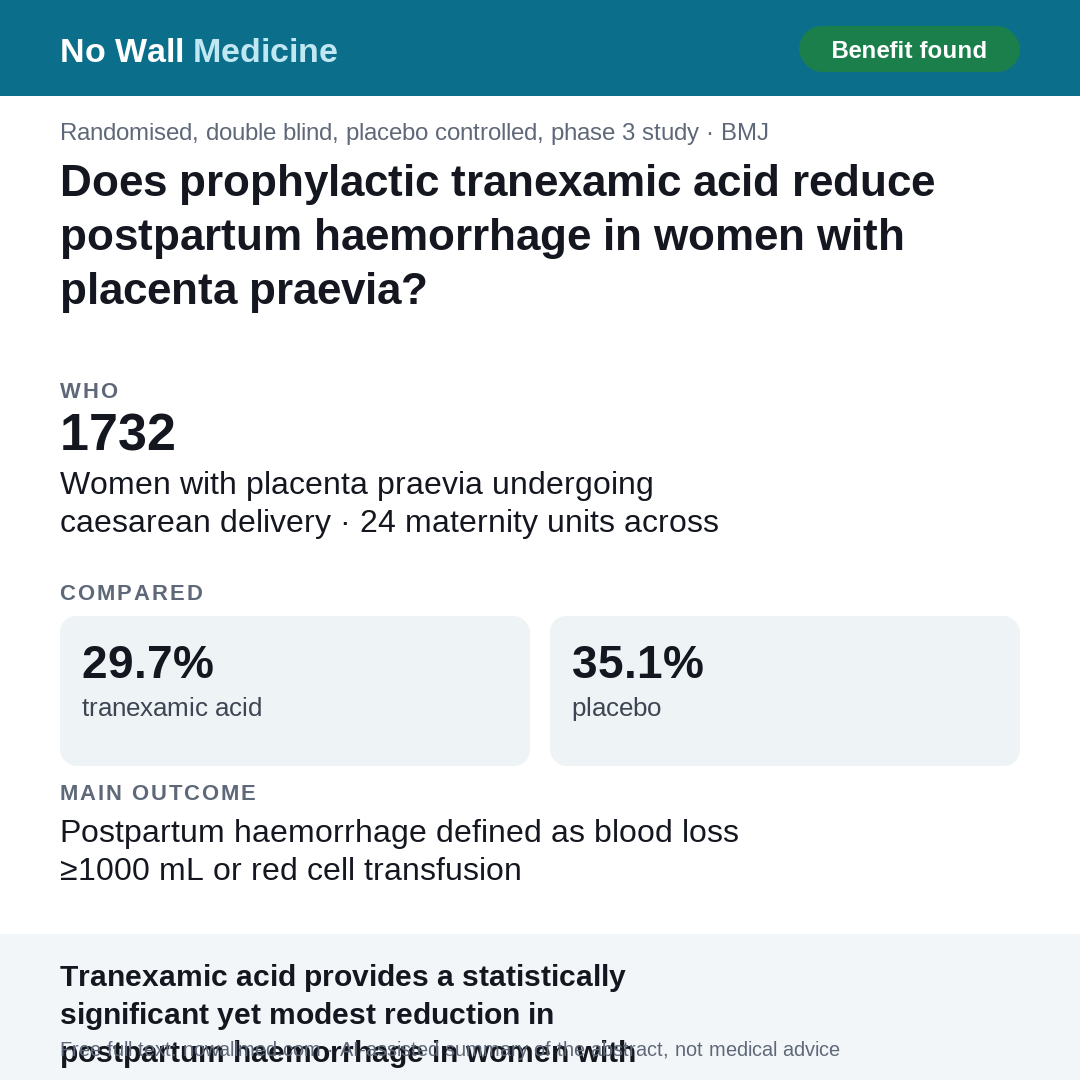
Does prophylactic tranexamic acid reduce postpartum haemorrhage in women with placenta praevia?
Who
1732
Women with placenta praevia undergoing caesarean delivery · 24 maternity units across China
Compared
29.7%tranexamic acid (251/845)
35.1%placebo (297/846)
Main outcome
Postpartum haemorrhage defined as blood loss ≥1000 mL or red cell transfusion
Result: relative risk 0.85, 95.2% confidence interval (CI) 0.75 to 0.96
Bottom line: Tranexamic acid provides a statistically significant yet modest reduction in postpartum haemorrhage in women with placenta praevia.
BMJ · 2026-05-13Download image
Clinical question: Does prophylactic tranexamic acid reduce postpartum haemorrhage in women with placenta praevia?
Why it matters: It was unclear if giving tranexamic acid, a medication used to prevent bleeding, could reduce postpartum hemorrhage in women with placenta praevia.
In absolute numbers
tranexamic acid: 29.7% · placebo: 35.1% → a difference of 5.4 percentage points, so about 19 people would need the treatment for 1 more to benefit (number needed to treat) over the trial’s follow-up.
Worked out by us from the two group results above, not reported by the authors. Check the paper for the exact outcome and timing.
Key points
- Researchers studied 1732 women with placenta praevia undergoing caesarean delivery across 24 maternity units in China.
- The primary outcome of postpartum hemorrhage occurred in 29.7% (251/845) of the tranexamic acid group compared to 35.1% (297/846) of the placebo group.
- Serious adverse events, including blood clots and seizures, were similar between the tranexamic acid group and the placebo group at 0.5% for both.
Headline and key points written with AI from the paper’s abstract, with every number checked against it. Read the paper before relying on them.
Abstract
Objective
To investigate whether prophylactic tranexamic acid reduces the incidence of postpartum haemorrhage in women with placenta praevia compared with placebo. Design
Randomised, double blind, placebo controlled, phase 3 study. Setting
24 maternity units across China between July 2023 and March 2025. Participants
1732 women with placenta praevia undergoing caesarean delivery. Interventions
Participants were randomly (1:1) assigned to receive prophylactic oxytocin and either tranexamic acid (1 g in 10 mL) or placebo (10 mL normal saline) diluted in 40 mL normal saline intravenously over 10 minutes, initiated within five minutes of umbilical cord clamping. Main outcome measures
The primary outcome was postpartum haemorrhage, defined as calculated estimated blood loss ≥1000 mL or as red cell transfusion within two days after delivery. Serious adverse events included thromboembolic events, seizures, acute kidney or liver injury, and maternal death. Results
Of 1732 women with placenta praevia who were randomised, 38 were excluded because they withdrew consent or were determined to be ineligible after randomisation. Primary outcome data were available for 99.8% (1691/1694) of the remaining women. Placenta accreta spectrum was diagnosed in 303 participants (17.9%). The primary outcome occurred in 29.7% (251/845) of the tranexamic acid group and 35.1% (297/846) of the placebo group (relative risk 0.85, 95.2% confidence interval (CI) 0.75 to 0.96; P=0.01). The rates of serious adverse events were similar between the tranexamic acid group and placebo group (0.5% (4 of 837) v 0.5% (4 of 845); relative risk 1.01, 95% CI 0.25 to 4.00). Conclusions
In women with placenta praevia who underwent caesarean delivery and received prophylactic oxytocin, treatment with tranexamic acid resulted in a statistically significant yet modest reduction in the incidence of postpartum haemorrhage, with no signal of increased serious adverse events. Trial registration
ClinicalTrials.gov NCT05811676.
Abstract reproduced under the article’s CC BY NC licence.
Topics
Cite this article
Zhang L, Bi S, Chen L, Du L, He F, Qiao Y. Prophylactic tranexamic acid for the prevention of postpartum haemorrhage in women with placenta praevia: multicentre, double blind, randomised, placebo controlled, phase 3 trial. BMJ. 2026. doi:10.1136/bmj-2026-089636
Spotted a mistake? Suggest a correction