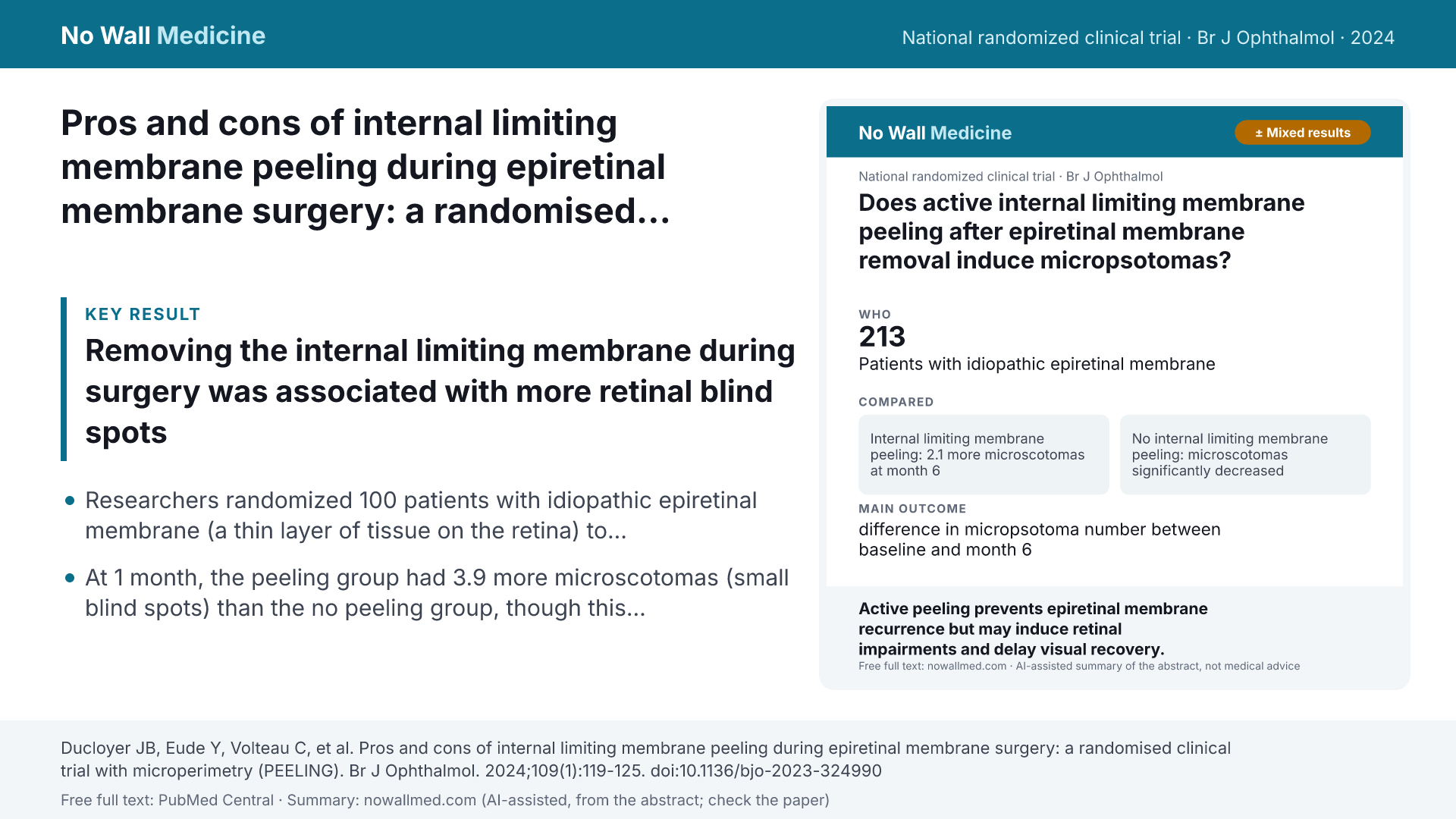
Removing the internal limiting membrane during surgery was associated with more retinal blind spots
Pros and cons of internal limiting membrane peeling during epiretinal membrane surgery: a randomised clinical trial with microperimetry (PEELING)
National randomized clinical trialMixed results
Does active internal limiting membrane peeling after epiretinal membrane removal induce micropsotomas?
Who
213
Patients with idiopathic epiretinal membrane
Compared
Internal limiting membrane peeling: 2.1 more microscotomas at month 6
No internal limiting membrane peeling: microscotomas significantly decreased
Main outcome
difference in micropsotoma number between baseline and month 6
Result: 2.1 more microscotomas in ILM peeling group (-0.5;4.7) p=0.1155
Bottom line: Active peeling prevents epiretinal membrane recurrence but may induce retinal impairments and delay visual recovery.
Br J Ophthalmol · 2024-12-17Download image
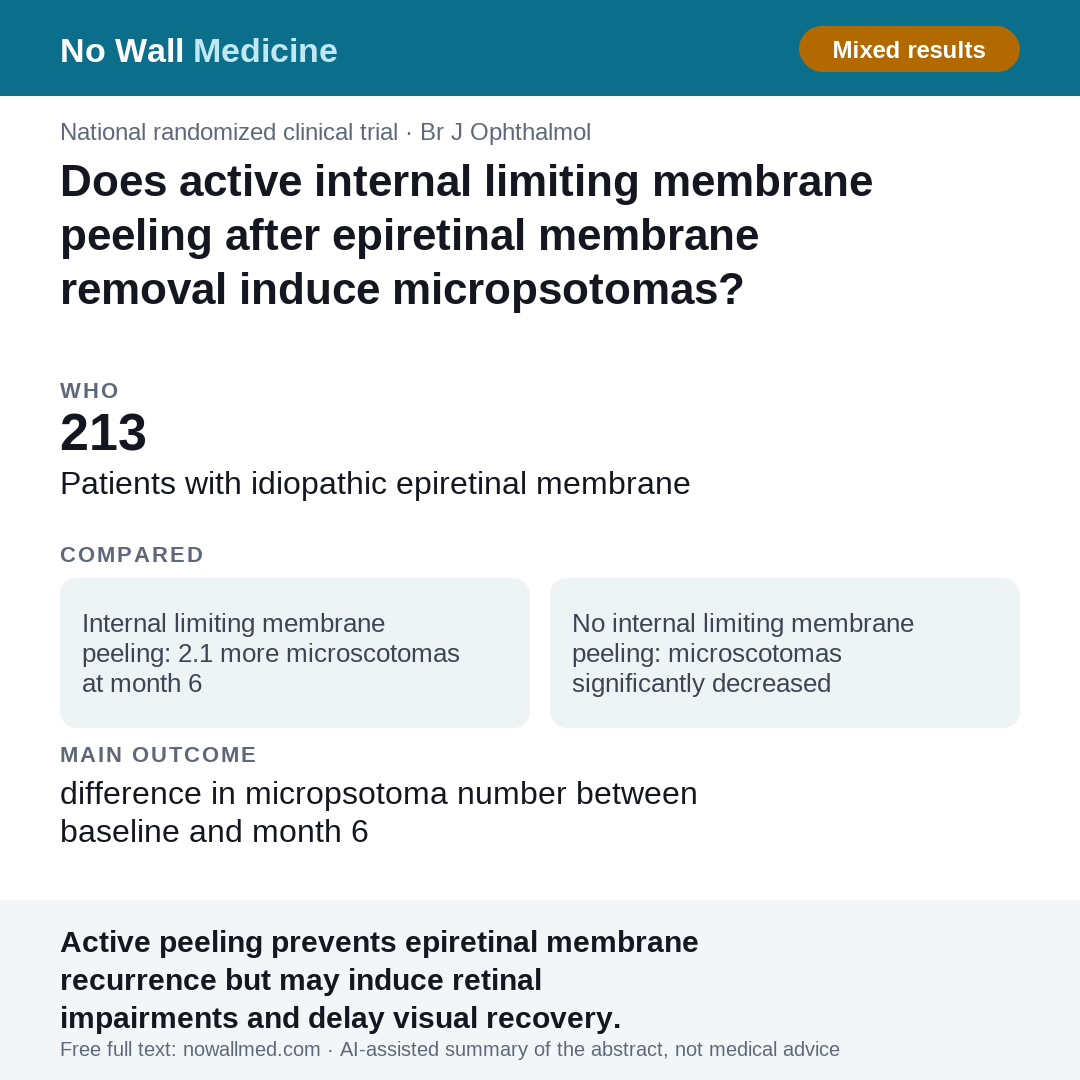
Clinical question: Does active internal limiting membrane peeling after epiretinal membrane removal induce micropsotomas?
Why it matters: It is unclear whether removing the internal limiting membrane during surgery for idiopathic epiretinal membrane prevents recurrence without causing retinal impairments like blind spots.
Key points
- Researchers randomized 100 patients with idiopathic epiretinal membrane (a thin layer of tissue on the retina) to either receive internal limiting membrane peeling or no peeling.
- At 1 month, the peeling group had 3.9 more microscotomas (small blind spots) than the no peeling group, though this difference was not significant at 6 months.
- Epiretinal membrane recurrence occurred in 19.6% of the no peeling group compared to 0% in the peeling group.
Headline and key points written with AI from the paper’s abstract, with every number checked against it. Read the paper before relying on them.
Was this summary helpful?
Abstract
Background
After idiopathic epiretinal membrane (iERM) removal, it is unclear whether the internal limiting membrane (ILM) should be removed. The objective was to assess if active ILM peeling after iERM removal could induce microscotomas. Methods
The PEELING study is a national randomised clinical trial. When no spontaneous ILM peeling occurred, patients were randomised either to the ILM peeling or no ILM peeling group. Groups were compared at the month 1 (M1), M6 and M12 visits in terms of microperimetry, best-corrected visual acuity (BCVA) and optical coherence tomography findings. The primary outcome was the difference in microscotoma number between baseline and M6. Results
213 patients were included, 101 experienced spontaneous ILM peeling and 100 were randomised to the ILM peeling (n=51) or no ILM peeling group (n=49). The difference in microscotoma number between both groups was significant at M1 (3.9 more microscotomas in ILM peeling group, (0.8;7.0) p=0.0155) but not at M6 (2.1 more microscotomas in ILM peeling group (-0.5;4.7) p=0.1155). Only in the no ILM peeling group, the number of microscotomas significantly decreased and the mean retinal sensitivity significantly improved. The ERM recurred in nine patients in the no ILM peeling group (19.6%) versus zero in the ILM peeling group (p=0.0008): two of them underwent revision surgery. There was no difference in mean BCVA and microperimetry between patients experiencing or not a recurrence at M12. Conclusion
Spontaneous ILM peeling is very common. Active ILM peeling prevents anatomical ERM recurrence but may induce retinal impairments and delay visual recovery. Trial registration
NCT02146144.
Abstract reproduced under the article’s CC BY NC licence.
Subject terms
Cite this article
Ducloyer JB, Eude Y, Volteau C, et al. Pros and cons of internal limiting membrane peeling during epiretinal membrane surgery: a randomised clinical trial with microperimetry (PEELING). Br J Ophthalmol. 2024. doi:10.1136/bjo-2023-324990
Spotted a mistake? Suggest a correction