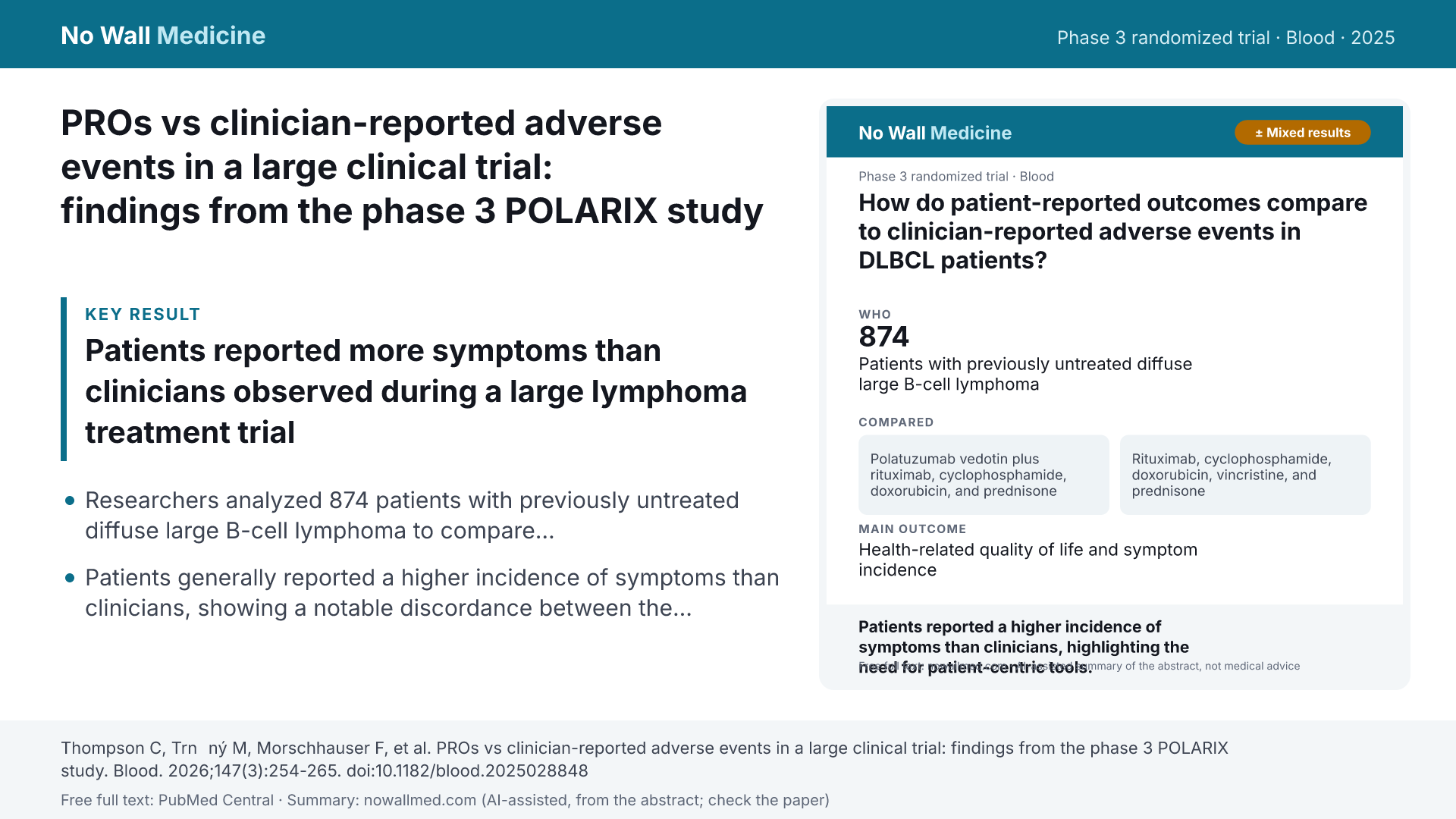
Patients reported more symptoms than clinicians observed during a large lymphoma treatment trial
PROs vs clinician-reported adverse events in a large clinical trial: findings from the phase 3 POLARIX study
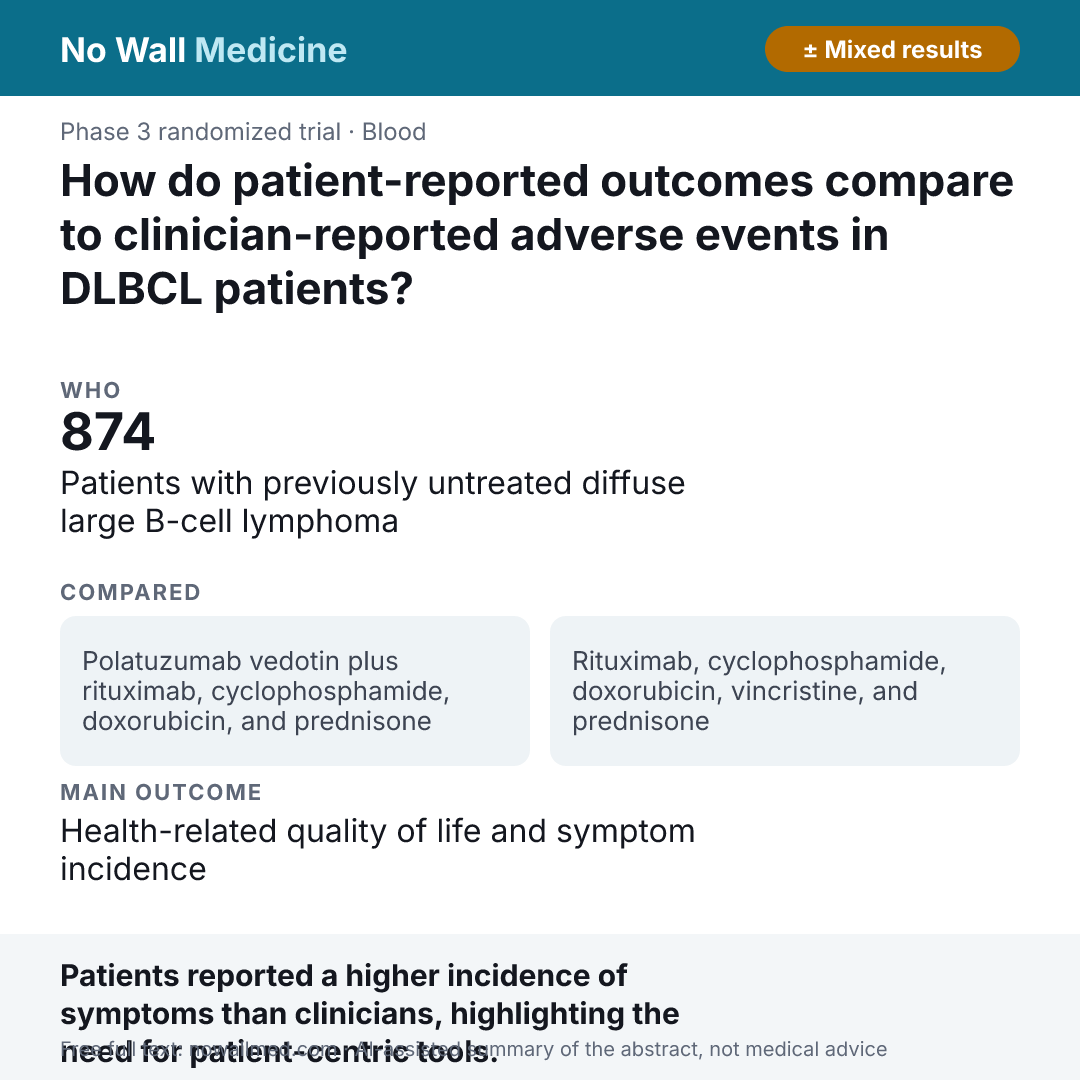
Phase 3 randomized trialMixed results
How do patient-reported outcomes compare to clinician-reported adverse events in DLBCL patients?
Who
874
Patients with previously untreated diffuse large B-cell lymphoma
Compared
Polatuzumab vedotin plus rituximab, cyclophosphamide, doxorubicin, and prednisone
Rituximab, cyclophosphamide, doxorubicin, vincristine, and prednisone
Main outcome
Health-related quality of life and symptom incidence
Bottom line: Patients reported a higher incidence of symptoms than clinicians, highlighting the need for patient-centric tools.
Blood · 2025-09-25 · Save PNG
Same trial (NCT03274492)
Papers we list that report this registered trial, oldest first. Read a secondary analysis alongside the main results.
- Related analysis Benefit found
Polatuzumab vedotin combined with chemotherapy was associated with longer progression-free survival in lymphoma patients NEJM 2021-12 - Secondary analysis Key finding
Polatuzumab vedotin combined with chemotherapy was associated with better progression-free survival in Asian patients Blood 2023-01 - Secondary analysis Benefit found
Pola-R-CHP showed improved progression-free survival in older patients with diffuse large B-cell lymphoma Blood Adv 2025-03 - Related analysis Benefit found
Five-year results show Pola-R-CHP improves progression-free survival in diffuse large B-cell lymphoma J Clin Oncol 2025-09 - Main results Mixed results
This paper Blood 2025-09
Clinical question: How do patient-reported outcomes compare to clinician-reported adverse events in DLBCL patients?
Why it matters: Clinicians and patients may perceive treatment side effects differently, which complicates the full characterization of the patient experience during lymphoma treatment.
Key points
- Researchers analyzed 874 patients with previously untreated diffuse large B-cell lymphoma to compare patient-reported outcomes with clinician-reported adverse events.
- Patients generally reported a higher incidence of symptoms than clinicians, showing a notable discordance between the two reporting methods.
- Both treatment groups showed rapid and sustained improvements in health-related quality of life, lymphoma symptoms, fatigue, and social functioning.
Headline and key points written with AI from the paper’s abstract, with every number checked against it. Read the paper before relying on them.
Was this summary helpful?
Abstract
Diffuse large B-cell lymphoma (DLBCL) poses a challenge in hematology given its varied symptoms, and the complex interplay between disease and treatment effects on health-related quality of life (HRQoL). The phase 3 POLARIX study demonstrated superior progression-free survival and a similar safety profile with polatuzumab vedotin plus rituximab, cyclophosphamide, doxorubicin, and prednisone (Pola-R-CHP) vs R-CHOP (rituximab, cyclophosphamide, doxorubicin, vincristine, and prednisone) in patients with previously untreated DLBCL. Here, we evaluate HRQoL through patient-reported outcome (PRO) instruments to fully characterize the patient experience in the POLARIX study. Changes from baseline in HRQoL, lymphoma symptoms, and gastrointestinal (GI) symptoms were assessed, as well as incidence and severity of common symptoms by PROs vs clinician-reported adverse events (AEs). Baseline characteristics of PRO-evaluable patients (N = 874) were consistent. Comparison between PROs and clinician-reported AEs revealed a notable discordance; patients generally reported a higher incidence of symptoms than clinicians, emphasizing the need for patient-centric tools to accurately capture the patient experience. Both treatments exhibited rapid and sustained improvements in HRQoL and lymphoma symptoms, with the most substantial improvements seen in global health status/QoL, lymphoma symptoms, fatigue, role, emotional, and social functioning. GI symptoms (diarrhea, constipation, nausea, and vomiting) were generally similar between treatment arms and returned to baseline levels after treatment completion. These HRQoL data underscore the complementarity of PROs, as an adjunct to clinician-reported AEs, in evaluating the efficacy and tolerability of new treatments, including Pola-R-CHP, which may represent a new benchmark for patient-reported HRQoL in previously untreated DLBCL. This trial was registered at www.clinicaltrials.gov as NCT03274492.
Abstract reproduced under the article’s CC BY NC ND licence.
Subject terms
Headline, design, result, key points, caveat and citation as plain text.
Cite this article
Thompson C, Trněný M, Morschhauser F, et al. PROs vs clinician-reported adverse events in a large clinical trial: findings from the phase 3 POLARIX study. Blood. 2026;147(3):254-265. doi:10.1182/blood.2025028848
Spotted a mistake? Suggest a correction