Updated guidelines recommend specific nerve blocks and medications for pain management after hip replacement surgery
PROSPECT guideline for total hip arthroplasty: updated systematic review and procedure-specific postoperative pain management recommendations
Systematic review of randomized controlled trialsBenefit found
What are the best postoperative pain management recommendations for elective primary total hip arthroplasty?
Who
103
Patients undergoing elective primary total hip arthroplasty
Compared
Recommended core management
Quadratus lumborum and lumbar erector spinae plane blocks: increased risk of motor weakness
Main outcome
pain, opioid consumption, functional recovery, and adverse effects
Bottom line: Scheduled paracetamol, non-steroidal anti-inflammatory drugs, and dexamethasone are recommended alongside specific regional nerve blocks.
Anaesthesia · 2026-07-20Download image
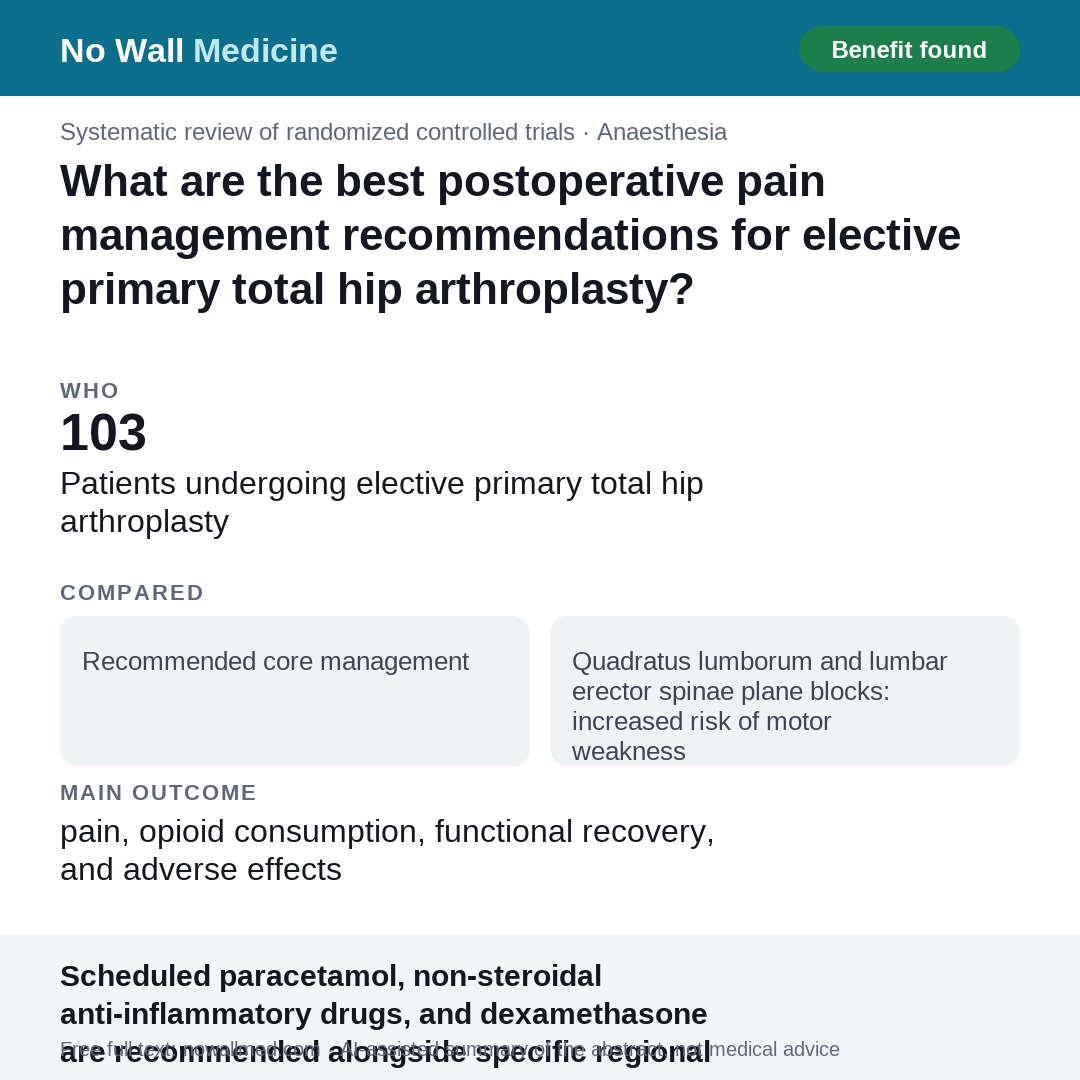
Clinical question: What are the best postoperative pain management recommendations for elective primary total hip arthroplasty?
Why it matters: New evidence regarding motor-sparing regional techniques, which are nerve blocks that aim to avoid muscle weakness, has emerged since the previous 2021 guidelines.
Key points
- Researchers reviewed 103 studies published between January 2020 and June 2024 to update pain management recommendations for elective primary total hip replacement.
- Core recommendations include scheduled paracetamol and non-steroidal anti-inflammatory drugs combined with a single intravenous dose of dexamethasone of 10 mg or less.
- Supra-inguinal fascia iliaca compartment block and pre-operative pericapsular nerve group block are preferred regional techniques, while lumbar erector spinae plane blocks showed inconsistent efficacy.
Headline and key points written with AI from the paper’s abstract, with every number checked against it. Read the paper before relying on them.
Spotted a mistake? Suggest a correction