Adding rotor ablation to conventional ablation showed no difference in treating persistent atrial fibrillation
Prospective Randomized Trial of Rotor Ablation vs Conventional Ablation for Persistent Atrial Fibrillation: REAFFIRM Trial
Randomized trialNo clear difference
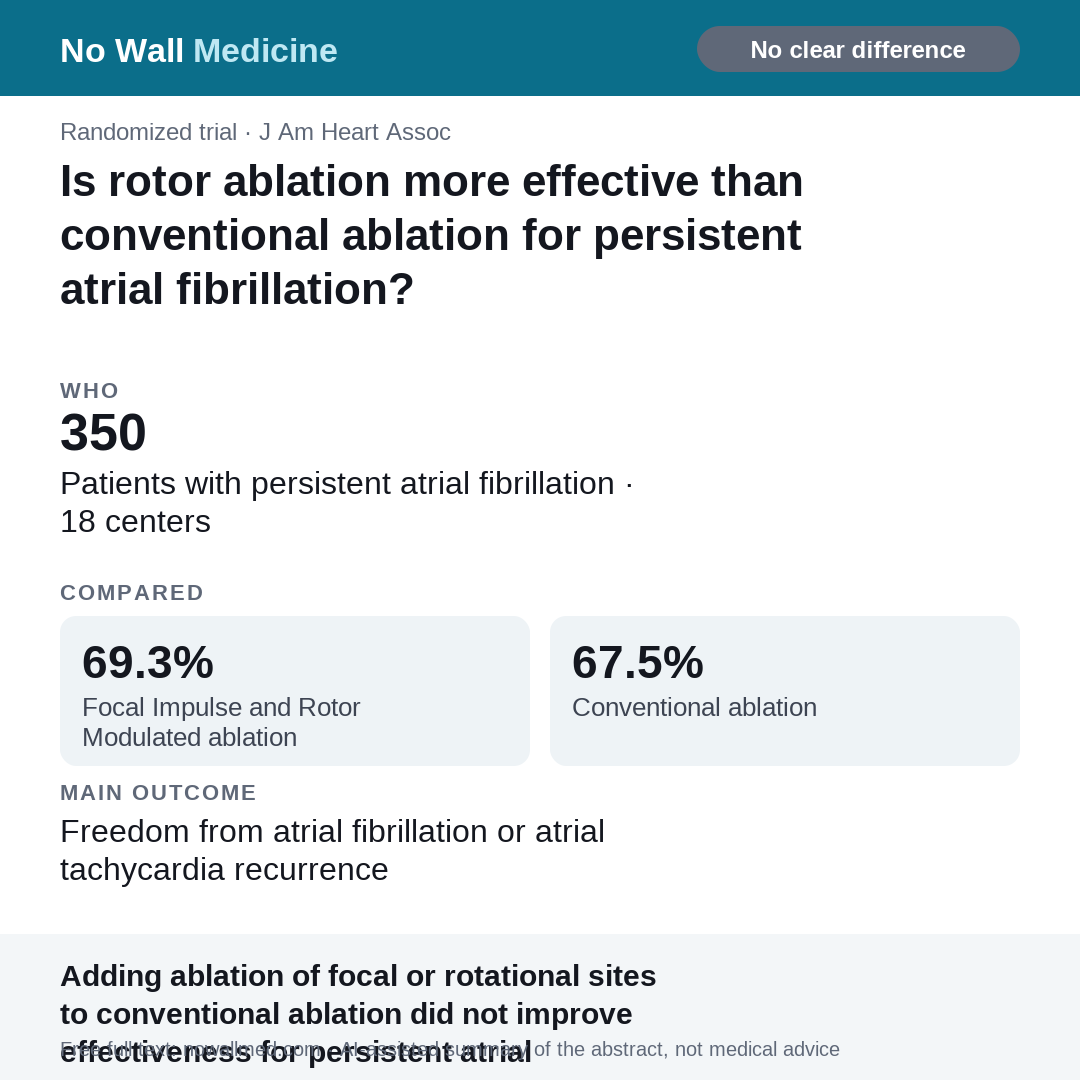
Is rotor ablation more effective than conventional ablation for persistent atrial fibrillation?
Who
350
Patients with persistent atrial fibrillation · 18 centers
Compared
69.3%Focal Impulse and Rotor Modulated ablation
67.5%Conventional ablation
Main outcome
Freedom from atrial fibrillation or atrial tachycardia recurrence
Bottom line: Adding ablation of focal or rotational sites to conventional ablation did not improve effectiveness for persistent atrial fibrillation.
J Am Heart Assoc · 2025-06-18Download image
Clinical question: Is rotor ablation more effective than conventional ablation for persistent atrial fibrillation?
Why it matters: It is unclear if adding the ablation of focal or rotational drivers to standard pulmonary vein isolation improves outcomes for patients with persistent atrial fibrillation.
Key points
- Researchers randomized 350 patients across 18 centers to compare conventional ablation with Focal Impulse and Rotor Modulation (FIRM) ablation for persistent atrial fibrillation.
- The primary effectiveness rate at 3 to 12 months was 69.3% for the FIRM group and 67.5% for the conventional group, which was not statistically significant.
- There was no difference between the two groups regarding the safety of the procedure or the time required to complete the ablation.
Headline and key points written with AI from the paper’s abstract, with every number checked against it. Read the paper before relying on them.
Was this summary helpful?
Subject terms
Cite this article
Brachmann J, Vogtmann T, Hummel J, Swarup V, Wilber D, Rapkin J. Prospective Randomized Trial of Rotor Ablation vs Conventional Ablation for Persistent Atrial Fibrillation: REAFFIRM Trial. J Am Heart Assoc. 2025. doi:10.1161/JAHA.121.022346
Spotted a mistake? Suggest a correction
Top studies every Monday
The week’s key trials and guidelines in your specialties, plus any topics you follow. By email, free.
Get the weekly digest