Randomized trialThe Lancet Oncology · Nov 20, 2026
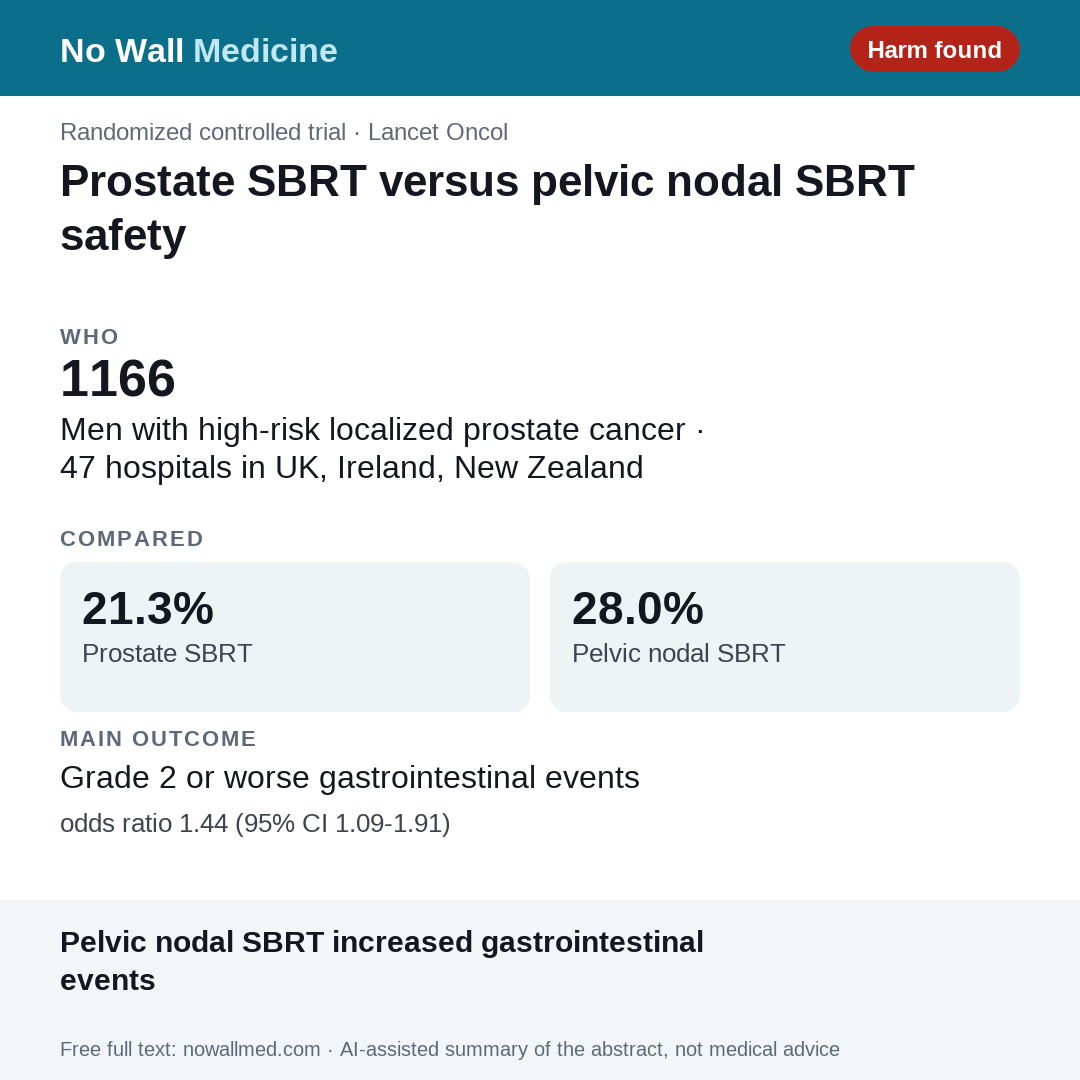
Prostate and pelvic node radiotherapy increased gastrointestinal adverse events by 6.7 percentage points
Prostate and pelvic nodal stereotactic body radiotherapy (SBRT) versus prostate-only SBRT for high-risk, localised prostate cancer (PACE-NODES): early adverse event results from an international, open-label, phase 3, randomised controlled trial
Pathmanathan A, Jain S, Cafferty FH, Leaning D, Chan A, Venkitaraman R, et al
Prostate SBRT: 21.3% · Pelvic nodal SBRT: 28% → a difference of 6.7 percentage points, so about 15 people would receive it for 1 more to be harmed (number needed to harm) over the trial’s follow-up.
Worked out by us from the two group results above, not reported by the authors. Check the paper for the exact outcome and timing.
Key points
1166 men with high-risk prostate cancer were randomly assigned to prostate-only or prostate and pelvic node stereotactic body radiotherapy.
21.3% of patients receiving prostate-only radiotherapy and 28.0% receiving prostate and pelvic node radiotherapy had grade 2 or worse gastrointestinal events within 12 weeks.
Genitourinary adverse events were similar in both groups, with 40.2% of patients receiving prostate-only radiotherapy and 35.8% receiving prostate and pelvic node radiotherapy having grade 2 or worse events.
Headline and key points written with AI from the paper’s abstract, with every number checked against it. Read the paper before relying on them.
Background
Radiotherapy to the prostate and pelvic lymph nodes compared with prostate-only radiotherapy has shown benefits for high-risk prostate cancer in some studies, but evidence remains unclear. In low-risk or intermediate-risk disease, prostate-only stereotactic body radiotherapy (P-SBRT) is safe and effective. PACE-NODES aims to demonstrate safety and efficacy of prostate and pelvic nodal SBRT (PPN-SBRT) for high-risk disease. Methods
PACE-NODES is a phase 3, open-label, randomised trial conducted at 47 hospitals in the UK, Ireland, and New Zealand. The trial recruited men aged 18 years or older, with a WHO performance status of 0-2, and with high-risk (Gleason score 8-10, stage T3a-T4, or prostate-specific antigen >20 ng/mL), localised prostate adenocarcinoma, planned for at least 12 months of hormone therapy. Participants were randomly assigned (1:1), using minimisation with a random element, to P-SBRT (36·25 Gy prostate) or PPN-SBRT (36·25 Gy prostate, 25 Gy pelvic nodes) in five fractions, on alternate days. Neither participants nor researchers were masked to treatment allocation. The primary endpoint is time to biochemical or clinical failure (not yet mature). This preplanned safety analysis is on secondary endpoints, with a focus on Common Terminology Criteria for Adverse Events grade 2 or worse gastrointestinal and genitourinary adverse events within 12 weeks of treatment, analysed by treatment received. Patient-reported outcomes include Expanded Prostate Index Composite Short Form (EPIC-26), International Prostate Symptom Score (IPSS), and EQ-5D-5L. This study is registered at ClinicalTrials.gov (NCT05613023) and is ongoing. Findings
Between Sept 9, 2022, and July 31, 2025, 1166 participants were recruited and randomly assigned (583 per group). The median age was 72·7 years (IQR 67·7-76·5). 18 patients did not receive radiotherapy; a further 60 (17 assigned to P-SBRT, 43 assigned to PPN-SBRT) did not receive allocated radiotherapy, mostly where planning constraints were not met. This analysis includes 555 patients receiving P-SBRT and 511 patients receiving PPN-SBRT who had completed acute follow-up. Median follow-up was 13·8 months (IQR 7·8-21·0). 118 (21·3%) of 555 patients receiving P-SBRT and 143 (28·0%) of 511 receiving PPN-SBRT had grade 2 or worse gastrointestinal events within 12 weeks (difference 6·7 percentage points [95% CI 1·6-11·9]; p=0·011; odds ratio [OR] 1·44 [95% CI 1·09-1·91]). This included grade 3 events in eight (1·4%) patients treated with P-SBRT and 11 (2·2%) treated with PPN-SBRT, and a grade 4 event in one (0·2%) patient treated with P-SBRT. 223 (40·2%) of 555 patients receiving P-SBRT and 183 (35·8%) of 511 receiving PPN-SBRT had grade 2 or worse genitourinary events (difference -4·4 percentage points [-10·2 to 1·5]; p=0·14; OR 0·83 [0·65-1·06]). This included grade 3 events in seven (1·3%) patients treated with P-SBRT and two (0·4%) treated with PPN-SBRT (no grade 4 events). Genitourinary and gastrointestinal adverse events peaked at 2 weeks and were low and similar between groups at 12 weeks. There were no treatment-related deaths. More patients receiving PPN-SBRT had important decreases in bowel function on 4-week EPIC-26 (208 [54·9%] of 379 receiving P-SBRT, 239 [65·5%] of 365 receiving PPN-SBRT). The proportion of patients reporting moderate or severe urinary symptoms on IPSS at 4 weeks was similar in those receiving P-SBRT (312 [72·4%] of 431) and those receiving PPN-SBRT (284 [71·9%] of 395), as were 4-week decreases in overall health score on EQ-5D-5L (-3·2 [99% CI -4·8 to -1·6] for P-SBRT and -2·5 [-4·1 to -0·9] for PPN-SBRT). Interpretation
P-SBRT and PPN-SBRT for patients with high-risk prostate cancer were deliverable in an international multicentre trial. PPN-SBRT increased gastrointestinal but not genitourinary adverse events. Side-effects diminished rapidly, with no difference by 12 weeks. Follow-up continues for late adverse events and cancer control, which are essential for confirming a role for PPN-SBRT in this setting. Funding
Prostate Cancer UK.
Abstract reproduced under the article’s CC BY licence.