Physician-centered intervention reduced unnecessary bone scans for low-risk prostate cancer patients
Prostate Cancer Imaging Stewardship: a multimodal, physician-centered intervention for guideline-concordant imaging
Stepped-wedge, cluster-randomized trialBenefit found
Does PCIS reduce low-value imaging?
Who
2302
Patients with incident prostate cancer · 10 VAMCs
Compared
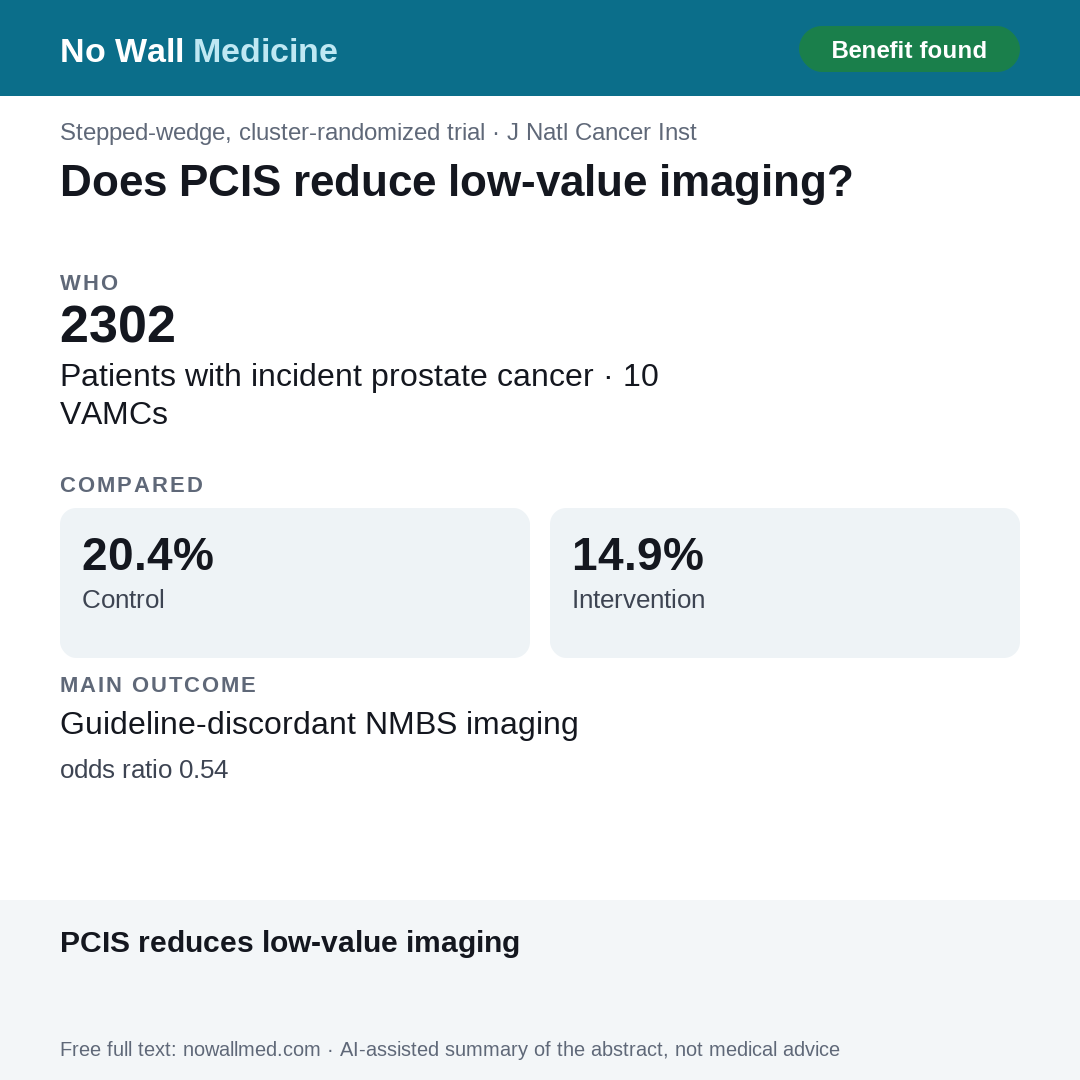
20.4%Control (141/690)
14.9%Intervention (109/734)
Main outcome
Guideline-discordant NMBS imaging
Result: odds ratio 0.54
Bottom line: PCIS reduces low-value imaging
J Natl Cancer Inst · 2025-08-13Download image
Clinical question: Does PCIS reduce low-value imaging?
Why it matters: Inappropriate imaging to stage low-risk prostate cancer is considered low-value care, and the effectiveness of the Prostate Cancer Imaging Stewardship intervention needed to be determined.
In absolute numbers
Control: 20.4% · Intervention: 14.9% → a difference of 5.5 percentage points, so about 19 people would need the treatment for 1 more to benefit (number needed to treat) over the trial’s follow-up.
Worked out by us from the two group results above, not reported by the authors. Check the paper for the exact outcome and timing.
Key points
- Researchers conducted a cluster-randomized trial involving 61 urology providers and 2302 patients with prostate cancer across 10 medical centers.
- The intervention was associated with a decrease in guideline-discordant nuclear medicine bone scans for patients not requiring them, from 20.4% during control to 14.9% during intervention.
- The intervention was not associated with a significant difference in patients who missed necessary bone scans, with rates of 6.8% during control and 5.5% during intervention.
Headline and key points written with AI from the paper’s abstract, with every number checked against it. Read the paper before relying on them.
Topics
Cite this article
Makarov DV, Thomas JK, Ciprut S, Rivera AJ, Sherman SE, Braithwaite RS. Prostate Cancer Imaging Stewardship: a multimodal, physician-centered intervention for guideline-concordant imaging. J Natl Cancer Inst. 2025. doi:10.1093/jnci/djaf210
Spotted a mistake? Suggest a correction
Top studies every Monday
The week’s key trials and guidelines in your specialties, plus any topics you follow. By email, free.
Get the weekly digest