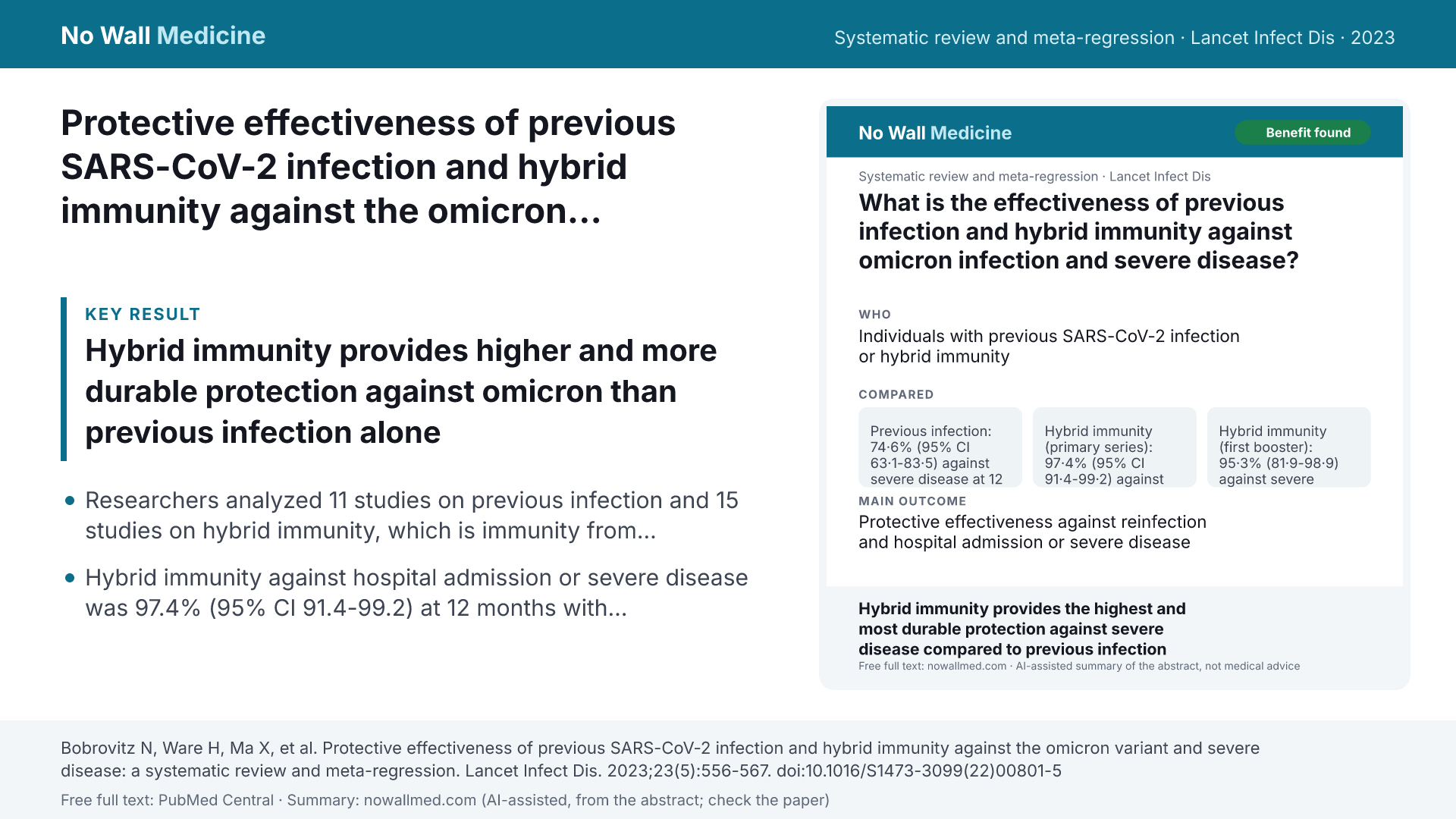
Hybrid immunity provides higher and more durable protection against omicron than previous infection alone
Protective effectiveness of previous SARS-CoV-2 infection and hybrid immunity against the omicron variant and severe disease: a systematic review and meta-regression
Systematic review and meta-regressionBenefit found
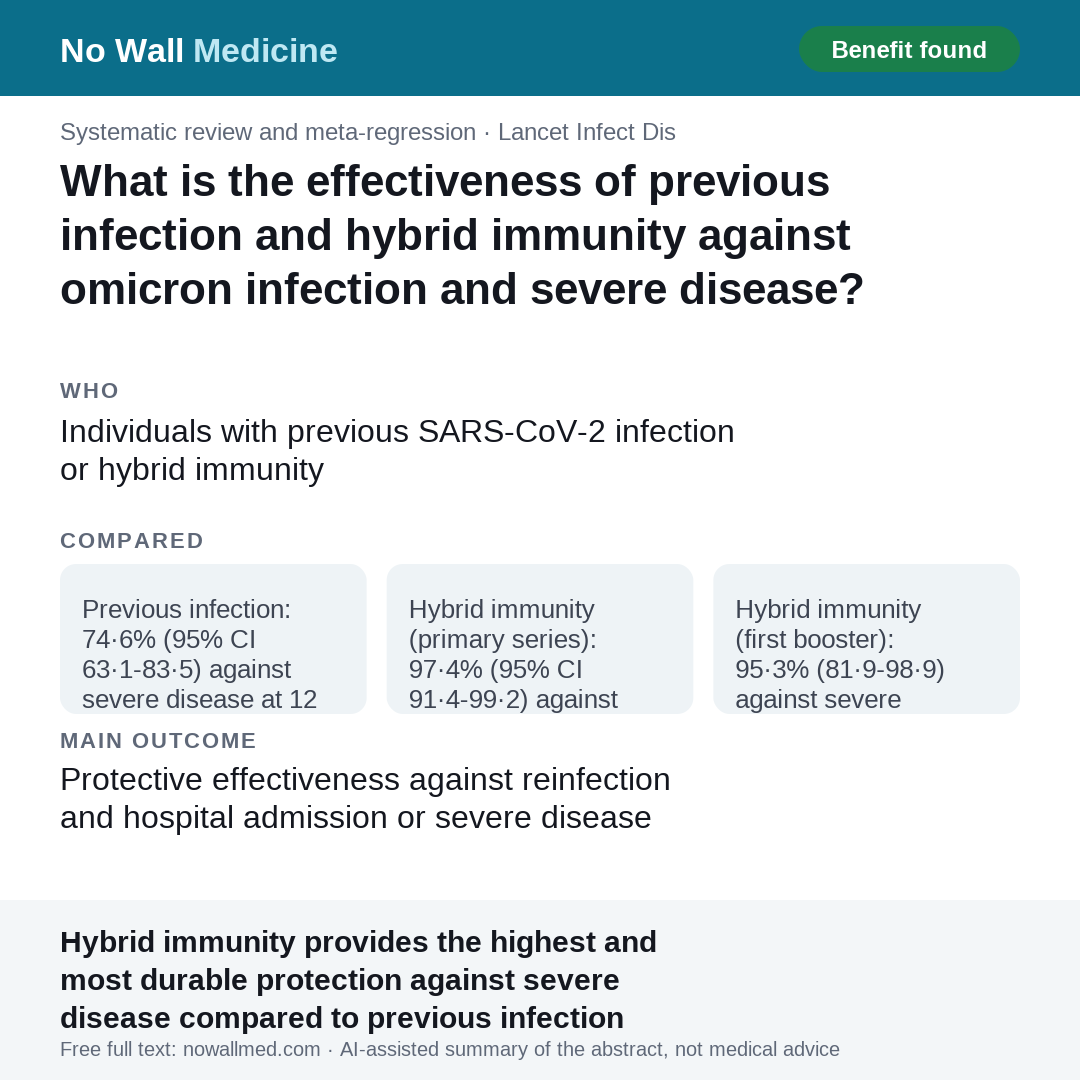
What is the effectiveness of previous infection and hybrid immunity against omicron infection and severe disease?
Who
Individuals with previous SARS-CoV-2 infection or hybrid immunity
Compared
Previous infection: 74·6% (95% CI 63·1-83·5) against severe disease at 12 months
Hybrid immunity (primary series): 97·4% (95% CI 91·4-99·2) against severe disease at 12 months
Hybrid immunity (first booster): 95·3% (81·9-98·9) against severe disease at 6 months
Main outcome
Protective effectiveness against reinfection and hospital admission or severe disease
Bottom line: Hybrid immunity provides the highest and most durable protection against severe disease compared to previous infection alone.
Limitation: Many included estimates had moderate or serious risk of bias
Funded by: WHO COVID-19 Solidarity Response Fund and CEPI
Lancet Infect Dis · 2023-01-18Download image
Clinical question: What is the effectiveness of previous infection and hybrid immunity against omicron infection and severe disease?
Why it matters: The magnitude and duration of protection from previous infection and hybrid immunity against the omicron variant and severe disease were not fully established.
Key points
- Researchers analyzed 11 studies on previous infection and 15 studies on hybrid immunity, which is immunity from both infection and vaccination.
- Hybrid immunity against hospital admission or severe disease was 97.4% (95% CI 91.4-99.2) at 12 months with primary vaccination and 95.3% (81.9-98.9) at 6 months with a booster.
- Protection from previous infection against reinfection waned to 24.7% (95% CI 16.4-35.5) at 12 months, while hybrid immunity against reinfection was 41.8% (95% CI 31.5-52.8) at 12 months.
Limitation the authors note: Many included studies had a moderate or serious risk of bias.
Headline and key points written with AI from the paper’s abstract, with every number checked against it. Read the paper before relying on them.
Was this summary helpful?
Abstract
Background
The global surge in the omicron (B.1.1.529) variant has resulted in many individuals with hybrid immunity (immunity developed through a combination of SARS-CoV-2 infection and vaccination). We aimed to systematically review the magnitude and duration of the protective effectiveness of previous SARS-CoV-2 infection and hybrid immunity against infection and severe disease caused by the omicron variant. Methods
For this systematic review and meta-regression, we searched for cohort, cross-sectional, and case-control studies in MEDLINE, Embase, Web of Science, ClinicalTrials.gov, the Cochrane Central Register of Controlled Trials, the WHO COVID-19 database, and Europe PubMed Central from Jan 1, 2020, to June 1, 2022, using keywords related to SARS-CoV-2, reinfection, protective effectiveness, previous infection, presence of antibodies, and hybrid immunity. The main outcomes were the protective effectiveness against reinfection and against hospital admission or severe disease of hybrid immunity, hybrid immunity relative to previous infection alone, hybrid immunity relative to previous vaccination alone, and hybrid immunity relative to hybrid immunity with fewer vaccine doses. Risk of bias was assessed with the Risk of Bias In Non-Randomized Studies of Interventions Tool. We used log-odds random-effects meta-regression to estimate the magnitude of protection at 1-month intervals. This study was registered with PROSPERO (CRD42022318605). Findings
11 studies reporting the protective effectiveness of previous SARS-CoV-2 infection and 15 studies reporting the protective effectiveness of hybrid immunity were included. For previous infection, there were 97 estimates (27 with a moderate risk of bias and 70 with a serious risk of bias). The effectiveness of previous infection against hospital admission or severe disease was 74·6% (95% CI 63·1-83·5) at 12 months. The effectiveness of previous infection against reinfection waned to 24·7% (95% CI 16·4-35·5) at 12 months. For hybrid immunity, there were 153 estimates (78 with a moderate risk of bias and 75 with a serious risk of bias). The effectiveness of hybrid immunity against hospital admission or severe disease was 97·4% (95% CI 91·4-99·2) at 12 months with primary series vaccination and 95·3% (81·9-98·9) at 6 months with the first booster vaccination after the most recent infection or vaccination. Against reinfection, the effectiveness of hybrid immunity following primary series vaccination waned to 41·8% (95% CI 31·5-52·8) at 12 months, while the effectiveness of hybrid immunity following first booster vaccination waned to 46·5% (36·0-57·3) at 6 months. Interpretation
All estimates of protection waned within months against reinfection but remained high and sustained for hospital admission or severe disease. Individuals with hybrid immunity had the highest magnitude and durability of protection, and as a result might be able to extend the period before booster vaccinations are needed compared to individuals who have never been infected. Funding
WHO COVID-19 Solidarity Response Fund and the Coalition for Epidemic Preparedness Innovations.
Abstract reproduced under the article’s CC BY licence.
Subject terms
Cite this article
Bobrovitz N, Ware H, Ma X, et al. Protective effectiveness of previous SARS-CoV-2 infection and hybrid immunity against the omicron variant and severe disease: a systematic review and meta-regression. Lancet Infect Dis. 2023. doi:10.1016/S1473-3099(22)00801-5
Spotted a mistake? Suggest a correction