Protein supplements and antibiotics did not improve linear growth in Bangladeshi infants
Protein supplementation delivered alone or in combination with presumptive azithromycin treatment for enteric pathogens did not improve linear growth in Bangladeshi infants: results of a cluster-randomized controlled trial
2 × 4 factorial cluster-randomized trialNo clear difference
Do protein supplementation and azithromycin improve linear growth in Bangladeshi infants?
Who
1821
Infants aged 6-12 months in northwestern Bangladesh · Northwestern Bangladesh
Compared
Protein supplement: β: 0.05 (95% CI: 0.00, 0.11)
Isocaloric supplement
Azithromycin: β: -0.05 (95% CI: -0.11, 0.01)
Placebo
Main outcome
Length-for-age z score and stunting
Bottom line: Protein supplementation and azithromycin treatment did not improve linear growth in infants aged 6 to 12 months.
Am J Clin Nutr · 2025-01-07Download image
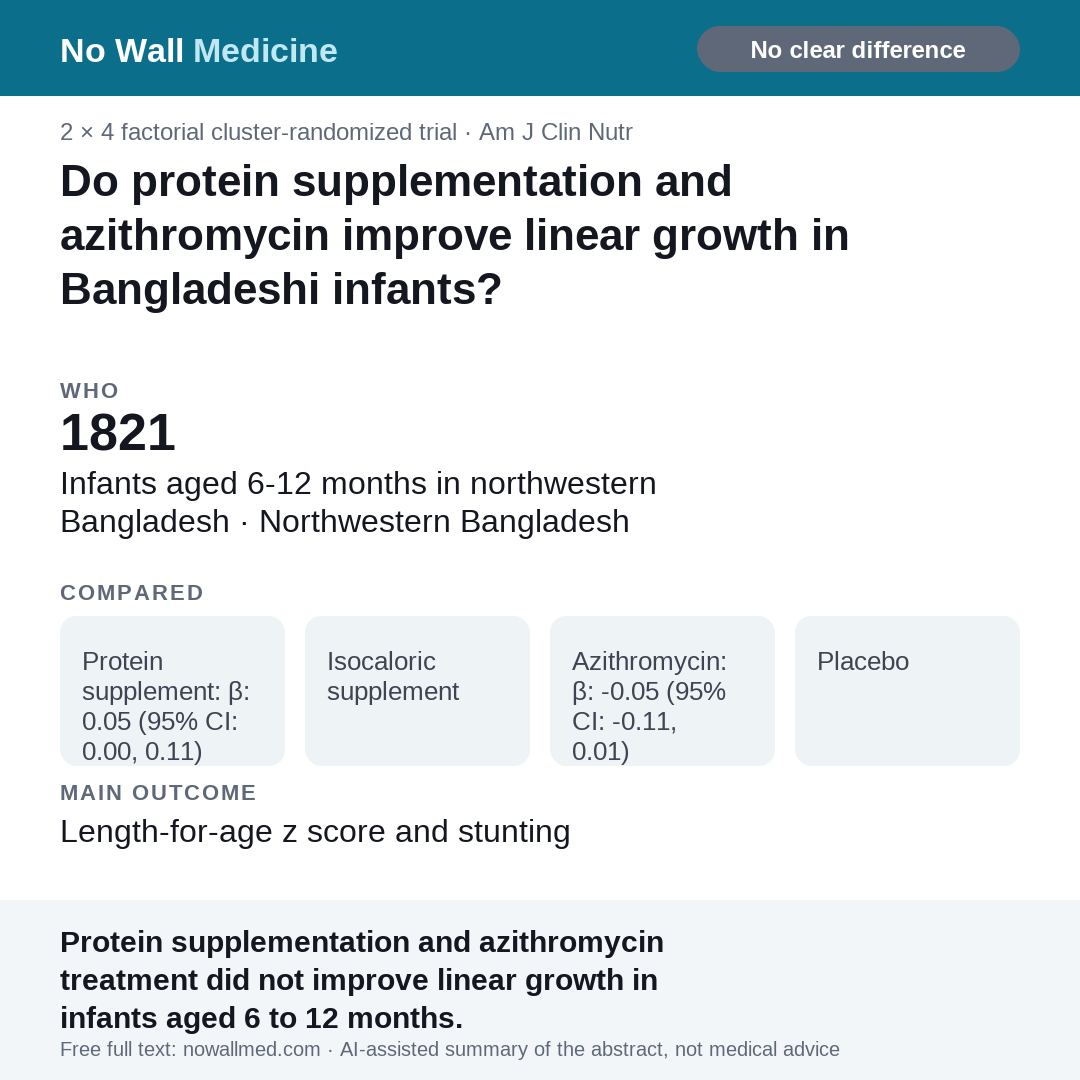
Clinical question: Do protein supplementation and azithromycin improve linear growth in Bangladeshi infants?
Why it matters: Protein requirements for healthy populations may be insufficient for infants eating mostly cereal-based foods and facing frequent exposure to intestinal pathogens.
Key points
- Researchers studied 1821 infants in northwestern Bangladesh to compare protein supplements and antibiotic treatment for intestinal pathogens.
- Protein supplementation did not improve length-for-age z-score (β: 0.05; 95% CI: 0.00, 0.11; P = 0.07) or stunting (prevalence ratio: 1.12; 95% CI: 0.85, 1.49; P = 0.41).
- The antibiotic intervention also had no effect on length-for-age z-score (β: -0.05; 95% CI: -0.11, 0.01; P = 0.09) or stunting (prevalence ratio: 0.99; 95% CI: 0.75, 1.31; P = 0.96).
Headline and key points written with AI from the paper’s abstract, with every number checked against it. Read the paper before relying on them.
Was this summary helpful?
Subject terms
Cite this article
Palmer AC, Hossain MI, Ali H, Ayesha K, Shaikh S, Islam MT. Protein supplementation delivered alone or in combination with presumptive azithromycin treatment for enteric pathogens did not improve linear growth in Bangladeshi infants: results of a cluster-randomized controlled trial. Am J Clin Nutr. 2025. doi:10.1016/j.ajcnut.2024.12.027
Spotted a mistake? Suggest a correction
Top studies every Monday
The week’s key trials and guidelines in your specialties, plus any topics you follow. By email, free.
Get the weekly digest