Protocolized Postextubation Respiratory Support to Prevent Reintubation: A Randomized Clinical Trial
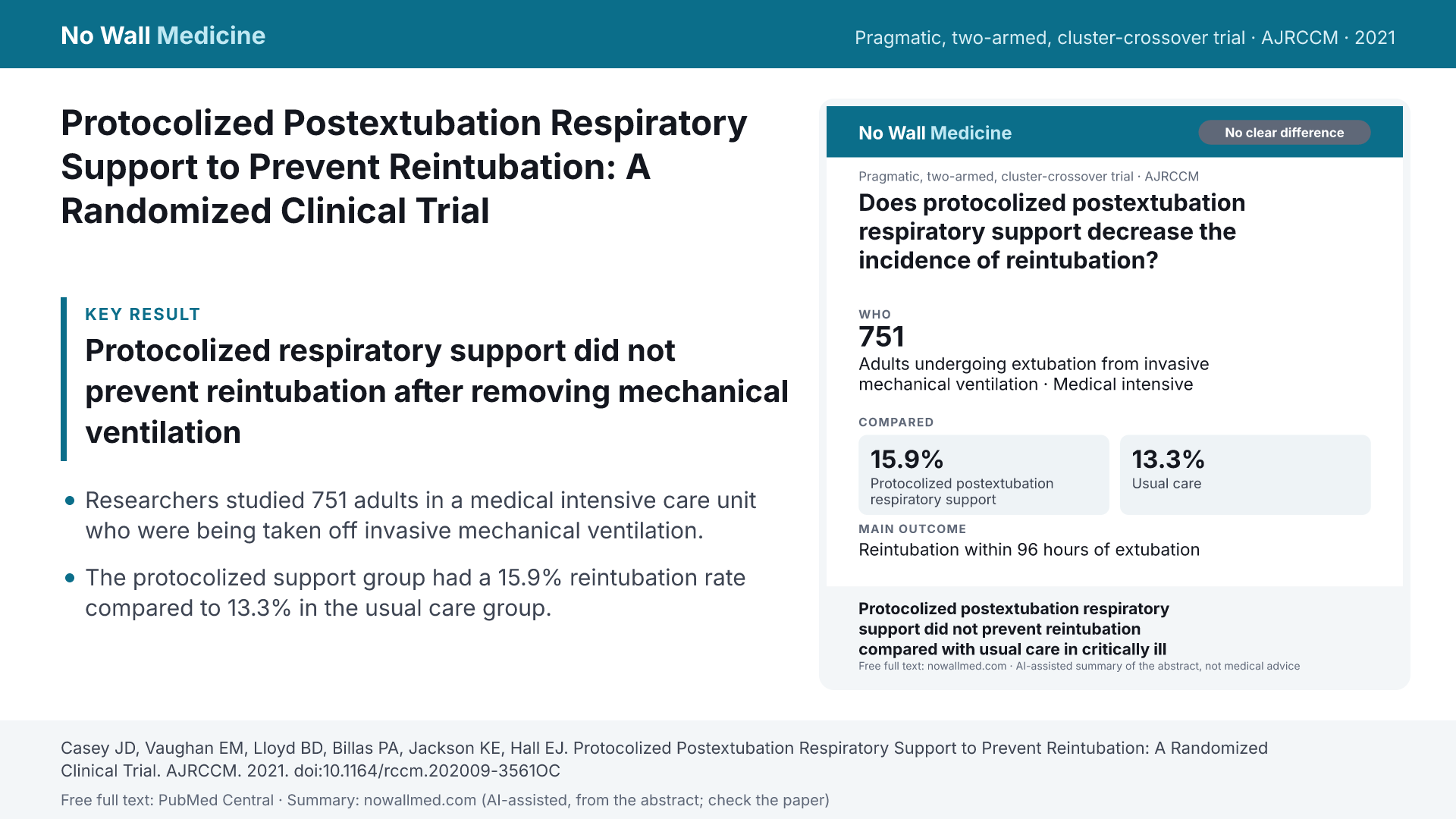
Key result: Protocolized respiratory support did not prevent reintubation after removing mechanical ventilation
Pragmatic, two-armed, cluster-crossover trialNo clear difference
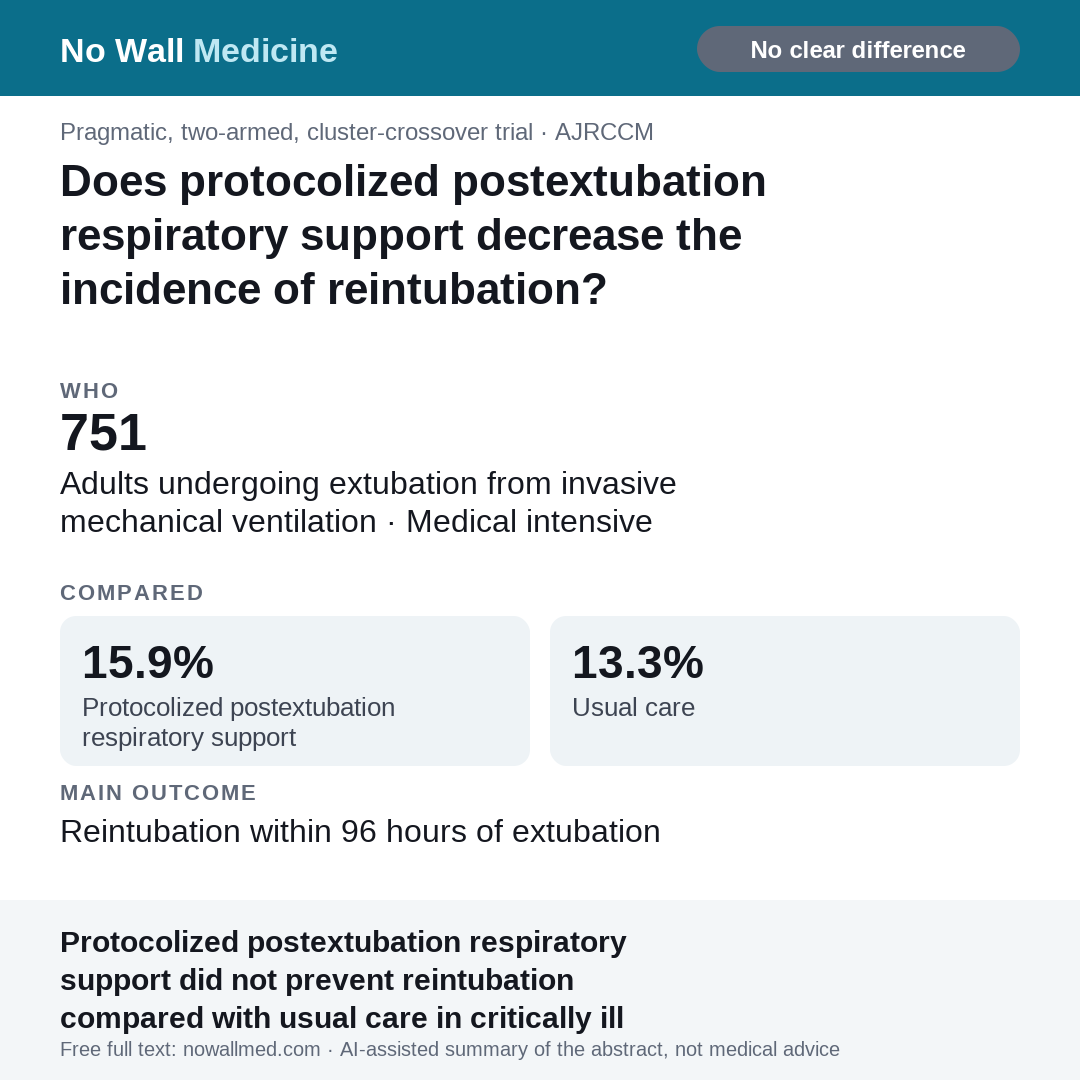
Does protocolized postextubation respiratory support decrease the incidence of reintubation?
Who
751
Adults undergoing extubation from invasive mechanical ventilation · Medical intensive care unit at an academic medical center
Compared
15.9%Protocolized postextubation respiratory support
13.3%Usual care
Main outcome
Reintubation within 96 hours of extubation
Result: odds ratio 1.23 (95% confidence interval, 0.82 to 1.84)
Bottom line: Protocolized postextubation respiratory support did not prevent reintubation compared with usual care in critically ill adults.
AJRCCM · 2021-04-02Download image
Key points
- Researchers studied 751 adults in a medical intensive care unit who were being taken off invasive mechanical ventilation.
- The protocolized support group had a 15.9% reintubation rate compared to 13.3% in the usual care group.
- The difference in reintubation rates between the two groups was not statistically significant (P = 0.32).
Why it matters: It is unknown if providing noninvasive ventilation or high-flow nasal cannula to all patients after extubation reduces the need for reintubation.
Discussion prompts
- Would these patients look like yours? Who was left out?
- Is the main outcome one that matters to patients?
- Is the difference large enough to change what you do?
Cite: Casey JD, Vaughan EM, Lloyd BD, Billas PA, Jackson KE, Hall EJ. Protocolized Postextubation Respiratory Support to Prevent Reintubation: A Randomized Clinical Trial. AJRCCM. 2021. doi:10.1164/rccm.202009-3561OC
Free full text: PubMed Central · Summary and visual abstract: nowallmed.com/a/protocolized-postextubation-respiratory-support-to-prevent-yggl3v/ (AI-assisted from the abstract; check the paper before relying on it).