Protocolized reduction of non-resuscitation fluids versus usual care in septic shock patients (REDUSE): a randomized multicentre feasibility trial
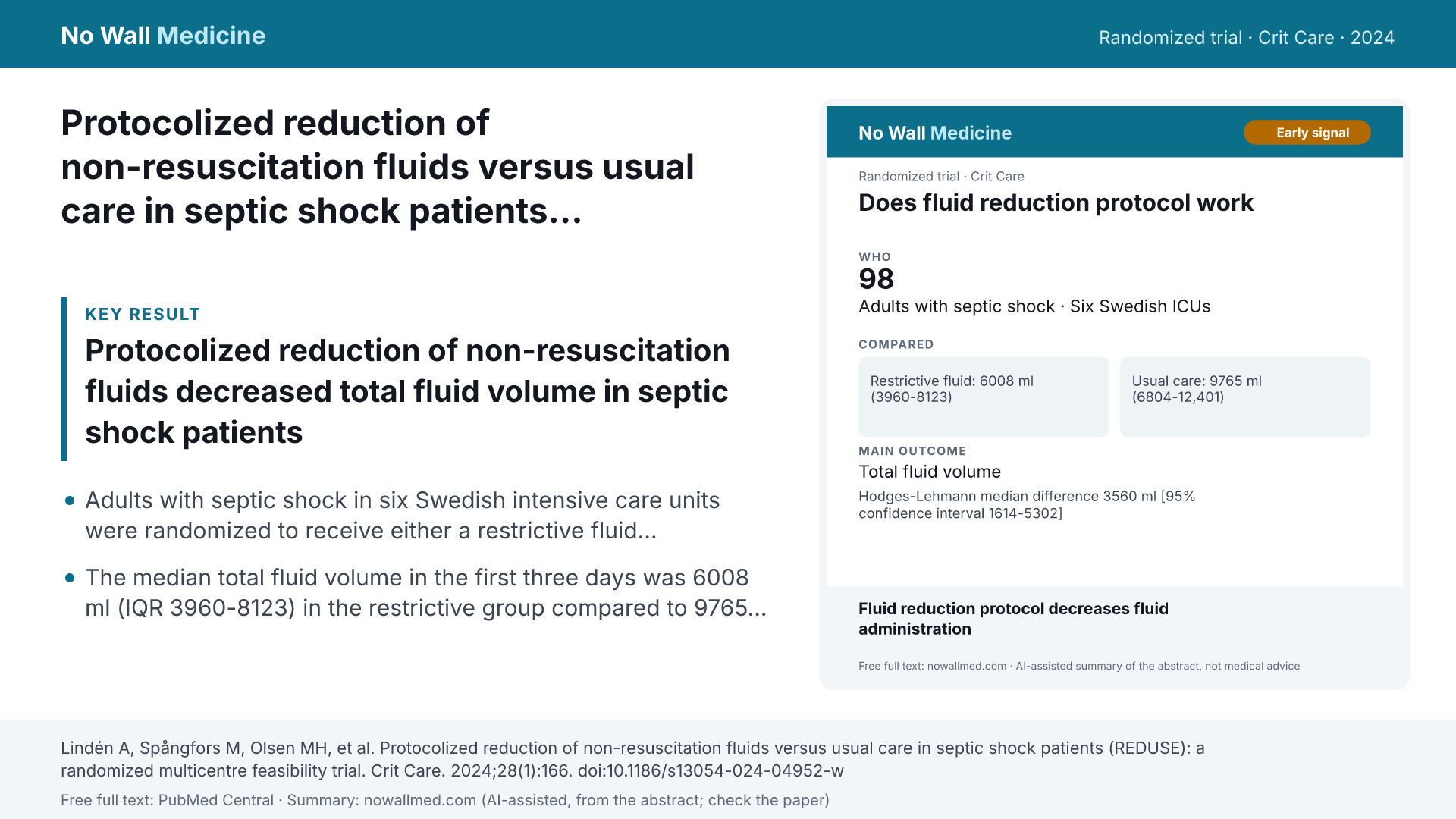
Key result: Protocolized reduction of non-resuscitation fluids decreased total fluid volume in septic shock patients
Randomized trialEarly signal
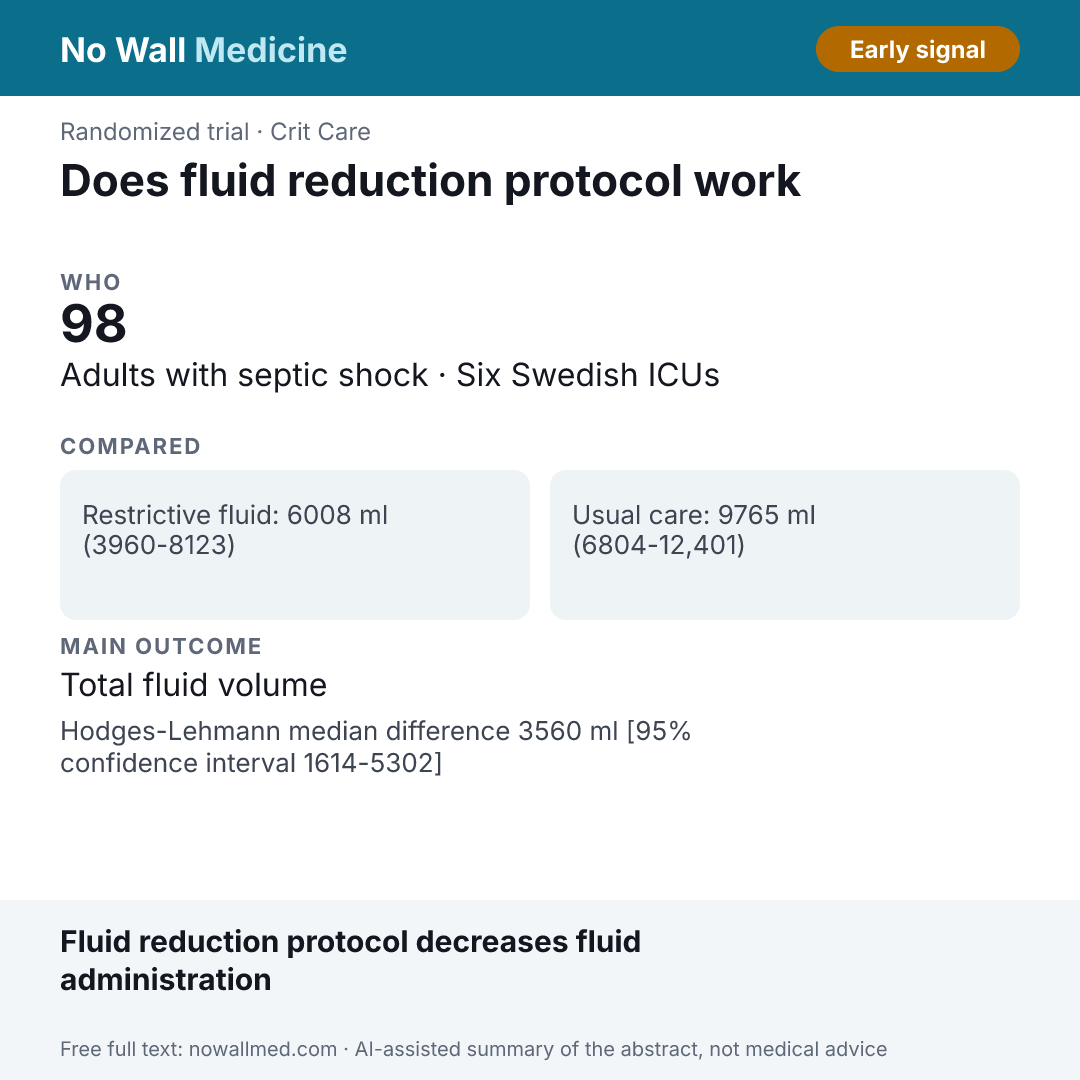
Does fluid reduction protocol work
Who
98
Adults with septic shock · Six Swedish ICUs
Compared
Restrictive fluid: 6008 ml (3960-8123)
Usual care: 9765 ml (6804-12,401)
Main outcome
Total fluid volume
Result: Hodges-Lehmann median difference 3560 ml [95% confidence interval 1614-5302]
Bottom line: Fluid reduction protocol decreases fluid administration
Crit Care · 2024-05-17 · Save PNG
Key points
- Adults with septic shock in six Swedish intensive care units were randomized to receive either a restrictive fluid protocol or usual care.
- The median total fluid volume in the first three days was 6008 ml (IQR 3960-8123) in the restrictive group compared to 9765 ml (IQR 6804-12,401) in the control group.
- The study found that 15/98 (15%) of participants experienced at least one protocol violation.
Discussion prompts
- Would these patients look like yours? Who was left out?
- Is the main outcome one that matters to patients?
- Is the difference large enough to change what you do?
Cite: Lindén A, Spångfors M, Olsen MH, et al. Protocolized reduction of non-resuscitation fluids versus usual care in septic shock patients (REDUSE): a randomized multicentre feasibility trial. Crit Care. 2024;28(1):166. doi:10.1186/s13054-024-04952-w
Free full text: PubMed Central · Summary and visual abstract: nowallmed.com/a/protocolized-reduction-of-non-resuscitation-fluids-versus-usual-care-1sfksiz/ (AI-assisted from the abstract; check the paper before relying on it).