Proximal hypoglossal nerve stimulation improved sleep apnea symptoms compared to a control group
Proximal Hypoglossal Nerve Stimulation for Obstructive Sleep Apnea in the OSPREY Study : A Randomized Controlled Trial
7-month randomized controlled trialBenefit found
Is proximal hypoglossal nerve stimulation effective for moderate-to-severe obstructive sleep apnea?
Who
104
Adults aged 22 years or older with moderate-to-severe obstructive sleep apnea · 23 U.S. health centers
Compared
58.2%treatment (95% CI, 45.5% to 70.2%)
13.5%control (CI, 4.5% to 28.8%)
Main outcome
proportion achieving greater than 50% apnea-hypopnea index improvement and AHI below 20
Bottom line: Proximal hypoglossal nerve stimulation yielded clinically significant responses compared to control for obstructive sleep apnea at month 7.
Limitation: Lack of blinding, small sample size, and short follow-up.
Funded by: LivaNova PLC
Ann Intern Med · 2026-04-21Download image
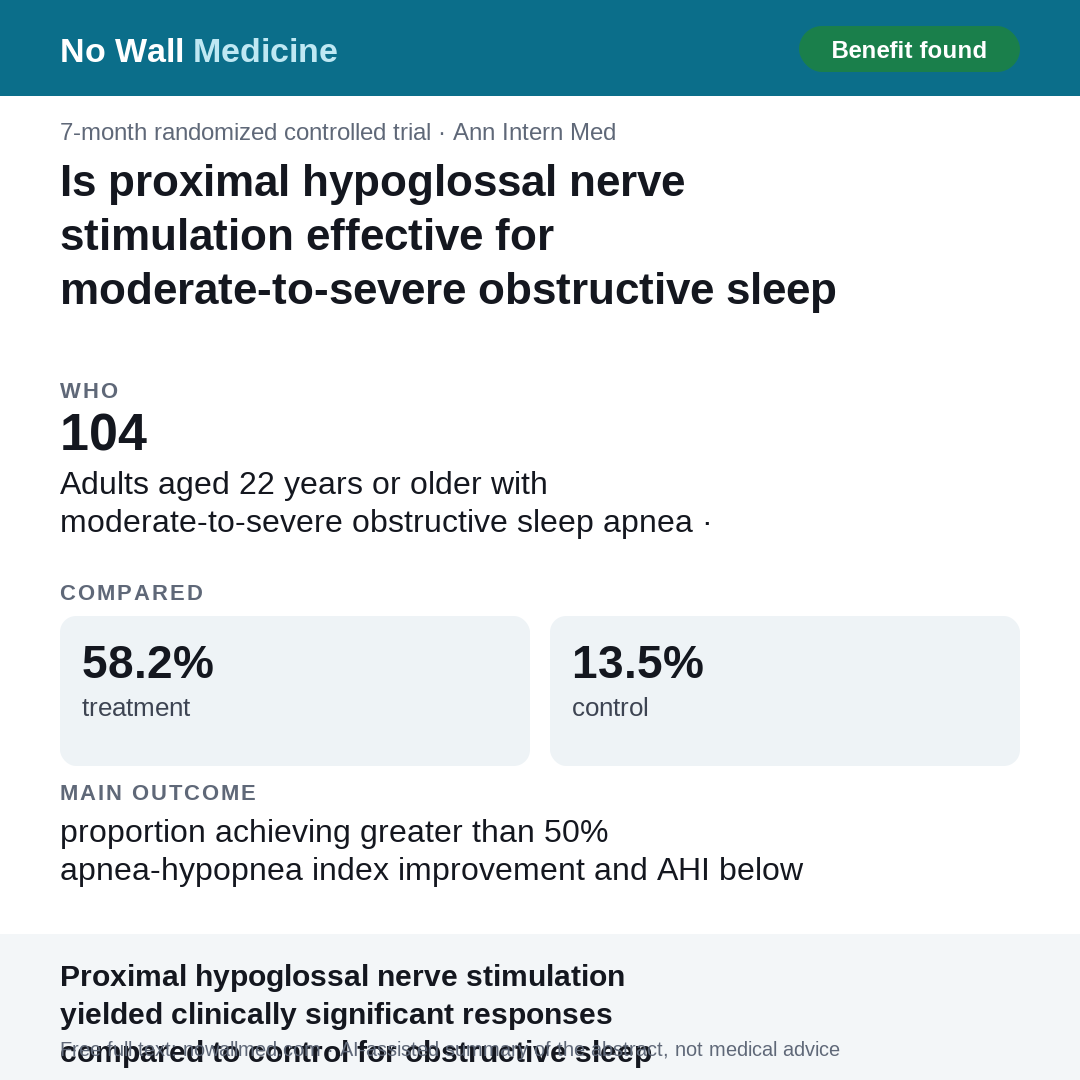
Clinical question: Is proximal hypoglossal nerve stimulation effective for moderate-to-severe obstructive sleep apnea?
Why it matters: Evidence is limited for patients with obstructive sleep apnea who cannot tolerate positive airway pressure therapy.
Key points
- Researchers studied 104 adults with moderate-to-severe obstructive sleep apnea who were assigned to receive proximal hypoglossal nerve stimulation or a control.
- At month 7, 58.2% of the treatment group achieved the primary end point compared to 13.5% of the control group.
- The treatment group showed improvements in daytime sleepiness scores, while the control group did not show improvement.
Limitation the authors note: The authors stated the study had a lack of blinding, small sample size, and short follow-up.
Headline and key points written with AI from the paper’s abstract, with every number checked against it. Read the paper before relying on them.
Topics
Spotted a mistake? Suggest a correction