Adolescent insecticide exposure linked to learning and memory impairments
Psychiatric Risk Implications From Behavioral and Neural Effects of Adolescent Exposure to Environmental Insecticides: A Systematic Review of Rodent Studies
Systematic review of rodent studiesHarm found
How does adolescent insecticide exposure affect neurocognitive, neuropsychiatric, and neurobiological outcomes in rodents?
Who
Rodents exposed to insecticides during early, middle, and late adolescence
Compared
Insecticide exposed rodents: learning and memory impairments, increased depression-relevant behaviors, altered locomotor activity
Control rodents
Main outcome
neurocognitive, neuropsychiatric, neurobiological, and general neurotoxicity outcomes
Bottom line: Adolescent insecticide exposure disrupts multiple neural systems, leading to learning impairments and behaviors relevant to psychiatric risk.
Limitation: Future research should model real-world exposures like dose and timing.
Biol Psychiatry · 2026-05-15Download image
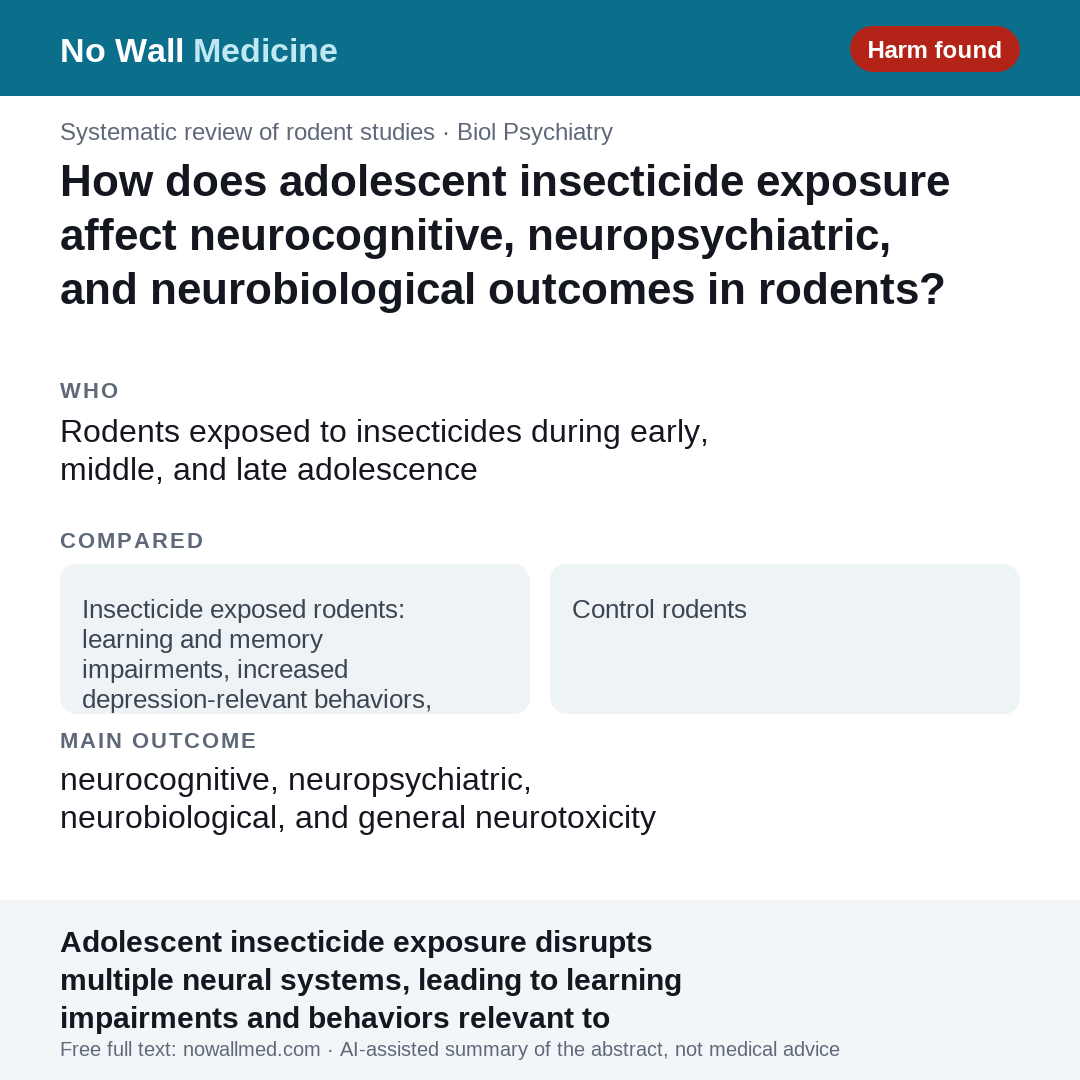
Clinical question: How does adolescent insecticide exposure affect neurocognitive, neuropsychiatric, and neurobiological outcomes in rodents?
Why it matters: Doctors have had little understanding of neural mechanisms linking insecticide exposure to psychiatric outcomes
Key points
- Fifty rodent studies examined neurotoxic outcomes after insecticide exposure at adolescent ages.
- Exposure led to learning and memory impairments and increased depression-relevant behaviors.
- Mechanistic findings showed disruptions in cholinergic and monoaminergic signaling and neurodegenerative processes.
Limitation the authors note: Future research should model real-world exposures to better inform translational understanding
Headline and key points written with AI from the paper’s abstract, with every number checked against it. Read the paper before relying on them.
Cite this article
Chen MX, Hing B, Taylor RJ, Stevens HE. Psychiatric Risk Implications From Behavioral and Neural Effects of Adolescent Exposure to Environmental Insecticides: A Systematic Review of Rodent Studies. Biol Psychiatry. 2026. doi:10.1016/j.biopsych.2026.05.003
Spotted a mistake? Suggest a correction