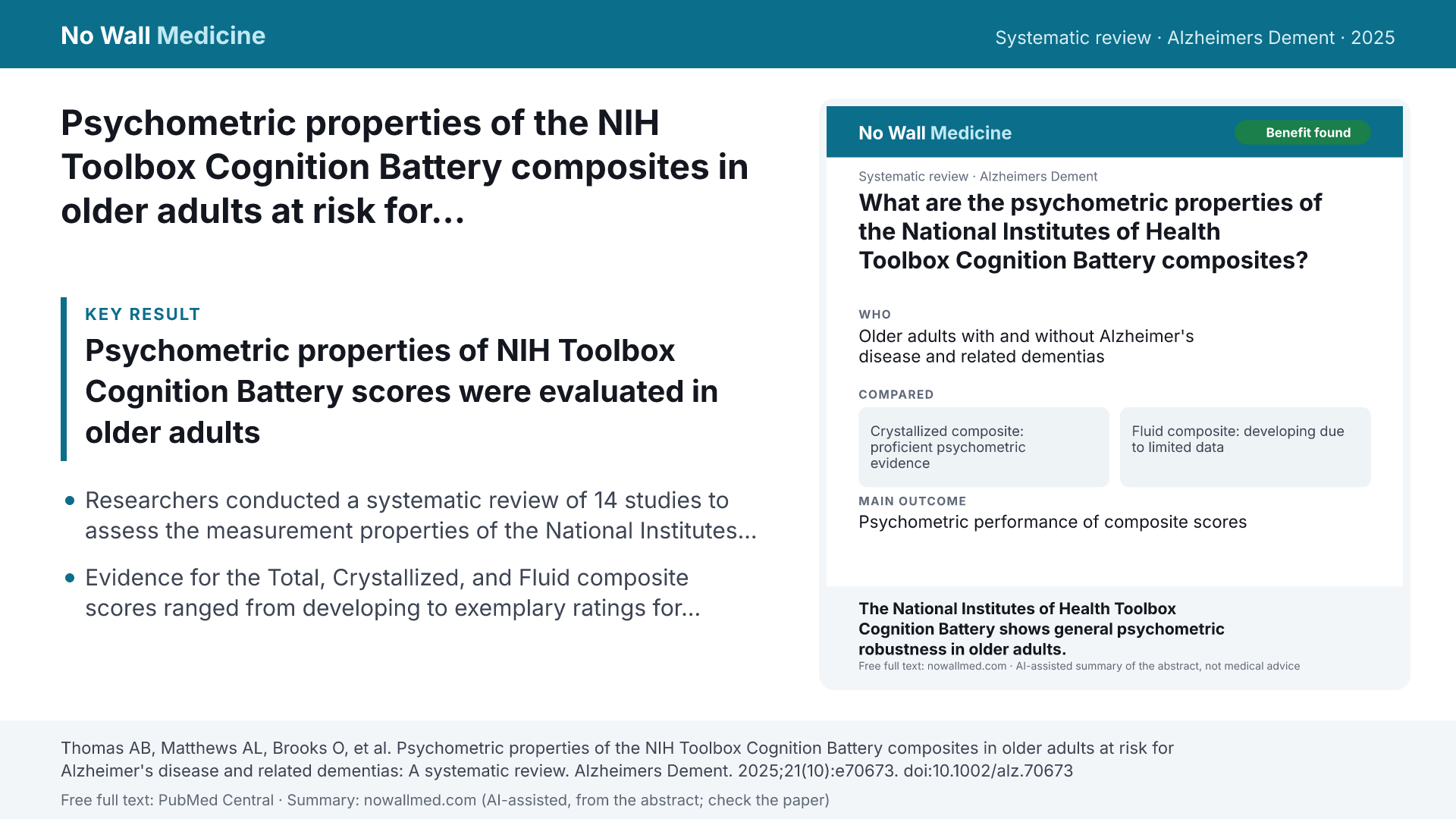
Psychometric properties of NIH Toolbox Cognition Battery scores were evaluated in older adults
Psychometric properties of the NIH Toolbox Cognition Battery composites in older adults at risk for Alzheimer's disease and related dementias: A systematic review
Systematic reviewBenefit found
What are the psychometric properties of the National Institutes of Health Toolbox Cognition Battery composites?
Who
Older adults with and without Alzheimer's disease and related dementias
Compared
Crystallized composite: proficient psychometric evidence
Fluid composite: developing due to limited data
Main outcome
Psychometric performance of composite scores
Bottom line: The National Institutes of Health Toolbox Cognition Battery shows general psychometric robustness in older adults.
Limitation: Limited research focuses on these composites in older adult and Alzheimer's populations.
Alzheimers Dement · 2025-10-28Download image
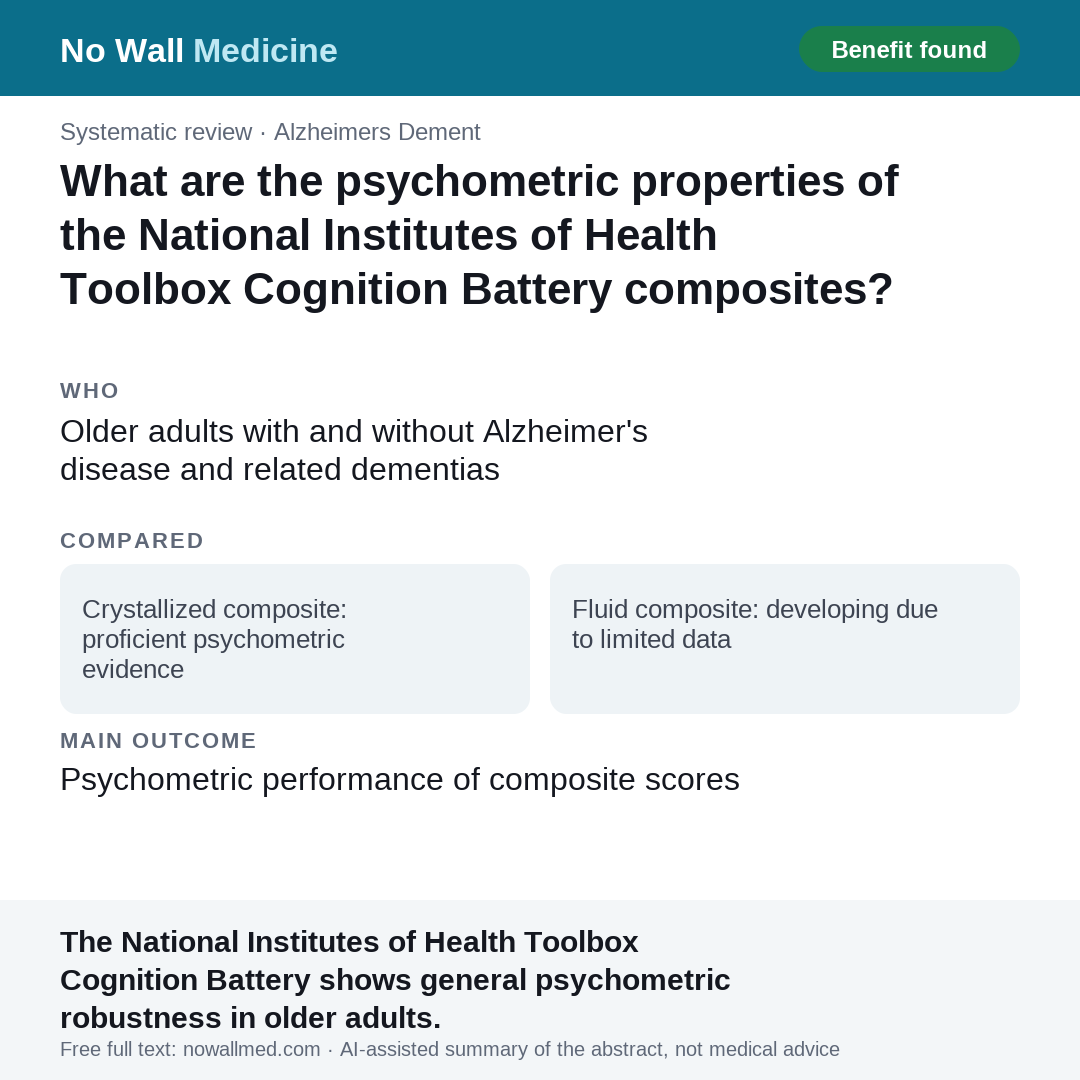
Clinical question: What are the psychometric properties of the National Institutes of Health Toolbox Cognition Battery composites?
Why it matters: The psychometric robustness of the National Institutes of Health Toolbox Cognition Battery composites in older adults at risk for Alzheimer's disease and related dementias was not fully established.
Key points
- Researchers conducted a systematic review of 14 studies to assess the measurement properties of the National Institutes of Health Toolbox Cognition Battery composite scores.
- Evidence for the Total, Crystallized, and Fluid composite scores ranged from developing to exemplary ratings for scoring, generalization, and extrapolation inferences.
- The Crystallized composite score showed proficient psychometric evidence, while the Fluid composite score was rated as developing due to limited data.
Limitation the authors note: The psychometric evidence for the Fluid composite score is currently limited by a lack of data.
Headline and key points written with AI from the paper’s abstract, with every number checked against it. Read the paper before relying on them.
Was this summary helpful?
Subject terms
Cite this article
Thomas AB, Matthews AL, Brooks O, Winquist A, Nelson LA, Arias-Fontenot R. Psychometric properties of the NIH Toolbox Cognition Battery composites in older adults at risk for Alzheimer's disease and related dementias: A systematic review. Alzheimers Dement. 2025. doi:10.1002/alz.70673
Spotted a mistake? Suggest a correction
Top studies every Monday
The week’s key trials and guidelines in your specialties, plus any topics you follow. By email, free.
Get the weekly digest