Psychosocial support interventions for tuberculosis patients show varying evidence for improving treatment outcomes
Psychosocial support interventions to improve treatment outcomes for people living with tuberculosis: a mixed methods systematic review and meta-analysis
Mixed methods systematic review and meta-analysisMixed results
Do psychosocial support interventions improve treatment outcomes for people living with tuberculosis?
Who
Adults with any clinical form of active tuberculosis · Low-and middle-income countries
Compared
Psychosocial support interventions
Standard care
Main outcome
Standard tuberculosis treatment outcomes
Bottom line: Psychosocial support provides multi-dimensional benefits, but psychological-based support alone lacks sufficient evidence for improving outcomes.
Limitation: Insufficient evidence that psychological-based support improves treatment outcomes on its own.
eClinicalMedicine · 2023-06-27Download image
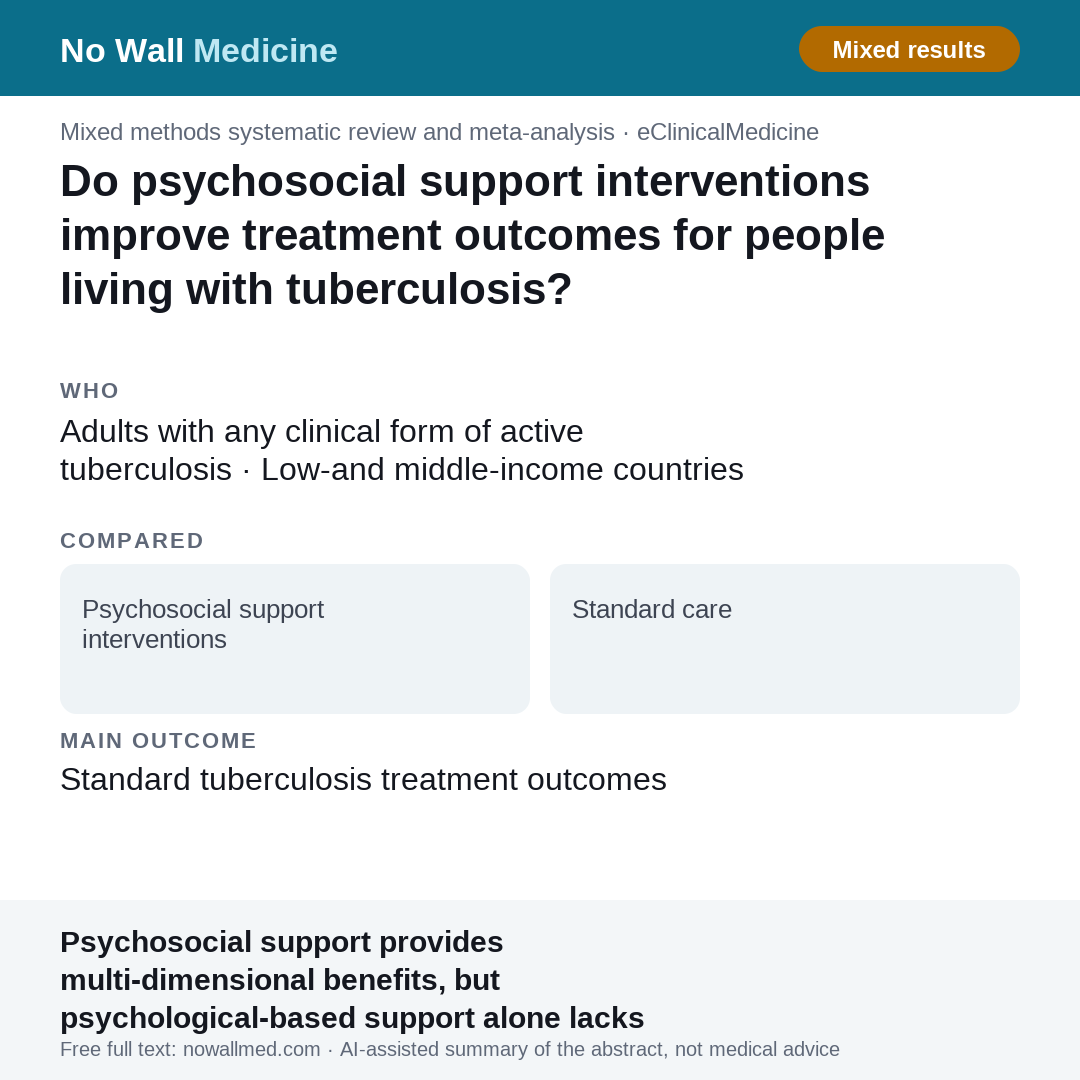
Clinical question: Do psychosocial support interventions improve treatment outcomes for people living with tuberculosis?
Why it matters: There is limited consensus on which specific psychosocial support interventions effectively improve treatment outcomes for people living with tuberculosis.
Key points
- Researchers reviewed 23 studies, including 12 quantitative, 10 qualitative, and 1 mixed methods study, involving adults with active tuberculosis.
- The review found that while psychological-based support is transformative, there is insufficient evidence that it improves treatment outcomes on its own.
- Effective interventions were found to provide multi-dimensional support, though results are contingent on variations in design and context.
Headline and key points written with AI from the paper’s abstract, with every number checked against it. Read the paper before relying on them.
Was this summary helpful?
Cite this article
Maynard C, Tariq S, Sotgiu G, Migliori GB, van den Boom M, Field N. Psychosocial support interventions to improve treatment outcomes for people living with tuberculosis: a mixed methods systematic review and meta-analysis. eClinicalMedicine. 2023. doi:10.1016/j.eclinm.2023.102057
Spotted a mistake? Suggest a correction
Top studies every Monday
The week’s key trials and guidelines in your specialties, plus any topics you follow. By email, free.
Get the weekly digest