Community first responders activated by smartphone application were studied for survival after cardiac arrest
Public access defibrillation by activated community first responders - the randomized HeartRunner trial
Randomized clinical controlled trialUnclear result
Does activating community first responders via smartphone application improve survival after out-of-hospital cardiac arrest?
Who
Patients with out-of-hospital cardiac arrest · Capital Region of Denmark
Compared
Standard care alone
Standard care with dispatched community first responders
Main outcome
30-day survival
Bottom line: The study was designed to examine if community first responders improve survival after out-of-hospital cardiac arrest.
Resusc Plus · 2026-07-21Download image
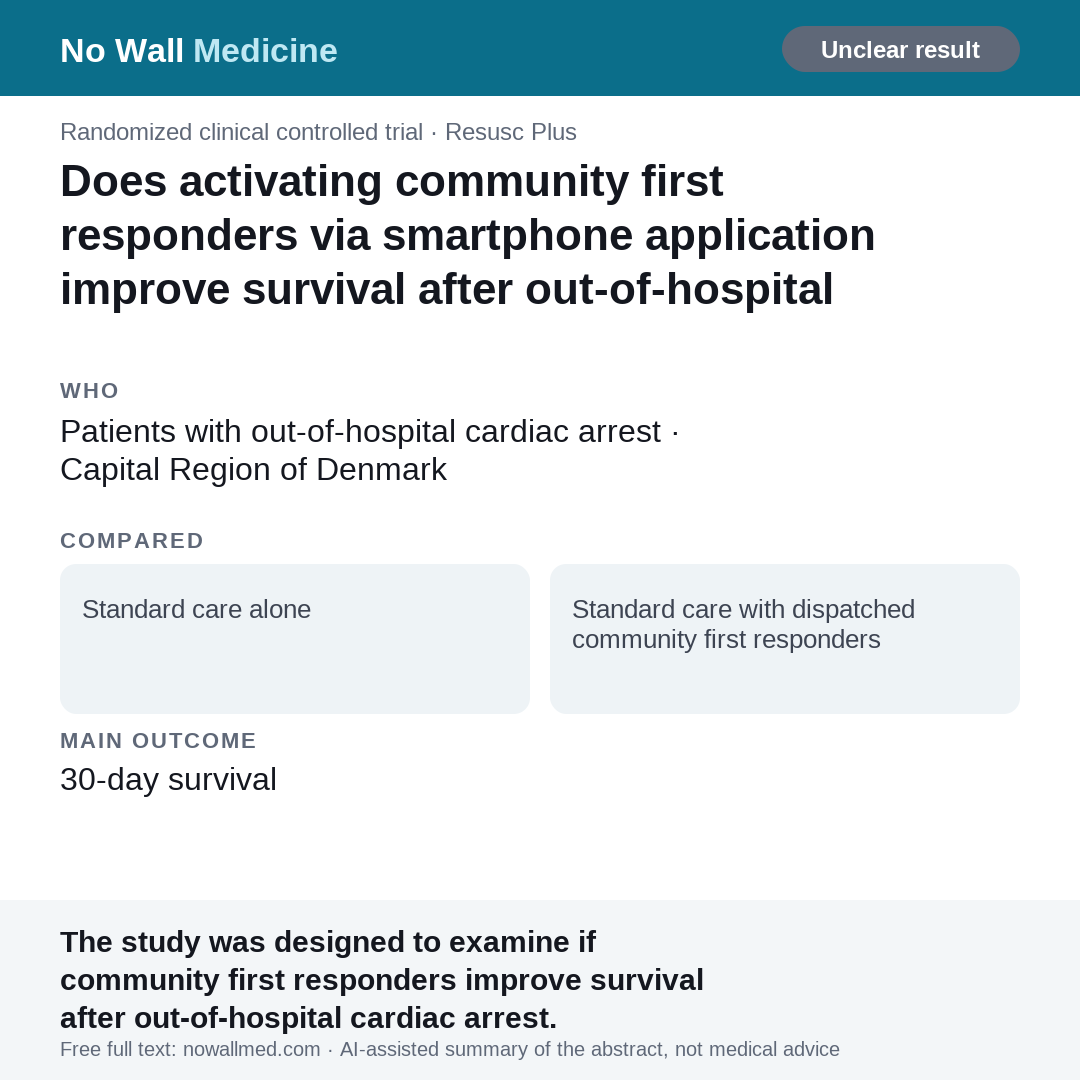
Clinical question: Does activating community first responders via smartphone application improve survival after out-of-hospital cardiac arrest?
Why it matters: It is unknown whether activating community first responders through a smartphone application improves survival after out-of-hospital cardiac arrest.
Key points
- The HeartRunner trial randomized patients with out-of-hospital cardiac arrest to receive standard care alone or standard care plus dispatched community first responders.
- The study took place in a region of 1.9 million inhabitants with 15,401 registered community first responders and 6200 publicly accessible automated external defibrillators.
- Researchers measured 30-day survival, bystander cardiopulmonary resuscitation, and potential physical or psychological risks to the activated responders.
Headline and key points written with AI from the paper’s abstract, with every number checked against it. Read the paper before relying on them.
Cite this article
Folke F, Andelius L, Ersbøll AK, Torp-Pedersen C, Gislason G, Køber L. Public access defibrillation by activated community first responders - the randomized HeartRunner trial. Resusc Plus. 2026. doi:10.1016/j.resplu.2026.101420
Spotted a mistake? Suggest a correction