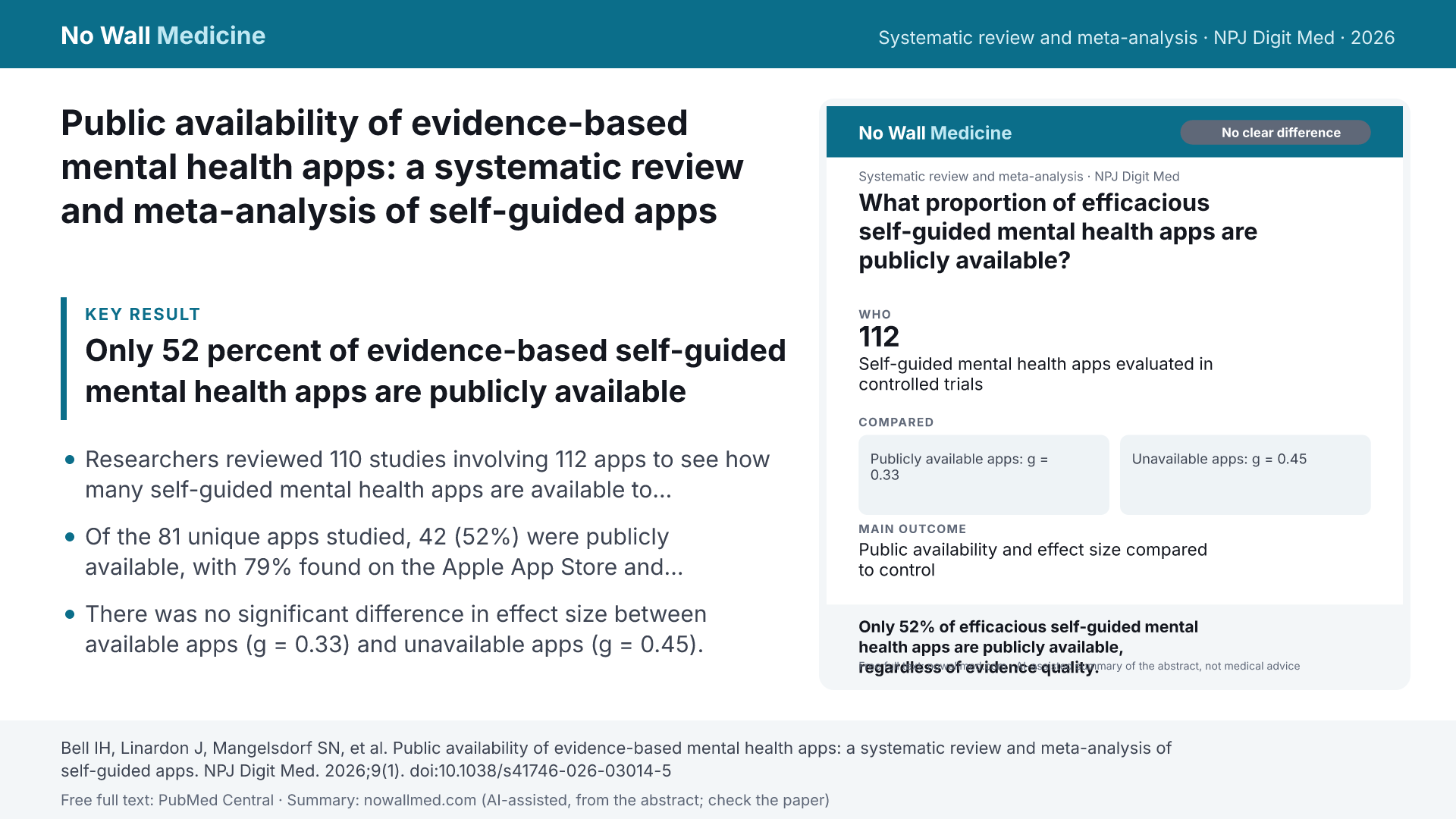
Only 52 percent of evidence-based self-guided mental health apps are publicly available
Public availability of evidence-based mental health apps: a systematic review and meta-analysis of self-guided apps
Systematic review and meta-analysisNo clear difference
What proportion of efficacious self-guided mental health apps are publicly available?
Who
112
Self-guided mental health apps evaluated in controlled trials
Compared
Publicly available apps: g = 0.33
Unavailable apps: g = 0.45
Main outcome
Public availability and effect size compared to control
Result: no significant difference (p = 0.228) in effect size (g = 0.33 vs g = 0.45)
Bottom line: Only 52% of efficacious self-guided mental health apps are publicly available, regardless of evidence quality.
NPJ Digit Med · 2026-07-16Download image
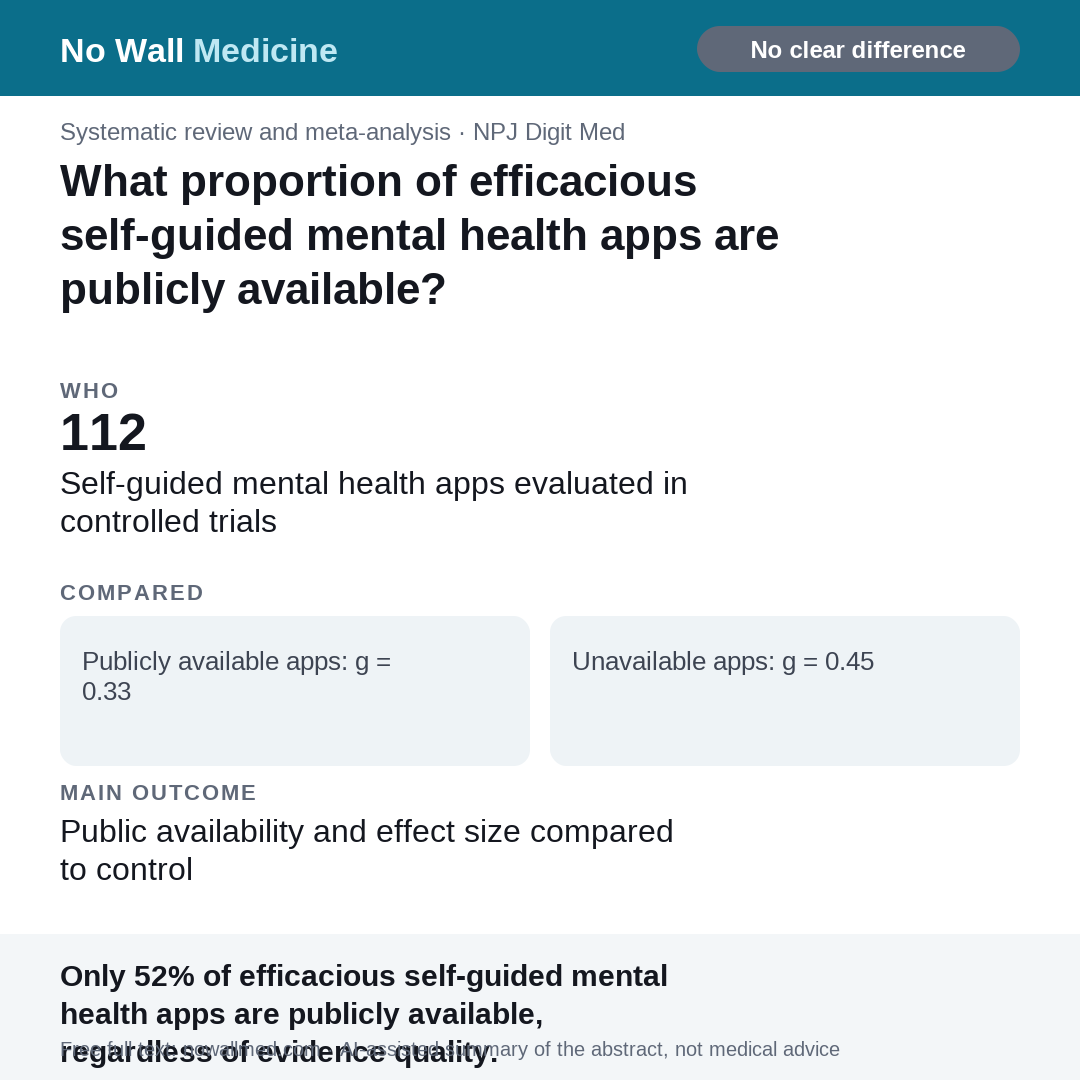
Clinical question: What proportion of efficacious self-guided mental health apps are publicly available?
Why it matters: Little is known about the proportion of mental health apps that have a rigorous evidence base and are actually available to the public.
Key points
- Researchers reviewed 110 studies involving 112 apps to see how many self-guided mental health apps are available to the public.
- Of the 81 unique apps studied, 42 (52%) were publicly available, with 79% found on the Apple App Store and Google Play Store.
- There was no significant difference in effect size between available apps (g = 0.33) and unavailable apps (g = 0.45).
Headline and key points written with AI from the paper’s abstract, with every number checked against it. Read the paper before relying on them.
Was this summary helpful?
Cite this article
Bell IH, Linardon J, Mangelsdorf SN, et al. Public availability of evidence-based mental health apps: a systematic review and meta-analysis of self-guided apps. NPJ Digit Med. 2026. doi:10.1038/s41746-026-03014-5
Spotted a mistake? Suggest a correction