Intrathecal morphine was associated with more respiratory depression but not sedation or hypoxaemia
Pulmonary complications after intrathecal morphine administration: a systematic review and meta-analysis with meta-regression and trial sequential analysis
Meta-analysis of 127 randomized controlled trialsMixed results
Does intrathecal morphine administration increase pulmonary complications after non-obstetric surgery?
Who
7388
Patients undergoing non-obstetric surgery under general or spinal anaesthesia
Compared
Intrathecal morphine
Control
Main outcome
Postoperative sedation, respiratory depression and hypoxaemia
Result: odds ratio 1.78 (95%CI 1.19-2.67) for respiratory depression
Bottom line: Intrathecal morphine may increase respiratory depression risk, but does not significantly increase sedation or hypoxaemia rates.
Anaesthesia · 2025-04-16Download image
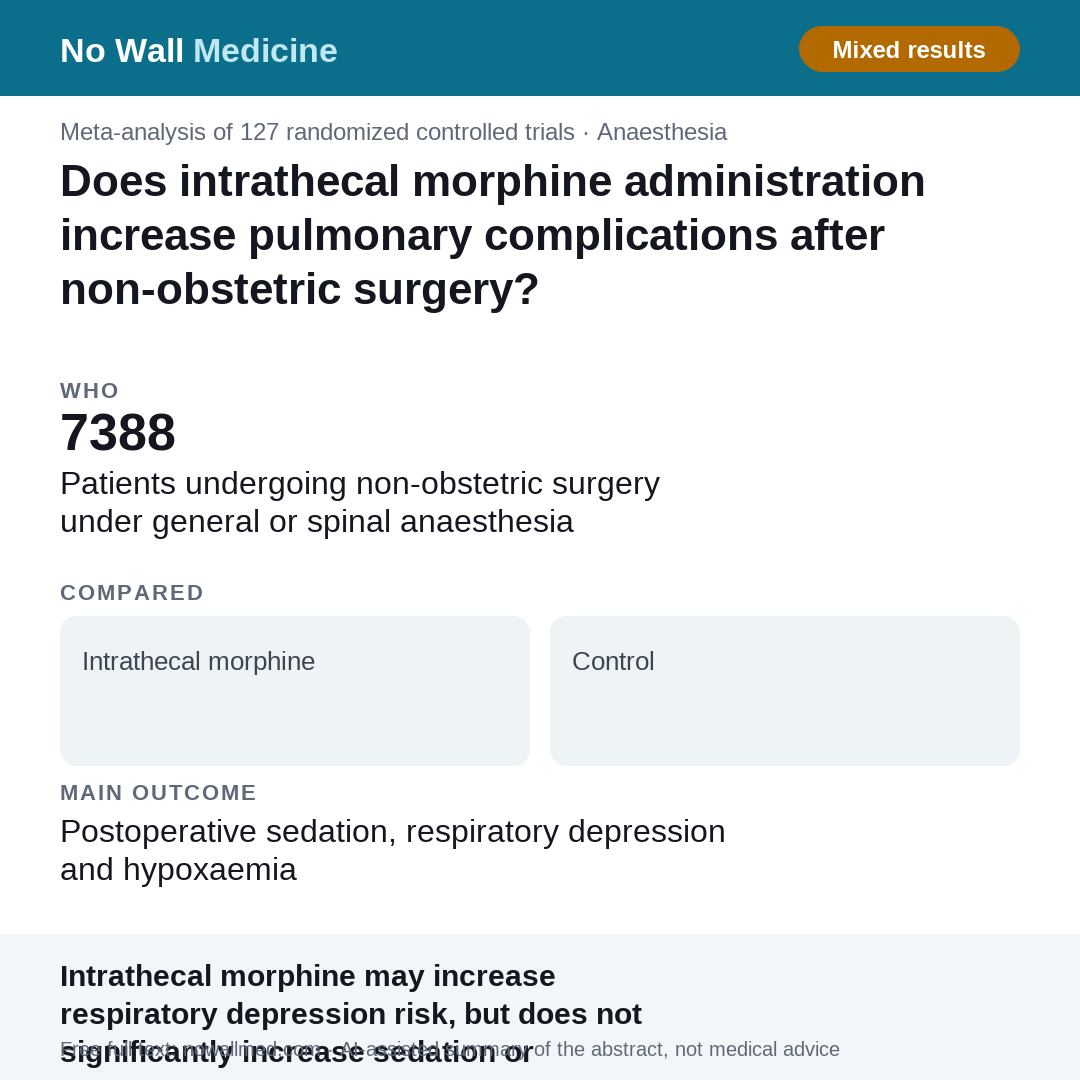
Clinical question: Does intrathecal morphine administration increase pulmonary complications after non-obstetric surgery?
Why it matters: Clinicians need to know if injecting morphine into the spinal fluid increases pulmonary complications after non-obstetric surgery or if the effect depends on the dose.
Key points
- Researchers analyzed 127 randomized controlled trials involving 7388 patients undergoing non-obstetric surgery under general or spinal anesthesia.
- Intrathecal morphine was associated with more respiratory depression (odds ratio 1.78, 95%CI 1.19-2.67, p=0.005), but sedation and hypoxaemia rates were not significantly increased.
- The association with respiratory depression was no longer significant when morphine doses greater than 500 μg were excluded (odds ratio 1.49, 95%CI 0.99-2.23, p=0.06).
Headline and key points written with AI from the paper’s abstract, with every number checked against it. Read the paper before relying on them.
Topics
Cite this article
El-Boghdadly K, Renard Y, Rossel JB, Moka E, Volk T, Rawal N. Pulmonary complications after intrathecal morphine administration: a systematic review and meta-analysis with meta-regression and trial sequential analysis. Anaesthesia. 2025. doi:10.1111/anae.16606
Spotted a mistake? Suggest a correction