Lung function and imaging abnormalities persist after SARS, MERS, and COVID-19 infections
Pulmonary function test and computed tomography features during follow-up after SARS, MERS and COVID-19: a systematic review and meta-analysis
Systematic review and meta-analysisMixed results
What are the longitudinal pulmonary function and computed tomography features after SARS, MERS, and COVID-19?
Who
Patients recovering from SARS, MERS, and COVID-19 infection
Compared
SARS and COVID-19: over 30% ground-glass opacity, linear opacities and reticulation at 6 months
MERS: persistent reduction in diffusing capacity for carbon monoxide at 12 months
Main outcome
Pulmonary function test parameters and computed tomography features
Bottom line: Persistent diffusion defects and computed tomography features suggest parenchymal lung injury after these coronavirus infections.
ERJ Open Res · 2022-05-30 · Save PNG
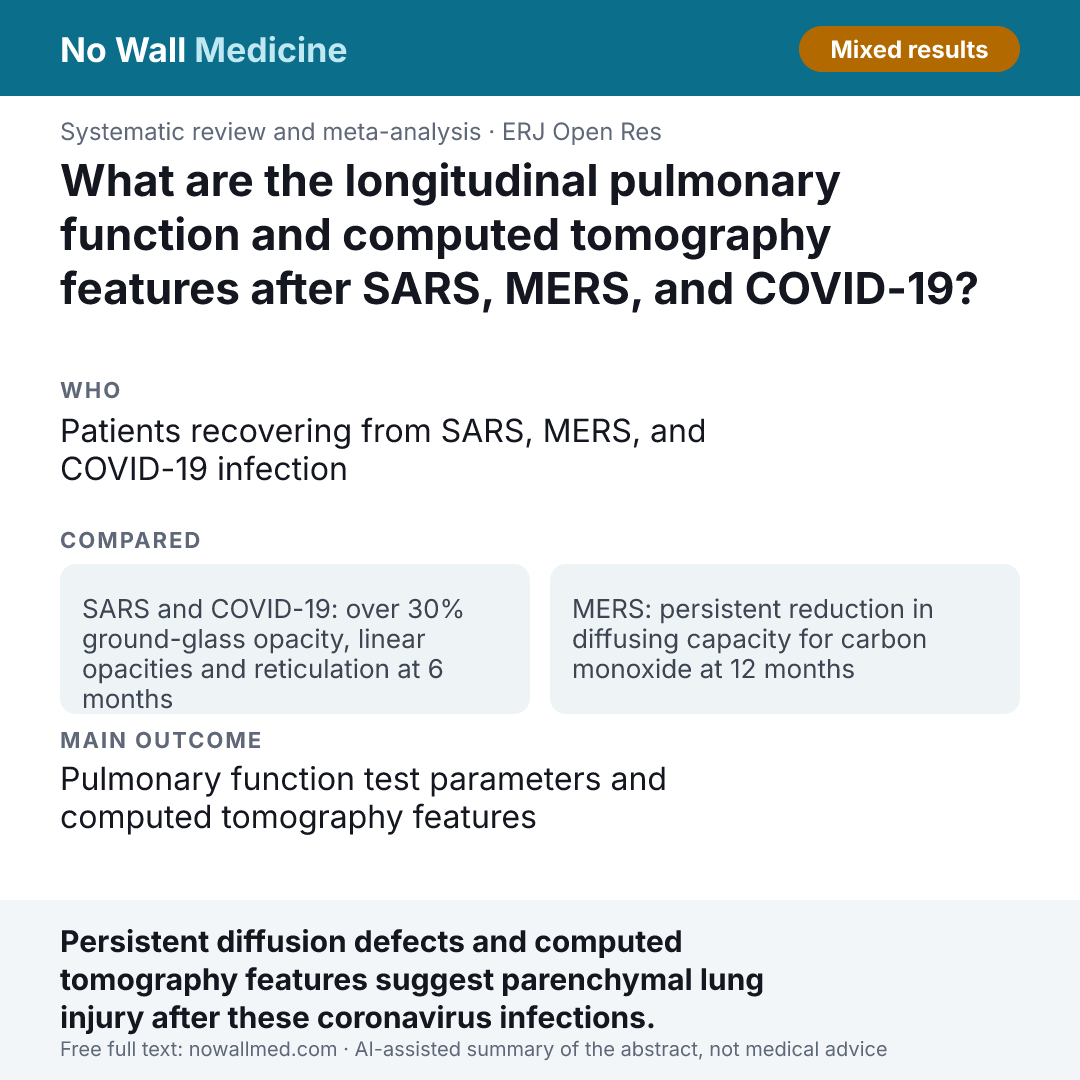
Clinical question: What are the longitudinal pulmonary function and computed tomography features after SARS, MERS, and COVID-19?
Key points
- Researchers performed a systematic review and meta-analysis comparing lung function tests and computed tomography (CT) scans in patients recovering from SARS, MERS, and COVID-19.
- A persistent reduction in the diffusing capacity for carbon monoxide—a measure of how well lungs transfer gas—was seen at 6 months for SARS and COVID-19 and at 12 months for MERS.
- At 6 months after SARS and COVID-19, ground-glass opacity, linear opacities, and reticulation (scar-like patterns) persisted in over 30% of patients.
Headline and key points written with AI from the paper’s abstract, with every number checked against it. Read the paper before relying on them.
Was this summary helpful?
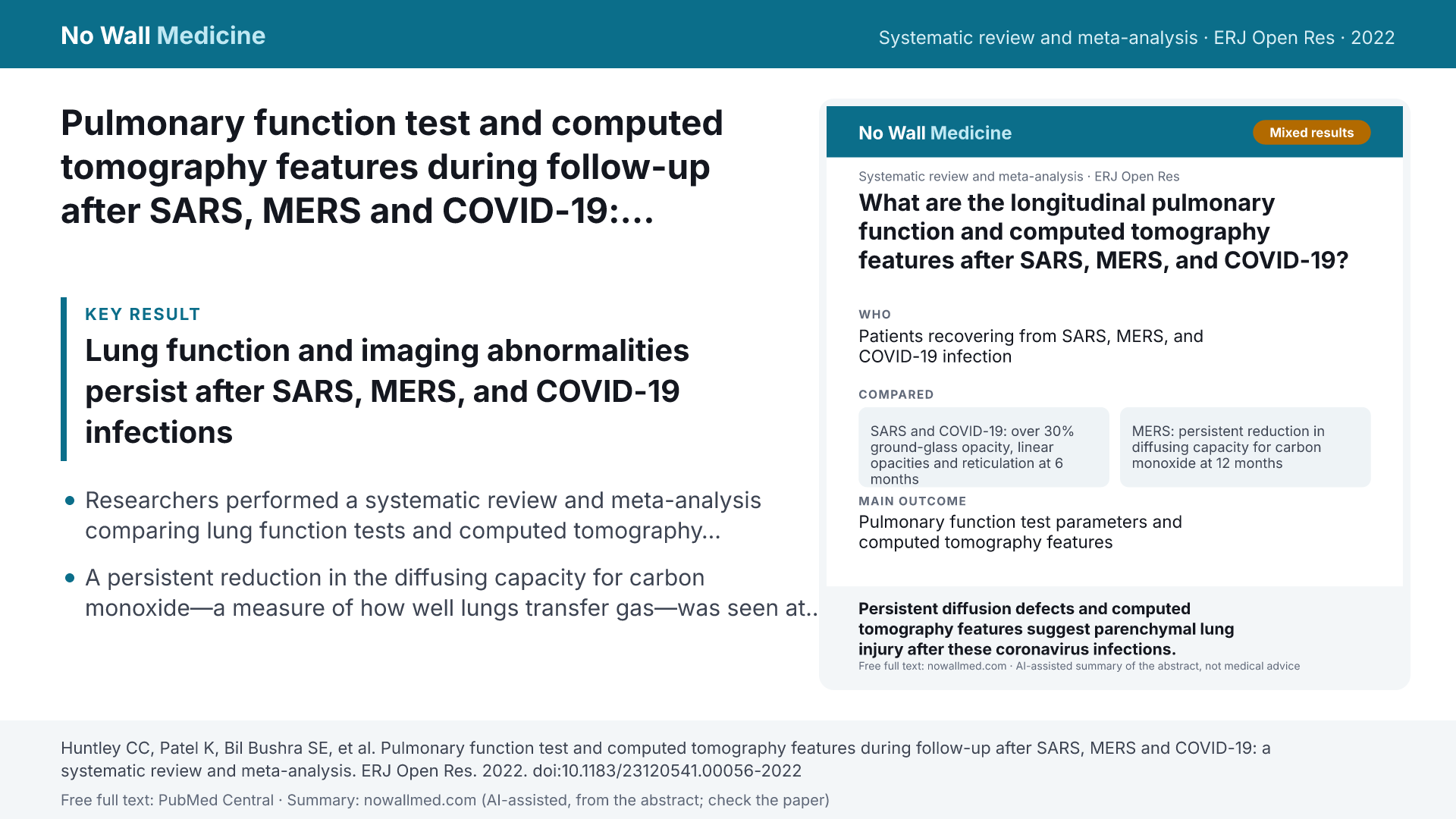
Headline, design, result, key points, caveat and citation as plain text.
Cite this article
Huntley CC, Patel K, Bil Bushra SE, et al. Pulmonary function test and computed tomography features during follow-up after SARS, MERS and COVID-19: a systematic review and meta-analysis. ERJ Open Res. 2022. doi:10.1183/23120541.00056-2022
Spotted a mistake? Suggest a correction