Residual vascular obstruction or perfusion defects were associated with persistent symptoms after pulmonary embolism
Pulmonary perfusion defects or residual vascular obstruction and persistent symptoms after pulmonary embolism: a systematic review and meta-analysis
Systematic review and meta-analysisMixed results
Are perfusion defects or residual vascular obstruction associated with persistent symptoms after pulmonary embolism?
Who
1888
Patients with pulmonary embolism
Compared
48%With perfusion defects or residual vascular obstruction (95% CI 37-60%)
34%Without perfusion defects or residual vascular obstruction (95% CI 20-51%)
Main outcome
Persistent symptoms
Result: odds ratio 2.15 (95% CI 1.66-2.78)
Bottom line: Perfusion defects or residual vascular obstruction are associated with higher odds of persistent symptoms, but not quality of life.
Limitation: A possible causality between these defects and residual functional limitation remains to be proven.
ERJ Open Res · 2024-07-29Download image
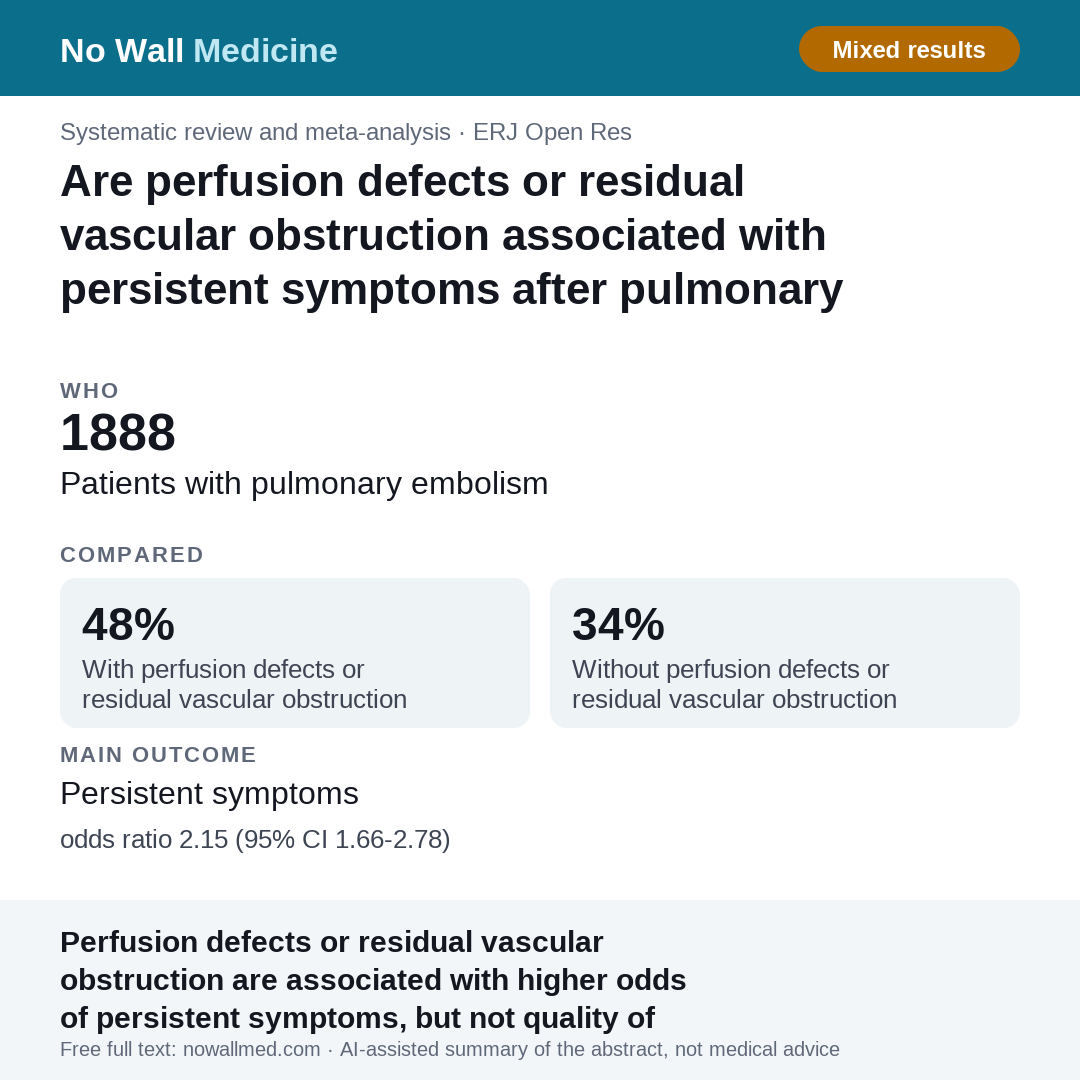
Clinical question: Are perfusion defects or residual vascular obstruction associated with persistent symptoms after pulmonary embolism?
Why it matters: It is unknown if perfusion defects or residual vascular obstruction are linked to persistent symptoms, quality of life, or exercise endurance after a pulmonary embolism.
Key points
- Researchers analyzed 12 studies involving 1888 patients with pulmonary embolism, measuring the link between vascular defects and functional recovery.
- Patients with perfusion defects or residual vascular obstruction had a 48% rate of persistent symptoms compared to 34% in those without defects.
- The presence of these defects was associated with persistent symptoms (OR 2.15, 95% CI 1.66-2.78), but not with quality of life or exercise test results.
Limitation the authors note: A possible causality between these vascular defects and residual functional limitation remains to be proven.
Headline and key points written with AI from the paper’s abstract, with every number checked against it. Read the paper before relying on them.
Was this summary helpful?
Cite this article
Cimini LA, Luijten D, Barco S, Ghanima W, Jervan Ø, Kahn SR. Pulmonary perfusion defects or residual vascular obstruction and persistent symptoms after pulmonary embolism: a systematic review and meta-analysis. ERJ Open Res. 2024. doi:10.1183/23120541.01010-2023
Spotted a mistake? Suggest a correction
Top studies every Monday
The week’s key trials and guidelines in your specialties, plus any topics you follow. By email, free.
Get the weekly digest